

Suez Canal hits 166-boxship surge as carriers defy Red Sea risks
Container transits jumped tenfold in Q3 2026 as Maersk, MSC and CMA CGM returned despite Houthi threats.
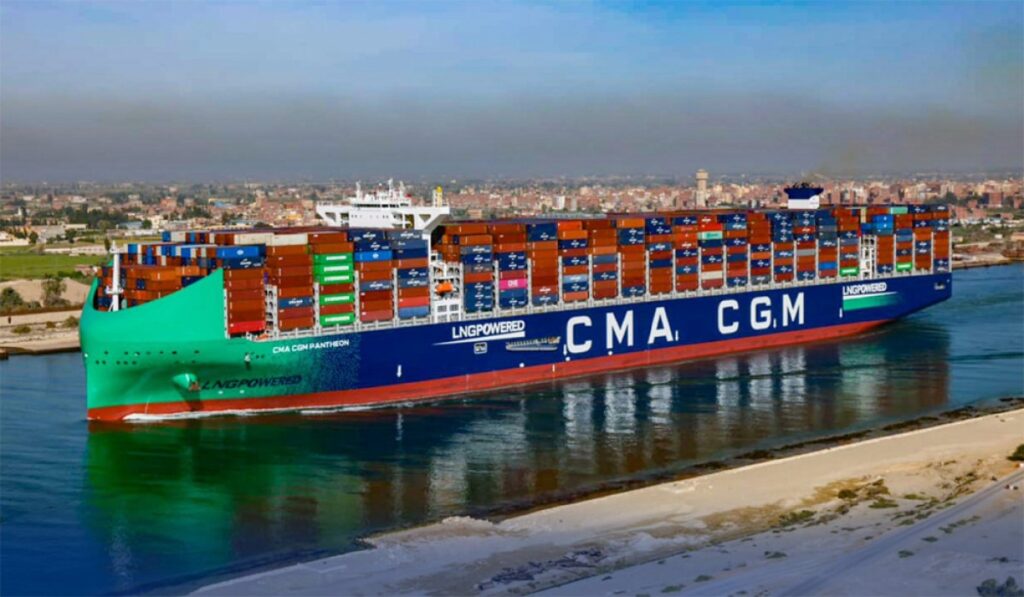
The Suez Canal has staged a dramatic rebound in container traffic, with 166 medium and ultra-large boxships transiting the waterway in the third quarter of 2026, dramatically the 16 vessels recorded in the same period last year.
The authority’s data reveals a an equally large increase, with large container vessels moving 29 million net tons through the canal between July and September, up from just 2.4 million in Q3 2025.
Admiral Ossama Rabiee, Chairman of the Suez Canal Authority, framed the canal’s resurgence as a strategic imperative for global trade.
A.P. Møller-Maersk
“The Suez Canal holds a strategic significance for containerized trade due to the operational savings it achieves and its promotion of the concept of economies of scale.”
Rabiee highlighted the mounting pressures on container lines, including rising fuel prices and freight rates, which make the canal’s shorter distances and reduced transit times an attractive proposition.
Drewry analysts estimate that using the Suez Canal route offers a saving of $43 per slot, equating to approximately $1 million per round trip.
“The apparent eagerness of container lines to return to the Suez Canal is difficult to explain if the calculation is reduced to a simple voyage-cost comparison between Suez and the Cape. The more convincing explanation for why carriers are so keen to return to Suez is that they are not really making a binary Suez versus Cape voyage decision based on economics alone. They are making a network, capacity and customer-service decision in which the value of time, vessel utilisation, and network integrity are all taken into consideration.".
The Pantheon, a 233,559 dwt vessel registered in France, was part of a northbound convoy travelling from Tangier Med to Port Klang, Malaysia. Alongside it, the 16,204 TEU CMA CGM Monte Cristo, a 158,064 dwt ship registered in Malta, also transited the canal on the same day.
The liners leading the charge, and the risks they face: suez canal transits
Maersk, Hapag-Lloyd, MSC Mediterranean Shipping Company, and OOCL have since followed suit, while COSCO has gradually reintroduced vessels. The Premier Alliance, a consortium that includes Ocean Network Express (ONE), HMM, and Yang Ming, is also set to resume Suez Canal transits in the coming days, signalling a broader industry shift.
The Suez Canal Authority has been proactive in attracting traffic, offering an integrated package of maritime and logistics services. The canal’s ability to handle the latest generation of ultra-large container vessels, such as the Pantheon and Monte Cristo, positions it as a critical node in global trade.
However, the security situation in the Red Sea remains volatile. Drewry’s analysts noted that the fundamental threat that initially drove carriers away, the Houthi insurgency and the conflict near the Bab al-Mandeb, has not dissipated. In fact, recent offensives and intensified fighting in the region may have heightened the risks.
For carriers, the decision to return to the Suez Canal is a calculated gamble. The shorter transit times, reduced transit times and shorter voyage distances compared to the Cape route, allow for more frequent voyages and improved vessel utilisation. This, in turn, helps liners maintain network integrity and meet customer demand, particularly as global supply chains continue to recover from the disruptions of recent years. The competitive pressure to match rivals’ schedules further incentivises the return, even as insurance costs and security concerns linger.
The Suez Canal Authority’s data for Q3 2026 reflects a broader trend in the shipping industry: the prioritisation of efficiency and network resilience over absolute risk avoidance. While the financial savings of the Suez route are modest, the operational advantages, shorter distances, faster turnarounds, and the ability to deploy larger vessels, are proving decisive. As Admiral Rabiee noted, the canal’s role in promoting economies of scale remains unmatched, making it an indispensable artery for containerised trade.
Looking ahead, the SCA expects volumes to continue rising, driven by its efforts to enhance maritime and logistics support. However, the sustainability of this rebound hinges on the security situation in the Red Sea. Should the conflict escalate, carriers may once again face the difficult choice between efficiency and safety. For now, the industry appears willing to take the risk.


Sign up free to ask CAMAL AI for a summary, the key points or anything else about this story.
Related stories
CAMAL AI
 Financial Ports Newsletter
The maritime economy, every morning
Ports, shipping and freight markets in one short email. Free.



