
Iran Sinks Containership in Hormuz—But Who Laid the Mine?
Singapore confirms the 39,446 dwt GFS Pride sank after striking an unidentified explosive in the world’s busiest.
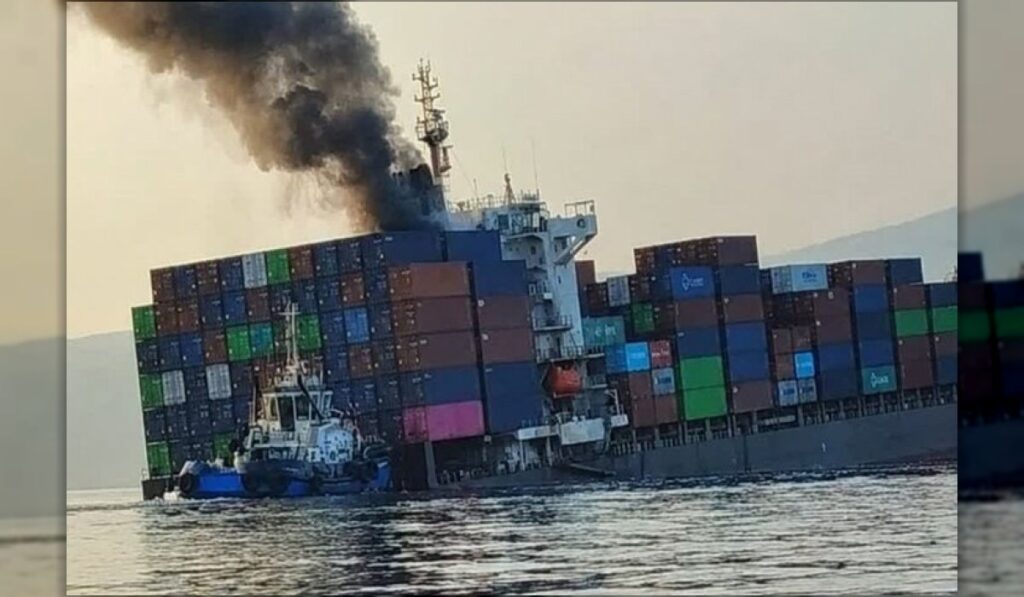
A 39,446 dwt containership registered in Singapore has sunk in the Strait of Hormuz after striking an unidentified explosive, Iran’s Islamic Revolutionary Guard Corps Navy claims.
Tehran released grainy images showing containers strewn across the water, but stopped short of providing evidence of a mine or detailing any rescue efforts for the 21 crew members.
What We Know, and What Tehran Won’t Say: strait of hormuz
The GFS Pride, built in 2008 and operated from Dubai, last transmitted its position from the Fujairah Anchorage nearly two weeks ago. Its sister ship, the GFS Giselle (54,117 dwt, 4,370 TEU), was also struck in the same attack window but managed to reach safe anchorage with all 22 crew accounted for. Singapore’s Maritime and Ports Authority confirmed both incidents, calling them “unprovoked, unjustifiable, and a breach of international law.”
“unprovoked, unjustifiable, and a breach of international law.”
Singapore Maritime and Ports Authority·Port Authority
The IRGC’s statement accused the vessel of traveling on an “illegal and dangerous” route but offered no proof of a mine. Meanwhile, UK Maritime Trade Operations reported two other vessels, a 23,500 dwt containership and a 38,842 dwt product tanker, were also struck by unidentified projectiles in the same area.
The UK Maritime Trade Operations (UKMTO), a Royal Navy-led initiative, has issued 24 warnings in October alone, with three advisories specifically addressing the recent spate of attacks.
warships that approach. The IRGC’s rhetoric has grown increasingly bellicose, with a spokesman warning earlier this week that “a horrific fire is the inevitable fate of every rogue tanker that seeks to disregard the security and regulations of the Strait of Hormuz.”
“A horrific fire is the inevitable fate of every rogue tanker that seeks to disregard the security and regulations of the Strait of Hormuz.”
IRGC Navy·Military Spokesman
Yet U.S. Central Command has pushed back, dismissing Iran’s claims of control over the waterway. In a pointed rebuttal, CENTCOM asserted that the “IRGC’s navy commander has no navy,” while highlighting the 19 million barrels of crude that transited the strait unimpeded yesterday. The standoff underscores the fragility of global supply chains, where a single chokepoint carries one-fifth of the world’s oil.
The Joint Maritime Information Center (JMIC), a multinational coalition focused on maritime security, has also weighed in on the escalating tensions. In an advisory issued on October 18, JMIC stated that there is “no substantiation” to the IRGC’s claims that two supertankers struck mines in the strait on October 17. The centre’s role is to collate and verify reports from commercial shipping and naval assets, providing a counterbalance to the often inflammatory rhetoric from Tehran.
For operators and insurers, the risks are becoming increasingly difficult to quantify. The GFS Pride’s sinking is the first confirmed total loss in the region since the Cape Dao incident in September, but it is unlikely to be the last. The International Group of P&I Clubs, which provides liability coverage for around 90% of the world’s ocean-going tonnage, has already warned its members of heightened risks in the Strait of Hormuz.
Premiums for war-risk insurance have surged in recent weeks, with some underwriters refusing to cover vessels transiting the area without additional security measures.
Separately, the 170,000 dwt bulker Cape Dao is reported sinking off Oman after an unsuccessful salvage attempt following a September 23 strike that killed one seafarer. The vessel, managed from the UAE, was hit 15 nautical miles northeast of Khasab, raising fears that the conflict’s geographic scope is expanding. The Cape Dao, registered in Antigua & Barbuda, was carrying a mixed cargo of bulk commodities when it was struck, though the exact nature of the attack remains unconfirmed.
The GFS Pride’s sinking leaves insurers and charterers scrambling. With no salvage operation announced, the wreck could become a navigational hazard in an already congested lane. The International Maritime Organization (IMO) has yet to issue specific guidance on the wreck, though it is likely to be classified as a hazard to navigation in the coming days. For now, the only certainty is that the Strait of Hormuz remains a flashpoint where geopolitics and commerce collide, with vessels caught in the crossfire.
What This Means for Global Shipping
The recent attacks have sent shockwaves through the maritime industry, prompting calls for increased naval patrols and coordinated international responses. The U.S. Fifth Fleet, based in Bahrain, has stepped up its presence in the region, though its ability to deter attacks remains limited. Meanwhile, the European Maritime Awareness in the Strait of Hormuz (EMASOH) mission, a French-led initiative, continues to monitor the situation, though its mandate is largely observational rather than interventionist.
For commercial shipping, the immediate impact is felt in rising insurance costs and longer transit times. Vessels are increasingly opting for longer routes around the Cape of Good Hope, adding days to voyages and driving up fuel costs. The Baltic Exchange, which tracks freight rates, has reported a sharp increase in demand for alternative routes, with some charterers paying premiums of up to 20% to avoid the Strait of Hormuz.
The Singapore Maritime and Ports Authority (MPA) has advised its flagged vessels to exercise extreme caution when transiting the area. In a recent circular, the MPA recommended that ships maintain a heightened state of readiness, including the deployment of additional lookouts and the use of private maritime security contractors where feasible. The authority also urged vessels to report any suspicious activity to UKMTO or the ReCAAP Information Sharing Centre, a regional body focused on piracy and maritime crime.
Looking ahead, the situation in the Strait of Hormuz is likely to remain volatile. The IRGC’s claims of acquiring “more advanced weapons” suggest that further attacks are not only possible but probable. For the global economy, the stakes could not be higher. With one-fifth of the world’s oil passing through this narrow waterway, any sustained disruption could send energy prices soaring and trigger supply chain bottlenecks across industries.
For now, the maritime industry is left grappling with a new reality: the Strait of Hormuz is no longer just a transit lane but a battleground where geopolitical tensions play out in real time. The GFS Pride’s sinking is a stark reminder of the risks, and the Cape Dao’s fate serves as a warning of what may come. As the situation evolves, the only certainty is that the world’s most critical chokepoint will remain a flashpoint for the foreseeable future.

Sign up free to ask CAMAL AI for a summary, the key points or anything else about this story.
Related stories
CAMAL AI
 Financial Ports Newsletter
The maritime economy, every morning
Ports, shipping and freight markets in one short email. Free.