

Hormuz tanker strike sparks fresh oil route crisis: 2m bpd at risk
A Kuwaiti VLCC was hit in the Strait of Hormuz, while Saudi Arabia’s Yanbu port suspended loading.
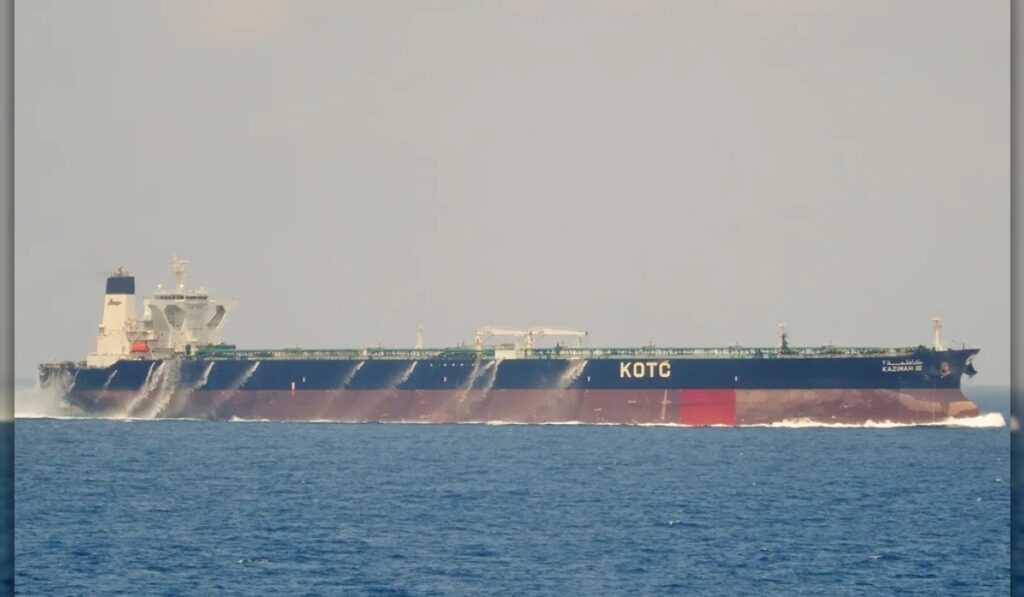
A Kuwaiti very large crude carrier (VLCC) was struck by an unknown projectile in the Strait of Hormuz on Thursday, triggering a fire onboard and extending a sharp resurgence in vessel attacks that threatens two of the Middle East’s key oil export routes.
The latest Hormuz casualty, identified as the Kuwait-flagged Kazimah III, was hit while transiting the strategic waterway. Maritime security firm Vanguard Tech confirmed the vessel, a 333-metre, 317,250 dwt VLCC built in 2006, was operated by Kuwait Oil Tanker Company (KOTC). UK Maritime Trade Operations (UKMTO) reported a third-party account of the strike, noting the crew was safe but the extent of damage and any environmental impact remained unknown.
The attack comes just four days after another KOTC VLCC, the 316,648 dwt Al Funtas, was struck in the same area. A fire broke out onboard the Al Funtas but was extinguished, with the vessel continuing its voyage without reported pollution.
Hormuz attacks surge as Saudi Arabia’s Yanbu port suspends loading: strait of hormuz
Meanwhile, on Saudi Arabia’s Red Sea coast, an unidentified projectile struck inside Yanbu port on Thursday, sparking a fire and prompting authorities to suspend loading operations. Maritime security firm Clearwater Dynamics described the incident as an aerial attack, reporting that loading with a Liberian-flagged tanker was temporarily halted before resuming. No casualties or damage to port infrastructure have been confirmed, and neither Saudi Aramco nor Saudi port authorities have publicly attributed the attack to a specific party.
Yanbu had only recently resumed crude export operations after drone attacks forced Saudi Arabia to shut its East-East-West Pipeline on September 11. The pipeline, which restarted on September 22, carries crude from Saudi Arabia’s eastern oil fields to the Red Sea, providing an alternative to the Strait of Hormuz. Pipeline flows were running at around 2m to 2.65m barrels per day (bpd), with capacity expected to build towards 3m to 4m bpd.
Saudi Arabia’s pivot to Red Sea exports faces fresh challenges
The latest attacks come as Saudi Arabia has increasingly relied on its Red Sea export routes to mitigate risks in the Strait of Hormuz. Satellite imagery from September 27 showed nearly 10m barrels of crude being loaded across Yanbu and the nearby Al Muajjiz terminal, as Riyadh stepped up efforts to reduce its exposure to the volatile waterway.
However, the Red Sea route has itself come under repeated attack, with the 320,926 dwt VLCC Amzan, operated by Saudi shipping giant Bahri, struck by a projectile in August about 63 nautical miles west of Yanbu. Yemen’s Iran-aligned Houthis subsequently claimed responsibility for that attack.
The East-East-West Pipeline has become a critical lifeline for Saudi crude exports, particularly as flows through Hormuz have fluctuated dramatically. Data from Kpler showed September crude flows through the strait at around 9.72m bpd, up from lows of 2.2m bpd in late July.
The group, which has targeted commercial shipping in the Red Sea and Bab el-Mandeb Strait, has intensified its campaign amid the broader regional conflict. Iran’s Islamic Revolutionary Guard Corps (IRGC) has also reportedly taken action against vessels in the Strait of Hormuz, with 13 ships targeted in the past week alone, according to maritime security sources.
The escalating tensions have raised concerns about the stability of global oil supplies, with the Strait of Hormuz and Red Sea routes serving as vital arteries for energy exports. The IMO has called for enhanced maritime security measures, but the frequency of attacks suggests that risks to commercial shipping are likely to persist in the near term. For now, the focus remains on restoring operations at Yanbu and ensuring the safety of vessels transiting Hormuz, as the region braces for further disruptions.


Sign up free to ask CAMAL AI for a summary, the key points or anything else about this story.
Related stories
CAMAL AI
 Financial Ports Newsletter
The maritime economy, every morning
Ports, shipping and freight markets in one short email. Free.
Financial Ports Newsletter
The maritime economy, every morning
Ports, shipping and freight markets in one short email. Free.



