

IRGC Warns Tankers: Abandon Kuwait and Bahrain Docks or Face Strikes
Iran’s Revolutionary Guard expands prohibited zone to Arabian Sea as US destroys five Iranian oil carriers
The Islamic Revolutionary Guard Corps Navy has issued an urgent warning to all tanker crews near Kuwaiti and Bahraini docks, ordering them to abandon their vessels immediately or face strikes. The threat, posted by the IRGC on Tuesday, marks a sharp escalation in the ongoing maritime conflict between Iran and US forces in the Gulf region.
The warning comes after the IRGC claimed to have targeted or attacked as many as 20 ships in retaliation for recent US strikes. On September 8, US Central Command (CENTCOM) reported destroying five Iranian crude oil carriers following two attempted ballistic missile attacks by the IRGC on a US Navy warship over the past two days. The US warship successfully evaded the attacks and continued its patrol in regional waters.
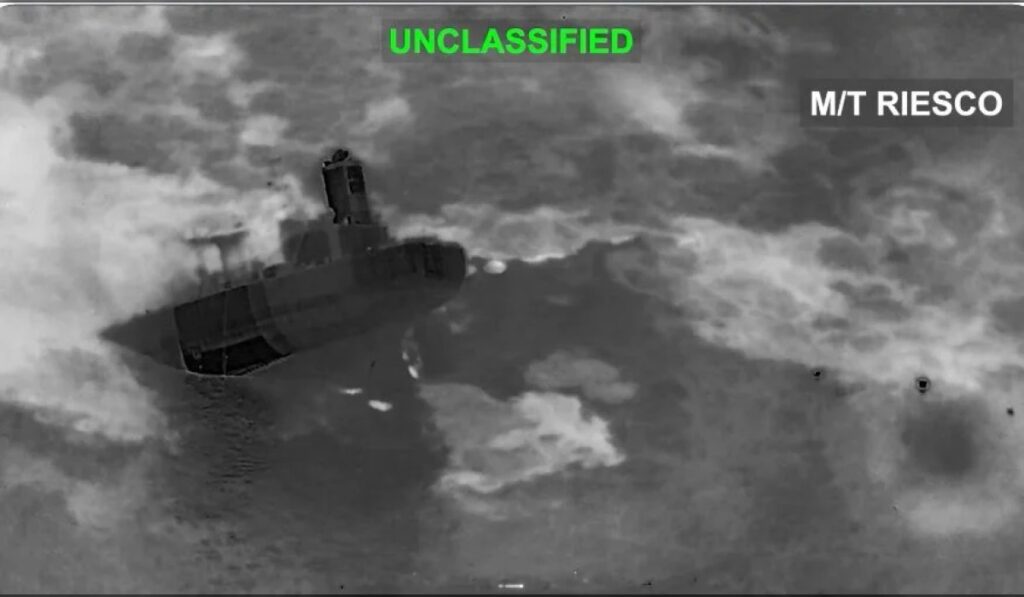
In a video released by CENTCOM, the 106,500-dwt crude oil tanker Riesco is shown sinking in the Gulf of Oman after being destroyed by US forces. The vessel, built in 2003 and sold to unknown interests in November 2025, had falsely claimed to sail under the flags of Tonga and Zimbabwe. The incident underscores the growing volatility in one of the world’s most critical maritime chokepoints.
Brent Crude
IRGC Expands Prohibited Zone to Arabian Sea
The IRGC has significantly widened its declared prohibited zone, now encompassing sections of the Sea of Oman and the Arabian Sea. Brigadier General Hossein Mohebbi, a spokesperson for the IRGC Navy, announced that the new zone’s starting boundary would be the port city of Chabahar, with exact geographical coordinates to be released later. The expansion follows a series of tit-for-tat attacks that US officials have described as “skirmishes” rather than an all-out war.
Mohebbi also outlined six conditions for ending the conflict, including an end to all military operations and threats against Iran, Israel’s withdrawal from Lebanon, the cessation of attacks on Yemen, the release of Iran’s frozen assets, and “total non-interference” in Iran’s nuclear and missile programs. The demands reflect Tehran’s broader geopolitical ambitions amid the escalating tensions.
Meanwhile, oil markets have reacted sharply to the developments. Brent crude prices surged above $100 a barrel for the first time since July, while diesel fuel prices experienced a significant jump. US gasoline prices have also been edging upward in recent weeks, raising concerns about broader economic impacts.
US and Iran Trade Blows in Strait of Hormuz
The Strait of Hormuz, a vital artery for global oil shipments, remains a flashpoint in the conflict. Iran claims to have targeted two US vessels and struck eight oil tankers, while also turning back 10 tankers attempting to transit the strait with “provocation and support” from the United States. The IRGC asserts that the strait remains “firmly under the surveillance and management of the capable and valiant IRGC Navy.”
Preliminary data from Reuters indicates that only six ships were visibly attempting to transit the Strait of Hormuz on Wednesday with their AIS transmissions active. However, it remains unclear how many vessels may be attempting “dark transits”, navigating without emitting signals to avoid detection. CENTCOM has claimed that US forces have redirected 94 commercial vessels as part of the ongoing blockade, further disrupting global shipping routes.
One confirmed incident involved the 302,477-dwt tanker New Andros, which was struck and set ablaze 28 nautical miles southeast of Al-Faw, Iraq. The Greek-owned vessel, registered in Panama, was reportedly being used by Iraq as floating storage. UK Maritime Trade Operations (UKMTO) confirmed the attack, which resulted in significant hull damage. Another vessel, the product tanker Hercules Star, was struck in the Dubai anchorage, leading to one seafarer’s death and another reported missing.
“Every time Iran tries to hit US naval ships, they’re going to lose tankers.”
Marco Rubio·US Secretary of State
The IRGC has also claimed to have chased away 40 US vessels and warships from the Persian Gulf, asserting that US forces have withdrawn at least 400 kilometers from the Strait of Hormuz. Brigadier General Mohebbi stated, “Today, not even a single one of them is present in this area, and US warships have withdrawn at least 400 kilometers from the Strait of Hormuz.” The IRGC further claims to have targeted US carriers at a distance of 500 kilometers, though these assertions remain unverified by independent sources.
Martin Kelly, Head of Advisory at EOS Risk Group, expects more details to emerge about the attacks on the eight ships in the coming days. “The situation is fluid, and the risk to commercial shipping in the region has never been higher,” Kelly noted. The escalating conflict poses significant challenges for global energy markets, with the potential for further disruptions to oil and gas supplies.
As tensions continue to rise, the international community watches closely, with many fearing that the conflict could spiral into a broader regional crisis. The stakes are particularly high for nations reliant on Gulf oil exports, as any prolonged disruption could have far-reaching economic consequences.


Sign up free to ask CAMAL AI for a summary, the key points or anything else about this story.
Related stories
CAMAL AI
 Financial Ports Newsletter
The maritime economy, every morning
Ports, shipping and freight markets in one short email. Free.
Financial Ports Newsletter
The maritime economy, every morning
Ports, shipping and freight markets in one short email. Free.