

US Strikes 5 Iranian Tankers After Missile Attack on Warship
CENTCOM destroys five vessels linked to IRGC funding network after ballistic missile attacks on US Navy warship.
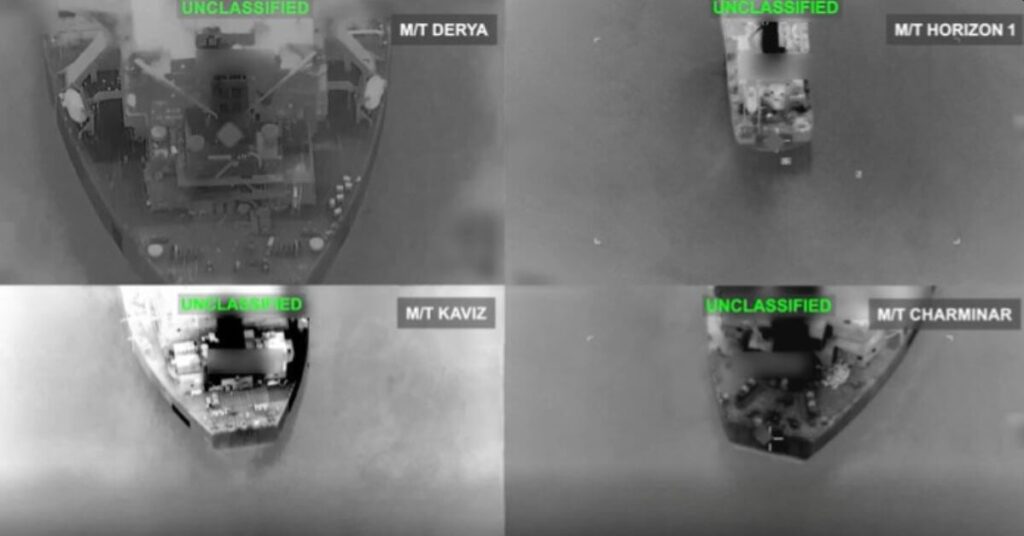
The US Central Command (CENTCOM) has destroyed five Iranian oil tankers in the Gulf of Oman, escalating tensions after the Islamic Revolutionary Guard Corps (IRGC) targeted a US Navy warship with ballistic missiles twice in two days.
The US Navy warship, which evaded both missile attacks without casualties, remained operational in regional waters. CENTCOM confirmed that crews were instructed to abandon the tankers before the strikes, ensuring no immediate loss of life.
CENTCOM, or the US Central Command, is responsible for military operations across 21 countries in the Middle East, Central Asia, and parts of South Asia. Headquartered in Tampa, Florida, with forward bases in Kuwait and Bahrain, CENTCOM plays a pivotal role in safeguarding maritime routes, including the Strait of Hormuz, through which nearly one-fifth of global oil supplies transit daily. Its mandate includes countering threats from state and non-state actors, such as the IRGC, which has been designated a terrorist organisation by the US.
Brent Crude
Why the Tanker Strikes Matter for Global Oil Markets: iranian oil tankers
The destruction of the tankers near Kharg Island, Iran’s primary crude-export hub, sent shockwaves through global energy markets. Brent crude prices surged close to $100 a barrel, while West Texas Intermediate traded near $95, reflecting fears of supply disruptions in the Strait of Hormuz, a critical chokepoint for nearly nearly one-fifth of the world’s oil. The economic ripple effects extend beyond oil prices.
Iran’s response was swift. Hours after the tanker strikes, Tehran launched 20 ballistic missiles at Jordan, though 18 were intercepted by Jordanian air defences. The remaining two landed in unpopulated areas, with no reported casualties. Jordanian authorities confirmed that specialist teams were securing missile fragments for analysis, while Iran issued a stark warning to tanker crews near ports in Kuwait and Bahrain, urging them to abandon their vessels.
“Tehran will target US military facilities across the region if Iranian tankers come under attack.”
Ali Abdollahi·Chief of Staff, Iran’s Armed Forces
The IRGC, a branch of Iran’s armed forces, operates a vast economic empire that includes oil smuggling, construction, and telecommunications. Its Quds Force, responsible for extraterritorial operations, has been accused of funding proxy groups such as Hezbollah in Lebanon and the Houthis in Yemen. The US Treasury has imposed sanctions on dozens of IRGC-linked entities, but the group has adapted by using front companies and shadow fleets to evade restrictions.
By disabling these tankers, CENTCOM aims to cut off a critical revenue stream for the IRGC, which is estimated to control up to 30% of Iran’s economy.
However, Iran’s resilience in the face of sanctions suggests that the IRGC will adapt. Analysts predict Tehran may shift its oil exports to smaller, less detectable vessels or rely more heavily on overland routes through Iraq and Syria. This cat-and-mouse game has played out for years, but the current escalation raises the stakes, with both sides testing the limits of their red lines.
What Happens Next in the Gulf Standoff
The latest strikes mark a dangerous shift in the US-Iran maritime conflict. Unlike previous incidents, where the US focused on defending its naval assets, the September 8 operation directly targeted Iranian commercial vessels, raising the stakes for both sides. CENTCOM’s decision to strike the tankers, which it claims were part of an IRGC funding network, suggests a broader strategy to cripple Tehran’s financial lifelines.
For shipping companies and insurers, the escalation has already triggered a wave of caution. The UK Maritime Trade Operations (UKMTO) issued an advisory warning of heightened military activity in the Strait of Hormuz, urging merchant vessels to exercise extreme vigilance.
Industry sources report that war-risk premiums for tankers transiting the region have spiked by 30-40% in the past week, adding millions in costs to each voyage. The advisory also highlighted reports of a merchant vessel in the strait being subject to interaction as part of ongoing military activity, a sign of the growing risks to commercial shipping.
The US has not ruled out further action. A CENTCOM spokesperson stated, “We will continue to defend our forces and disrupt IRGC operations that threaten regional stability.” Meanwhile, Iran’s warning to tanker crews in Kuwait and Bahrain suggests preparations for retaliatory measures, potentially targeting US-allied infrastructure in the Gulf. This could include cyberattacks on port facilities, sabotage of undersea cables, or even attacks on commercial vessels flagged by US allies.
With oil prices hovering near $100 a barrel, the economic fallout is already being felt. Energy analysts predict that if the conflict persists, supply chains could face delays, particularly for Asian refiners reliant on Iranian and Gulf crude. For now, the Strait of Hormuz remains open, but the risk of miscalculation looms large, with both sides testing the limits of maritime brinkmanship.
For stakeholders in the shipping and energy sectors, the situation demands heightened vigilance. Companies are advised to monitor real-time updates from CENTCOM and UKMTO, which provide critical advisories on maritime security. Additionally, the International Maritime Organization (IMO) has urged flag states to ensure their vessels comply with safety protocols in high-risk areas, including maintaining strict communication with naval forces patrolling the region.
The next 48 hours will be critical in determining whether this latest escalation spirals into a broader regional conflict or stabilises, albeit at a precariously high tension level. For now, the world watches as the Gulf teeters on the edge of a crisis that could reshape global energy markets and geopolitical alliances for years to come.


Sign up free to ask CAMAL AI for a summary, the key points or anything else about this story.
Related stories
CAMAL AI
 Financial Ports Newsletter
The maritime economy, every morning
Ports, shipping and freight markets in one short email. Free.
Financial Ports Newsletter
The maritime economy, every morning
Ports, shipping and freight markets in one short email. Free.