

Iran’s New Missile Fires First Shot Over US Warship in Hormuz Standoff
Tehran tests 650 nm-range Qasem Basir missile as US sinks Iranian tanker Riesco in Gulf of Oman retaliation
The United States and Iran remain locked in a cycle of economic and military pressure, with each side targeting the other’s strategic vulnerabilities. Washington’s goal is to drain Tehran’s financial reserves, which the Iranian government relies on to fund imports and subsidize essential goods. Without these funds, the regime risks facing widespread unrest from a population struggling with shortages.
Iran’s leadership is feeling the strain. Oil and gas exports—once a primary revenue source—have halted entirely, and the emergency crude reserves stored off China and Malaysia are expected to be depleted by the end of the year. The U.S. naval blockade in the region remains unyielding, leaving Iran with few options to break the deadlock. This desperation has led to a series of aggressive moves by the Islamic Revolutionary Guard Corps (IRGC), including missile strikes against U.S. warships in the Gulf of Oman.
Iran’s Missile Tests and U.S. Retaliation
In recent days, Iran has launched multiple attacks against U.S. naval forces. Central Command (CENTCOM) reported that the IRGC targeted a U.S. aircraft carrier and destroyer on September 6, followed by additional strikes on September 8 and during the night of September 8-9. While all attacks were repelled, they demonstrated Iran’s growing missile capabilities.
Mohsen Rezaei, Iran’s Secretary to the National Security Council, claimed a breakthrough in a statement to Press TV: “For the first time, we have tested a new anti-ship missile above a U.S. warship.” Though details remain unclear, analysts suggest the weapon is an upgraded version of the Qasem Basir ballistic missile, first unveiled in May 2025.
The missile, described as a two-stage system with a 650-nautical-mile range, uses an exo-atmospheric trajectory to achieve hypersonic speeds in its final phase. Iranian defense officials claim it employs thermal imaging to track heat signatures from targets.
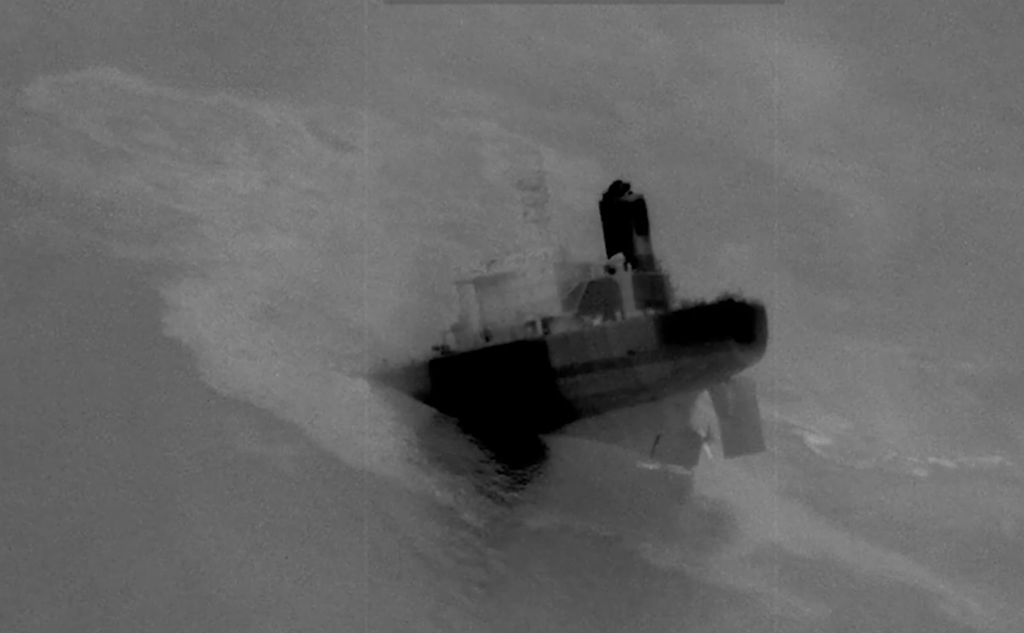
The U.S. responded with precision strikes on September 8, targeting five Iranian-linked vessels after warning crews to evacuate. Among them, the Zimbabwe-flagged Riesco was hit amidships in the Gulf of Oman, caught fire, and sank. Four other tankers—the Iranian-flagged Derya, Comoros-flagged Kaviz and Charminar, and the Turkish or unflagged Horizon-1—were struck near their engine rooms, disabling their propulsion without causing total destruction.
A Fragile Standoff with Rising Risks
Despite the escalation, both sides appear to be exercising restraint. The U.S. has avoided direct strikes on Iranian territory, while Iran’s attacks have focused on military assets and sanctioned ships. However, Tehran’s financial crisis is deepening, and its missile program is advancing, increasing the risk of miscalculation.
Iran has also sought alternative routes to bypass the blockade, including claims of a new “middle corridor” through the Strait of Hormuz in cooperation with Oman. Yet, with the U.S. maintaining its naval presence, such plans remain unlikely to succeed. Meanwhile, the IRGC has targeted U.S. bases in neighboring countries, though these strikes have yet to shift the strategic balance.
The coming weeks will be critical. If Iran fails to break the blockade through missile strikes, it may resort to broader attacks on commercial shipping in the Strait of Hormuz. For now, the conflict remains a high-stakes struggle of economic pressure and military posturing—but one misstep could trigger a wider confrontation.


Sign up free to ask CAMAL AI for a summary, the key points or anything else about this story.
Related stories
CAMAL AI
 Financial Ports Newsletter
The maritime economy, every morning
Ports, shipping and freight markets in one short email. Free.
Financial Ports Newsletter
The maritime economy, every morning
Ports, shipping and freight markets in one short email. Free.



