

$25bn SM-6 Deal: How the U.S. Navy Plans to Rebuild Its Missile Stockpile
The U.S. Navy awards Raytheon a $25 billion contract for SM-6 interceptors to counter depleted stockpiles.
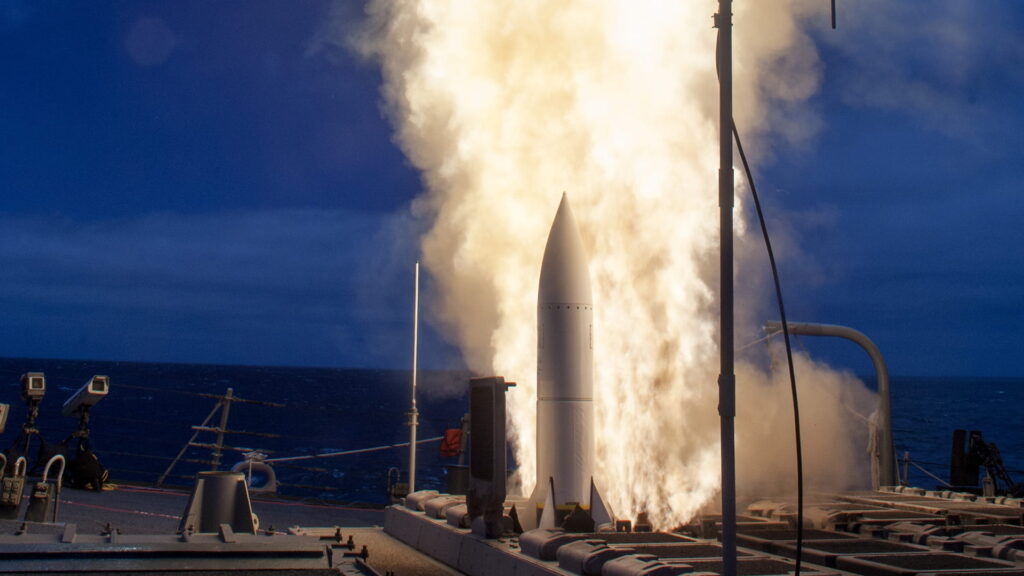
The U.S. Navy has placed a $24.4bn bet on Raytheon to rebuild its missile defence arsenal, depleted by a year of high-intensity conflict with Iran.
The urgency is clear: the Congressional Budget Office estimates the U.S. has used between one-half and two-thirds of its global stockpile of high-end interceptors, Patriot, THAAD, SM-3, and SM-6, since June 2025. The SM-6 contract is meant to correct that deficit, giving defence contractors the long-term visibility they need to scale up production.
The SM-6 contract underscores Raytheon’s pivotal role in addressing the U.S. military’s most pressing challenges. The company has invested heavily in modernising its production facilities, automating manufacturing processes, and expanding its skilled workforce to meet the surging demand for advanced interceptors.
The strategic role of Raytheon and RTX in U.S. defence
The SM-6 is the only combat-proven weapon capable of performing three missions simultaneously: anti-air warfare, anti-surface warfare, and ballistic missile defence. It has been successfully fired from both ship-based and land-based launchers, making it a versatile tool for modern naval operations. Raytheon President Phil Jasper emphasised the missile’s strategic importance:
“SM-6’s multi-mission capability is vital to our customer, and Raytheon is intensely focused on meeting the demand.”
Phil Jasper·President of Raytheon
The SM-6’s secondary role as an antiship missile adds another layer of value. At an estimated cost of $4m to $6m per unit, far cheaper than an SM-3, it offers a cost-effective solution for the Navy’s needs. The new contract is expected to yield a production rate many times higher than the previous 125 units per year, a critical step in replenishing stockpiles depleted by recent conflicts.
Why the SM-6 is the Navy’s missile of choice
The missile’s adaptability is particularly relevant in the current geopolitical climate, where threats are increasingly diverse and unpredictable.
The agreement provides Raytheon with the long-term stability needed to invest in capacity expansion, workforce development, and supply chain resilience. This, in turn, benefits the broader defence industrial base, as subcontractors and suppliers ramp up production to meet the increased demand.
For global security, the contract reflects a shift in U.S. defence priorities. The focus on multi-role weapons like the SM-6 indicates a move away from single-mission systems towards more adaptable, cost-effective solutions.
The SM-6 deal is part of a broader effort to modernise U.S. missile defence. The Army has committed $59bn for additional Patriot interceptors, while a prototype award round for long-range antiship missiles was announced this week, involving Anduril, RTX, Castelion, Lockheed Martin, and Mach Industries. These initiatives are critical to addressing the gaps exposed by recent conflicts, where the U.S. has relied heavily on its existing stockpiles of high-end interceptors.
However, the Navy’s contract still requires congressional approval. A continuing resolution is expected to extend through at least early December, delaying a full FY2027 defence budget. Admiral Daryl Caudle, Chief of Naval Operations, stressed the need for speed:
“Combat credibility depends on having enough weapons, produced at the speed and scale the Fleet requires. This SM-6 award gives industry the demand signal and stability to expand production, strengthen the munitions industrial base, and build the magazine depth our Fleet needs.”
Adm. Daryl Caudle·Chief of Naval Operations
Raytheon has already begun scaling up operations to meet demand. The company has invested in automation, workforce expansion, and partnerships across the defence industrial base. With 180,000 employees globally and $88bn in 2025 sales, RTX is positioning itself as a key player in the accelerating global defence procurement race.
The SM-6 contract also signals a shift in U.S. defence strategy, prioritising multi-role weapons that can adapt to evolving threats. As the Navy rebuilds its stockpiles, the focus will remain on ensuring readiness for future conflicts, whether in the air, at sea, or on land. For industry stakeholders and allied nations, the deal serves as a benchmark for future defence investments, highlighting the importance of scalability, versatility, and long-term planning in modern military procurement.
For those tracking developments in U.S. defence policy, the next critical milestone will be the passage of the FY2027 defence budget. Until then, the continuing resolution will keep the pressure on lawmakers to approve the necessary funding to sustain the momentum of the SM-6 contract and other key defence initiatives. The outcome will have far-reaching implications for the U.S. military’s ability to maintain its technological edge and operational readiness in an increasingly contested global environment.


Sign up free to ask CAMAL AI for a summary, the key points or anything else about this story.
Related stories
CAMAL AI
 Financial Ports Newsletter
The maritime economy, every morning
Ports, shipping and freight markets in one short email. Free.
Financial Ports Newsletter
The maritime economy, every morning
Ports, shipping and freight markets in one short email. Free.