

US offshore wind hits 704MW milestone despite Trump’s legal storms
Revolution Wind completes all 65 turbines in Rhode Island Sound.
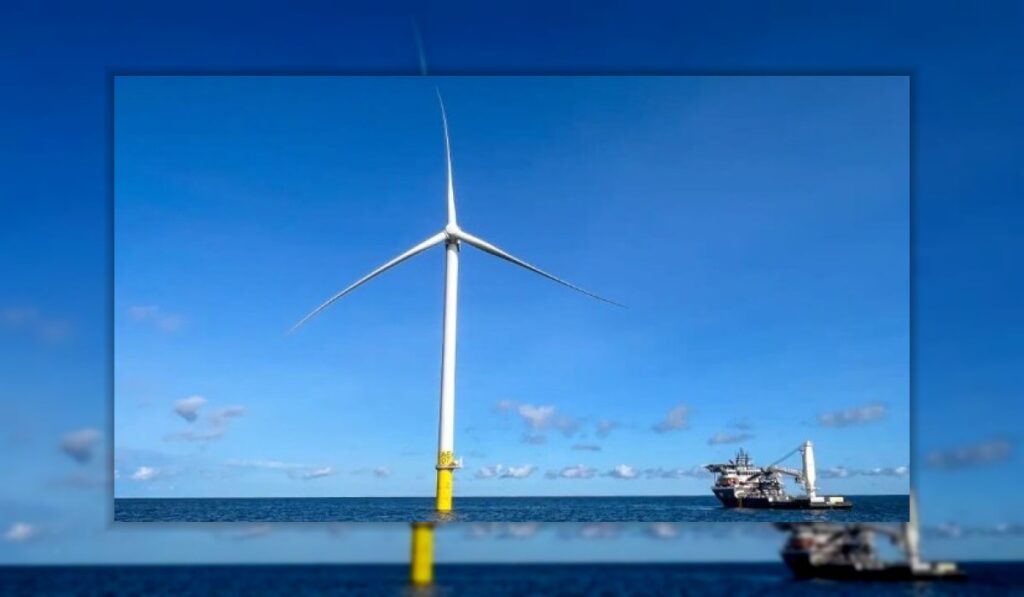
The United States’ offshore wind sector has reached a critical milestone with the completion of Revolution Wind’s final turbine, a 704-megawatt project that has weathered two federal stop-work orders to deliver clean energy to New England.
The last of 65 Siemens Gamesa turbines was installed this week in Rhode Island Sound, marking the end of offshore construction for the $6.2 billion project. Developed as a 50-50 partnership between Danish energy giant Orsted and Global Infrastructure Partners’ Skyborn Renewables, Revolution Wind is now the third large-scale offshore wind farm to be completed in the U.S., following Vineyard Wind and South Fork Wind.
Legal battles and political headwinds: offshore wind
The project’s path to completion has been far from smooth. After more than nine years of planning and permitting, Revolution Wind received its final federal approvals in November 2023. Offshore construction began in 2024, with the first turbine installed in September of that year. By August 2025, the project was 80% complete, with 45 turbines in place, only for the Trump administration to issue its first stop-work order, citing alleged permitting irregularities.
Natural Gas
The Bureau’s order was swiftly challenged in court, and Revolution Wind secured a preliminary injunction in September 2025, allowing work to resume. However, the respite was short-lived. In December 2025, the Department of the Interior, the parent agency of BOEM, halted construction again, this time citing undefined concerns over radar interference and national security.
A second injunction, granted in early 2026, enabled the project to proceed once more. These agreements, legally binding under state law, created a conflict between federal policy and state energy commitments, a tension that courts have so far resolved in favour of the latter.
Despite the legal turmoil, Revolution Wind began delivering power to the grid in March 2026, when it was 90% complete. Rhode Island Governor Dan McKee hailed the installation of the final turbine as “another major milestone,” reaffirming the state’s commitment to seeing the project through. In a statement, McKee said:
“We said we would see Revolution Wind through to the end.”
Dan McKee·Governor of Rhode Island
What 704MW means for New England
The project is expected to save New England ratepayers up to $500 million per year in wholesale energy costs, according to an analysis by Connecticut’s Department of Energy and Environmental Protection. This figure predates the recent surge in energy prices, suggesting the savings could be even higher today.
The project’s economic benefits extend beyond direct cost savings. Offshore wind farms like Revolution Wind contribute to local job creation, both during construction and in ongoing operations.
As electricity demand continues to grow, the region needs more generation that can strengthen reliability, diversify the power supply, and provide greater certainty for consumers.".
The project’s turbines have already proven their value during extreme weather events. Unlike traditional fossil fuel plants, which can be vulnerable to fuel supply disruptions or extreme weather, offshore wind farms operate independently of fuel logistics, making them a more reliable source of energy during crises.
For consumers in Rhode Island and Connecticut, the benefits of Revolution Wind will become increasingly tangible as the project reaches full commissioning by the end of 2026. The project’s power purchase agreements lock in energy prices for two decades, shielding ratepayers from the volatility of fossil fuel markets. This stability is particularly valuable in New England, where energy prices have historically been among the highest in the U.S. due to the region’s reliance on natural gas and heating oil.
Revolution Wind’s completion arrives at a pivotal moment for the U.S. offshore wind sector. While the project has demonstrated the industry’s resilience, its legal and political battles have exposed the fragility of the regulatory environment. The Trump administration’s opposition to offshore wind has already had a chilling effect on the sector, with BloombergNEF slashing its 2035 projection from 39GW to just 6GW by the end of 2025.
The administration’s offer of refunds to developers willing to forfeit their offshore wind leases has further dampened investor confidence, raising questions about the long-term viability of projects still in the pipeline.
The administration’s stance contrasts sharply with the policies of the previous administration, which actively promoted offshore wind as part of a broader strategy to decarbonise the U.S. energy sector. Under President Biden, the federal government set a target of deploying 30GW of offshore wind capacity by 2030, a goal that now appears increasingly unattainable. The shift in federal policy has left states like Rhode Island and Connecticut in a difficult position, as they must balance their own renewable energy targets with the uncertainty created by Washington.
Despite these challenges, Revolution Wind is not alone in its progress. Three other offshore wind projects remain under construction in the U.S.: Dominion Energy’s Coast Virginia Offshore Wind, expected to complete in mid-2027; Empire Wind and Sunrise Wind, both slated for completion in 2027.
These projects, however, face similar regulatory and political risks, particularly as the Trump administration continues to scrutinise the sector. For developers, the message is clear: offshore wind in the U.S. remains a high-risk, high-reward proposition, with success dependent on navigating a complex web of federal, state, and local interests.
For industry observers and energy analysts, Revolution Wind’s completion offers a case study in the challenges and opportunities of offshore wind in the U.S. The project’s ability to overcome legal and political obstacles demonstrates the determination of states to pursue their energy goals, even in the face of federal opposition. However, its struggles also highlight the need for a more stable regulatory framework, one that provides clarity for developers and investors while addressing legitimate concerns about environmental and national security impacts.
As Revolution Wind moves toward full operations, its performance will be closely watched as a bellwether for the sector’s future. If the project delivers on its promises of cost savings, reliability, and grid resilience, it could help shift the narrative around offshore wind, even in a hostile political climate. Conversely, if it encounters further setbacks, whether technical, financial, or regulatory, it could reinforce the scepticism that has taken hold in some quarters.
For now, Revolution Wind stands as a testament to the resilience of the U.S. offshore wind sector, and a reminder of the political and legal hurdles it must still overcome. Its success or failure will have implications far beyond Rhode Island and Connecticut, shaping the trajectory of the entire industry in the years to come.


Sign up free to ask CAMAL AI for a summary, the key points or anything else about this story.
Related stories
CAMAL AI
 Financial Ports Newsletter
The maritime economy, every morning
Ports, shipping and freight markets in one short email. Free.
Financial Ports Newsletter
The maritime economy, every morning
Ports, shipping and freight markets in one short email. Free.



