

Ammonia bunkering breakthrough: Japan fuels ship with toxic cargo at sea
NYK completes world’s first ship-to-ship transfer of ammonia to an ammonia-fuelled vessel at Ariake Shipyard.
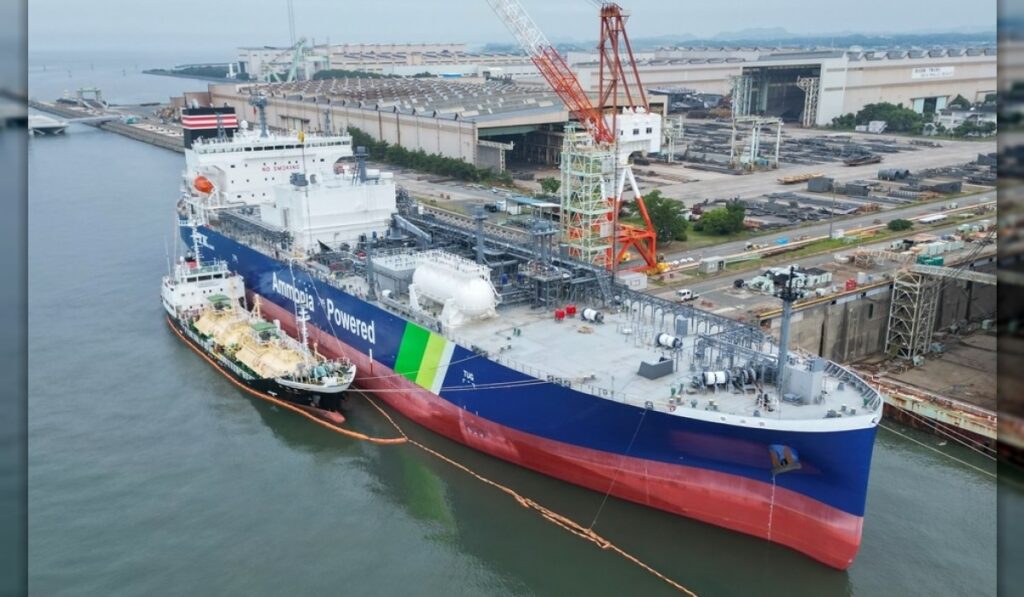
Japanese shipping giant Nippon Yusen Kaisha (NYK) and its partners have achieved a milestone in maritime decarbonisation by completing the world’s first ship-to-ship ammonia bunkering operation for an ammonia-fuelled vessel. The transfer occurred on September 17 at Japan Marine United’s Ariake Shipyard, where the 998-gross-ton ammonia carrier Shoei Maru supplied fuel to a new ammonia-powered medium gas carrier still under construction.
The operation involved a collaboration between NYK, Japan Marine United, Nihon Shipyard, Mitsubishi Gas Chemical, and Kokuka Sangyo. The partners developed specialised safety protocols and work processes to ensure the transfer proceeded without incident, addressing the significant handling challenges posed by ammonia’s toxicity.
The Shoei Maru, a 71.5-metre-long vessel owned by Kokuka Sangyo, primarily transports ammonia for Mitsubishi Gas Chemical’s Niigata plant. The fuel was transferred directly between ships using connecting hoses, a method that could become standard as the industry explores ammonia’s potential as a zero-carbon marine fuel.
Advancing ammonia as a marine fuel: ammonia bunkering
Ammonia is gaining attention as a leading candidate for decarbonising shipping because it emits no carbon dioxide when burned. However, its hazardous properties have made safe bunkering and onboard handling critical obstacles to widespread adoption. This operation provided practical data to refine procedures for future ammonia transfers, marking a step toward establishing the infrastructure needed for ammonia-fuelled vessels.
The new ammonia-fuelled medium gas carrier, scheduled for delivery to NYK in November, will now undergo sea trials using ammonia as fuel. The vessel is part of Japan’s ¥2 trillion ($13.7 billion) Green Innovation Fund, administered by the New Energy and Industrial Technology Development Organization (NEDO). The fund supports projects aimed at helping Japan reach carbon neutrality by 2050, including the development of zero-emission shipping technologies.
This achievement builds on NYK’s prior experience with ammonia. In 2024, the company converted the tug Sakigake into what it described as the world’s first commercial ammonia-fuelled vessel, though that vessel was refuelled using truck-to-ship bunkering. The successful ship-to-ship transfer at Ariake Shipyard demonstrates progress in scaling up ammonia refuelling methods for larger vessels.
Implications for the shipping industry
The completion of this operation signals growing momentum behind ammonia as a viable alternative to conventional marine fuels. If the upcoming sea trials prove successful, they could accelerate the adoption of ammonia-powered ships and the development of supporting infrastructure, such as bunkering facilities and storage terminals.
For the maritime sector, which accounts for a significant portion of global emissions, ammonia offers a potential pathway to reducing its carbon footprint. However, the transition will require continued collaboration between industry players, regulators, and technology providers to address safety concerns and build the necessary supply chains. The data gathered from this operation and the new vessel’s trials will be crucial in determining ammonia’s role in the future of zero-emission shipping.


Sign up free to ask CAMAL AI for a summary, the key points or anything else about this story.
Related stories
CAMAL AI
 Financial Ports Newsletter
The maritime economy, every morning
Ports, shipping and freight markets in one short email. Free.
Financial Ports Newsletter
The maritime economy, every morning
Ports, shipping and freight markets in one short email. Free.



