

Vroon breaks into offshore wind with £7m ERRV milestone
Vroon Offshore Services secures first long-term ERRV contract for ScottishPower’s East Anglia Two and Three wind farms
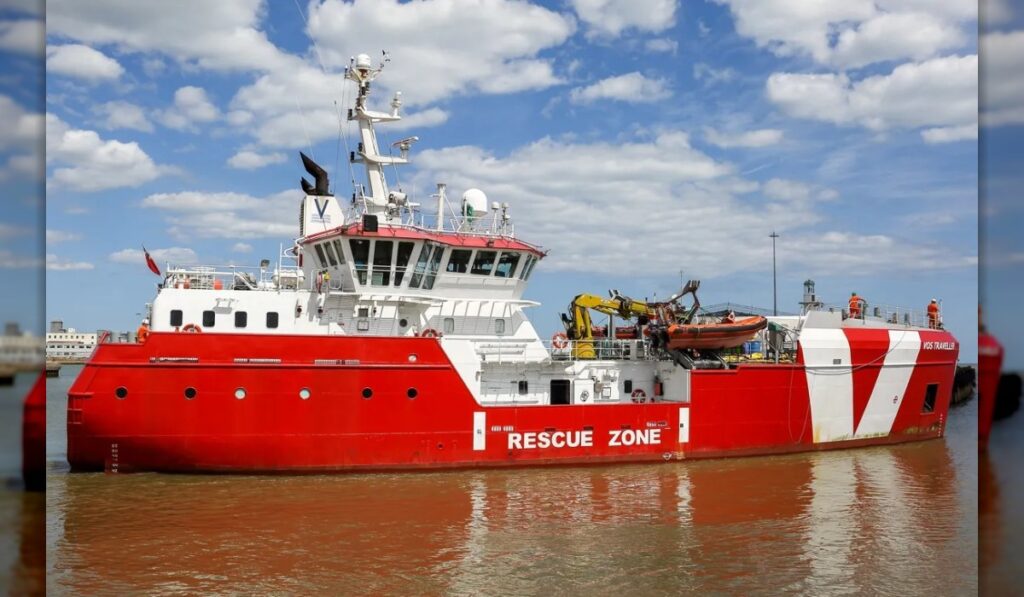
Vroon Offshore Services (VOS) has shattered its offshore oil and gas monopoly with a landmark £7m ($9.5m) contract to provide emergency response and rescue vessel (ERRV) services for ScottishPower Renewables’ East Anglia Two and Three offshore wind farms. The deal, VOS’s first long-term commitment in the renewables sector, signals a strategic pivot as the offshore wind industry scales up safety demands.
The 2008-built VOS Traveller, a purpose-built Class B ERRV, will anchor its operations at Lowestoft port, serving as a floating safety net for the 1.4 GW East Anglia projects. With a 24-strong crew working 28-day rotations, the vessel will maintain 24/7 standby, ready to deploy within 20 minutes in the event of an emergency. Its arsenal includes two fast rescue craft, a Dacon scoop, and a heavy-duty rescue basket, tools designed to pluck workers from the water or transfer them to safety amid harsh North Sea conditions.
Why this deal matters for offshore wind safety
The offshore wind sector is no stranger to risk. With turbine heights exceeding 250 metres and construction crews working in remote, often treacherous conditions, the need for robust emergency response infrastructure has never been more acute. The VOS Traveller addresses this gap with a suite of capabilities tailored for renewables: onboard medical facilities, advanced collision-avoidance radar, and environmental monitoring systems that track everything from oil spills to sudden weather shifts.
“This new cooperation with ScottishPower Renewables marks a major milestone for VOS, being our first long-term commitment providing ERRV services to the offshore renewables sector,” said Stuart Thom, VOS managing director. His words underscore the significance of the deal, not just as a commercial win, but as a validation of ERRVs’ role in the energy transition.
Historically, these vessels have been the domain of oil and gas, where their rapid-response capabilities are a regulatory requirement. The shift to offshore wind reflects a broader industry trend: as renewables projects grow in scale and complexity, so too do the safety protocols governing them.
The East Anglia Two and Three projects, located 40 miles off the Suffolk coast, are among the UK’s most ambitious offshore wind developments. Once completed, they will generate enough electricity to power 1.3 million homes, but their construction phase is fraught with hazards. Workers face risks ranging from falls and equipment failures to vessel collisions and extreme weather. The presence of a dedicated ERRV like the VOS Traveller mitigates these dangers, providing a critical layer of protection that could mean the difference between life and death.
What’s next for Vroon and the ERRV market
For Vroon, the ScottishPower deal is more than a one-off contract, it’s a proof of concept. The company, which has spent decades specialising in ERRV services for the oil and gas sector, is now positioning itself as a key player in offshore renewables. The move comes as the UK ramps up its offshore wind capacity, with the government targeting 50 GW by 2030, up from around 14 GW today. This exponential growth will require a corresponding expansion of support services, including emergency response.
The VOS Traveller’s deployment also highlights the evolving regulatory landscape for offshore wind. While the sector has historically operated under less stringent safety requirements than oil and gas, regulators are increasingly mandating ERRV coverage for large-scale projects. The UK’s Health and Safety Executive (HSE), for instance, has signalled that future wind farms may need to demonstrate robust emergency response plans as a condition of approval. Vroon’s entry into the market could accelerate this shift, setting a new benchmark for safety standards.
For industry stakeholders, the deal offers a glimpse into the future of offshore wind operations. As projects move further from shore and into deeper waters, the demand for specialised support vessels will only intensify. The VOS Traveller, with its Class B ERRV certification and renewables-focused capabilities, could become a template for the next generation of emergency response vessels. Meanwhile, competitors will be watching closely, likely spurred to explore similar partnerships as the offshore wind boom gathers pace.
One thing is clear: the days of offshore wind being a niche, low-risk sector are over. With projects like East Anglia Two and Three pushing the boundaries of scale and ambition, the industry must now confront the same safety challenges that have long defined oil and gas. Vroon’s deal with ScottishPower is a step in the right direction, but it’s only the beginning.


Sign up free to ask CAMAL AI for a summary, the key points or anything else about this story.
Related stories
CAMAL AI
 Financial Ports Newsletter
The maritime economy, every morning
Ports, shipping and freight markets in one short email. Free.
Financial Ports Newsletter
The maritime economy, every morning
Ports, shipping and freight markets in one short email. Free.