
Wind-powered ships: Oceanbird CEO reveals why the industry is returning
Oceanbird’s rigid wing sail cuts fuel costs with no moving parts—first installation on PCTC Tirranna a success.
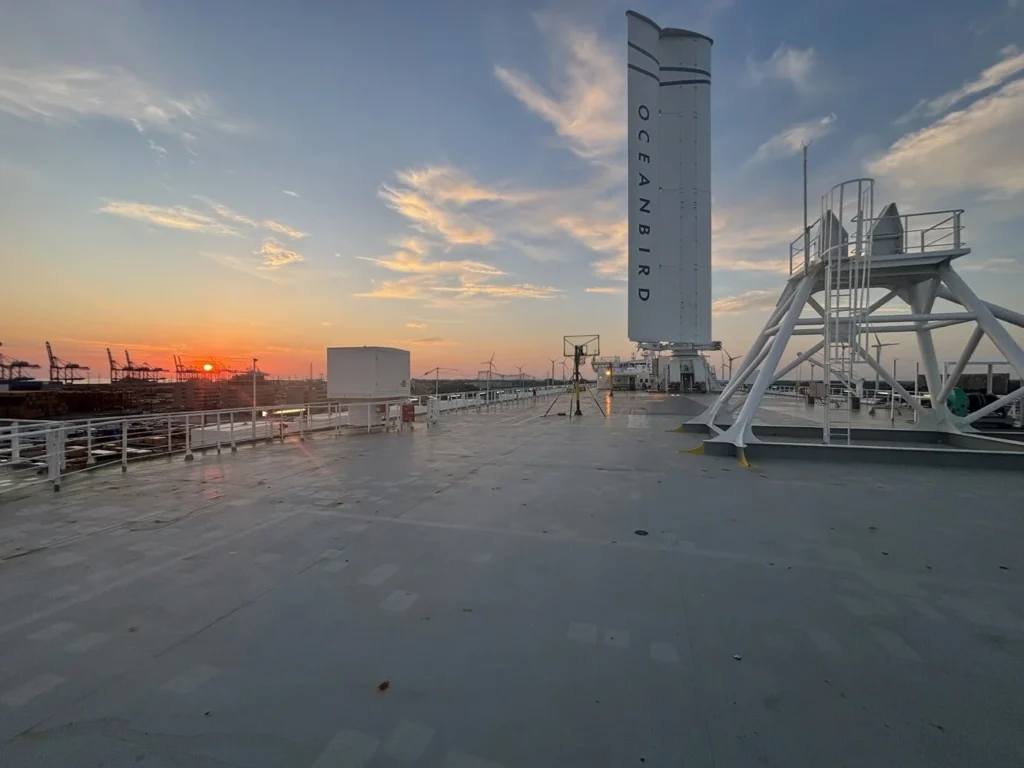
Oceanbird, a joint venture between Wallenius and Alfa Laval, has marked a milestone in maritime sustainability with the successful installation of its rigid wing sails on the Wallenius Wilhelmsen PCTC Tirranna. The technology, designed to cut fuel consumption on deep-sea vessels, completed its first deployment without complications, a rare achievement in the emerging field of wind-assisted propulsion.
Amrit Bhullar, Oceanbird’s CEO, described the moment as a breakthrough. “The team’s effort paid off—this installation went smoother than any first deployment we’ve seen in the industry,” she said. The rigid wing sails, which stand tall on the vessel’s deck, operate without rotating parts or noise, distinguishing them from other wind propulsion systems. Their automation and low maintenance requirements address key concerns for shipowners seeking efficiency without operational disruptions.
Why rigid wings could lead the market: Oceanbird
Bhullar emphasized that no single wind propulsion technology will fit all vessels. “The right solution depends on the ship’s size, route, and operational profile,” she explained. While smaller suction wings may suit niche markets, Oceanbird’s large rigid wings target deep-sea vessels on high-wind routes, where their scale delivers maximum fuel savings.
Wallenius Wilhelmsen
The technology’s appeal extends beyond hardware. Oceanbird has partnered with StormGeo and Wallenius Marine to develop digital tools that optimize sail performance using real-time weather and route data. “It’s not just about adding sails—it’s about integrating them seamlessly into the vessel’s operations,” Bhullar noted. Early adopters are already seeing fuel savings that offset the system’s cost, reinforcing its commercial viability.
A leader forged in maritime innovation
Bhullar’s path to Oceanbird was unconventional. After beginning her career as a corporate M&A lawyer in London, she moved to Norway and joined Rolls-Royce Marine in 2010, where she commercialized cutting-edge technologies, including a potential deal with Washington State Ferries for 12 vessels and early LNG fuel systems. When Rolls-Royce Marine was acquired by Kongsberg Maritime, she shifted to ship intelligence projects, working on the world’s first remote-controlled tug in Copenhagen and an autonomous ferry demonstrator in Finland.
Her role at Vard further honed her expertise in non-standard maritime solutions, including the delivery of the first cyber-class notation-approved ship under new regulations. When approached to lead Oceanbird, she saw an opportunity to scale a technology with tangible environmental and economic benefits. “Supported by Wallenius and Alfa Laval, we’re not just selling a product—we’re shaping the future of shipping,” she said.
With the maritime industry facing rising fuel costs and stricter emissions rules, Oceanbird’s rigid wing sails offer a glimpse of a more sustainable future. The question is no longer whether wind propulsion will play a role, but how quickly it will become standard.


Sign up free to ask CAMAL AI for a summary, the key points or anything else about this story.
Related stories
CAMAL AI
 Financial Ports Newsletter
The maritime economy, every morning
Ports, shipping and freight markets in one short email. Free.
Financial Ports Newsletter
The maritime economy, every morning
Ports, shipping and freight markets in one short email. Free.