

North Korea’s 5,000-ton destroyer enters service—after a launch
The Kang Kon, Pyongyang’s most advanced warship, joins the fleet 15 months after capsizing during its botched launch.
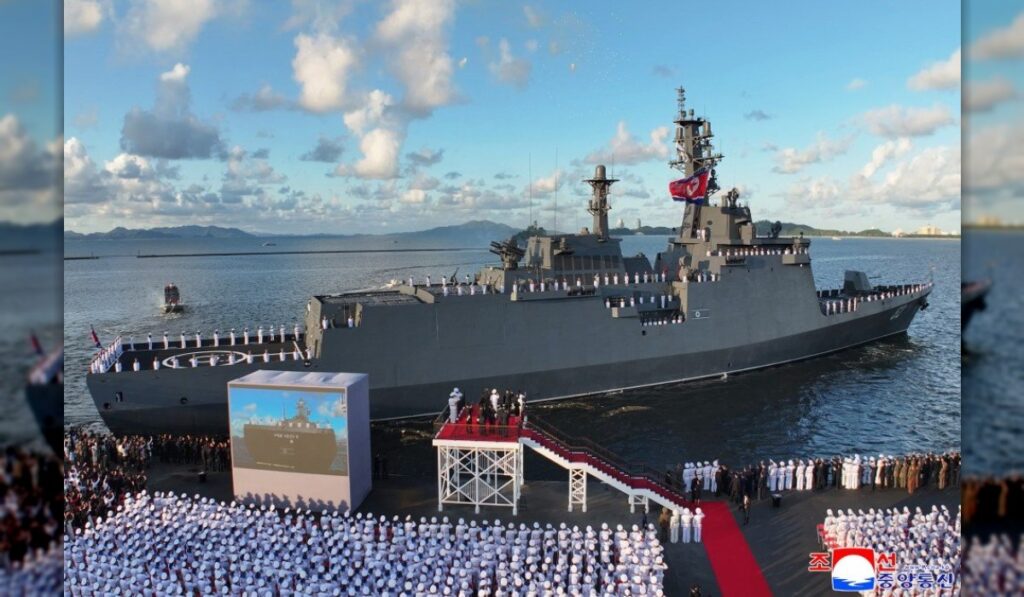
North Korea has officially commissioned its second Choe Hyon-class destroyer, the Kang Kon, marking a significant expansion of its naval capabilities. The ceremony, held at Wonsan Port on September 6, was attended by leader Kim Jong Un and featured a military parade, a nine-gun salute, and the raising of the national flag. State media KCNA broadcast the event, though no Western journalists were permitted to attend.
Kim described the new destroyer as a vessel with “complex combat capability”, emphasizing its role in strengthening the country’s navy. The 5,000-ton displacement warship is the largest ever built for North Korea, measuring 145 meters (approximately 475 feet) in length. Analysts suggest the ship is equipped with an advanced weapons system, including vertical launch systems capable of firing anti-ship, anti-aircraft, and land-attack cruise missiles. Additional armaments include a 127mm naval gun, a six-barrel 30mm close-in weapon system (CIWS), torpedo launchers, and decoy launchers.
Strategic ambitions and regional concerns: North Korea
The Kang Kon’s commissioning reflects North Korea’s broader push to modernize its naval forces. Historically reliant on coastal defenses, Pyongyang is now pursuing an “ocean fleet”, with Kim declaring the need to “exercise sovereignty at sea and underwater”. The destroyer’s deployment to the East Sea Fleet, while its sister ship, the Choe Hyon, operates in the West Sea Fleet, suggests a strategic division of North Korea’s most advanced surface combatants.
Analysts speculate that foreign assistance may have played a role in the ship’s development, with Russia potentially aiding in construction and China contributing to weapons systems. The vessel’s reported ability to launch nuclear-capable cruise missiles, tested in July, has raised alarms among neighboring countries. Kim’s remarks at the ceremony hinted at further advancements, including a “significant development” expected within eight months. Some experts believe this could refer to a nuclear-powered submarine, which would further extend North Korea’s strike capabilities.
A troubled past and an uncertain future
The Kang Kon’s path to commissioning was not without setbacks. In 2025, the vessel suffered a failed launch during a ceremony attended by Kim, toppling onto its side and sustaining hull damage. The leader reportedly ordered the ship to be righted within weeks and demanded full repairs, underscoring the importance of the project.
North Korea has also indicated plans to develop guided-missile cruisers, which would be roughly twice the size of the Choe Hyon-class. Such vessels would represent a major leap in Pyongyang’s naval ambitions, potentially enabling operations far beyond its coastal waters. As tensions in the Pacific remain high, regional powers are closely monitoring these developments, recognizing that North Korea’s growing naval capabilities could reshape military dynamics in East Asia.


Sign up free to ask CAMAL AI for a summary, the key points or anything else about this story.
Related stories
CAMAL AI
 Financial Ports Newsletter
The maritime economy, every morning
Ports, shipping and freight markets in one short email. Free.
Financial Ports Newsletter
The maritime economy, every morning
Ports, shipping and freight markets in one short email. Free.



