

North Korea’s 5,000-ton destroyer packs 64 missile launchers in power play
The Choe Hyon, Pyongyang’s largest warship, enters service with 88 vertical launch cells and nuclear-capable missiles.
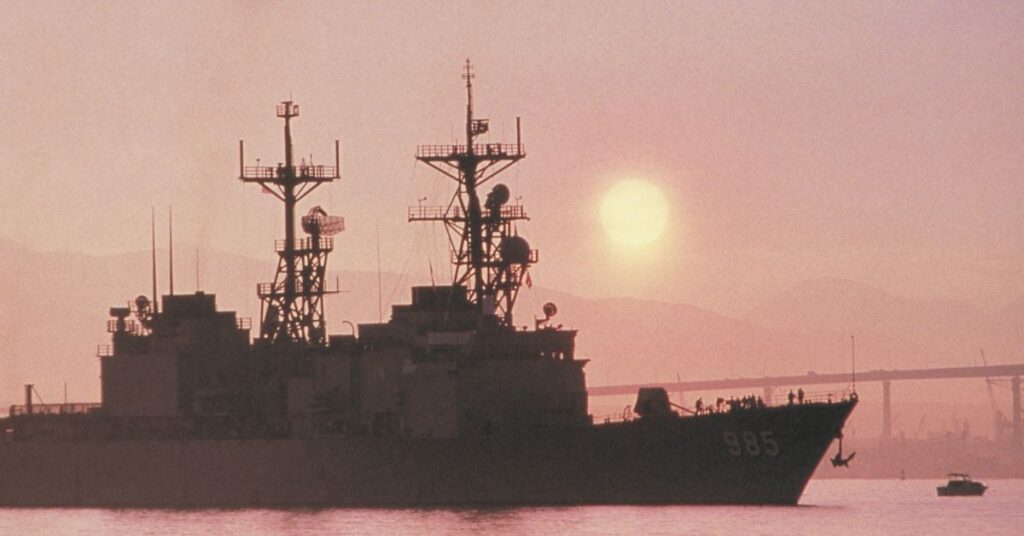
North Korea has taken a major step in expanding its naval capabilities with the launch of the Choe Hyon, its largest warship to date. The 5,000-ton destroyer, unveiled at the port city of Nampho, marks a shift from Pyongyang’s traditional focus on coastal defense toward a more ambitious strategy of projecting power beyond its shores.
The Choe Hyon measures between 144 and 145 meters in length with a beam of around 16 meters, making it the largest surface combatant ever constructed by North Korea. While smaller than the 9,000–10,000-ton Arleigh Burke-class destroyers operated by the U.S. Navy or South Korea’s 11,000-ton Sejong the Great-class Aegis destroyers, the vessel represents a significant upgrade for a fleet that has long relied on smaller vessels like torpedo boats and midget submarines.
A new era for North Korea’s navy
The warship is equipped with an 88-cell vertical launch system (VLS), an increase from an earlier 74-cell design. This system allows the Choe Hyon to deploy a variety of missiles, including surface-to-air interceptors, land-attack cruise missiles such as the Hwasal-2, and ballistic missiles capable of carrying nuclear warheads. The aft section alone contains 64 vertical launch cells, while additional launchers amidships support anti-ship operations with Kumsong-3 cruise missiles and Bulsae-4 short-range missiles.
For close-range defense, the destroyer features a 127 mm or 130 mm stealth-cupola naval cannon, along with layered close-in weapon systems (CIWS). These include an integrated Pantsir-ME hybrid missile and rotary-gun system and two 30 mm AK-630 multi-barrel cannons. Sub-surface threats are addressed through hull sonar and two twin 533 mm DTA-53 torpedo tube installations mounted on the ship’s sides. The vessel also includes a flight deck capable of supporting medium helicopters and unmanned aerial vehicles, though it lacks an enclosed hangar for maintenance.
North Korea has framed the Choe Hyon as a cornerstone of its new naval strategy, emphasizing the need for a combat-ready fleet capable of multifaceted and efficient operations. Leader Kim Jong Un has repeatedly warned that the Korean Peninsula is in a state of war, citing concerns over U.S. interference and the potential for nuclear conflict. The warship’s deployment aligns with Pyongyang’s broader goal of modernizing its military to counter the naval capabilities of South Korea and the United States.
Regional tensions and strategic ambitions
The introduction of the Choe Hyon also signals North Korea’s intent to assert greater control over contested waters, particularly in the West Sea (Yellow Sea). This region has been a flashpoint for maritime tensions, with South Korea, China, and Russia frequently conducting naval exercises in the area. By assigning the destroyer to this fleet, North Korea could challenge the Northern Limit Line (NLL), the de facto maritime border established after the 1953 Armistice, further complicating regional security dynamics.
While the Choe Hyon does not match the capabilities of U.S. or South Korean destroyers, its launch underscores Pyongyang’s determination to expand its naval influence and enforce its Two State Doctrine, which frames inter-Korean relations as permanently adversarial.


Sign up free to ask CAMAL AI for a summary, the key points or anything else about this story.
Related stories
CAMAL AI
 Financial Ports Newsletter
The maritime economy, every morning
Ports, shipping and freight markets in one short email. Free.



