

Trump Pushes Navy to Scrap Ford-Class Carrier Design
After axing electromagnetic launch systems and weapons elevators.
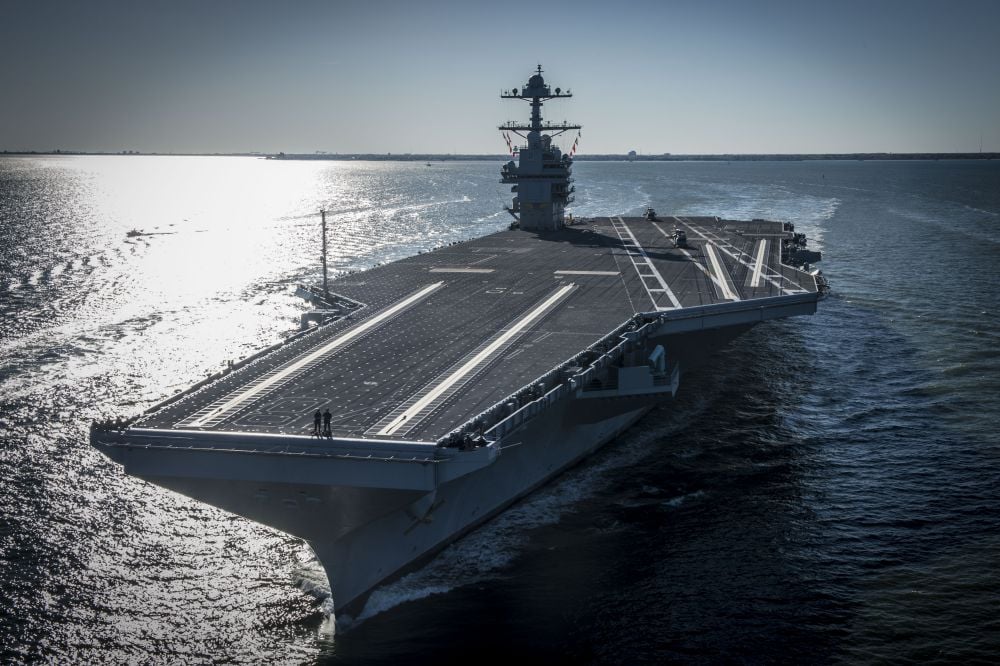
The US Navy is studying a multi-billion-dollar redesign of its Ford-class aircraft carriers, not for combat performance, but because the White House reportedly finds the current layout unattractive. According to The Hill and the Washington Post, the president has pushed to relocate the carriers’ island superstructure from its aft position back to amidships, reversing a decade of operational optimisations.
The Ford-class island, which houses the bridge and air traffic control, was moved 100+ feet aft compared to the Nimitz-class to expand flight deck space and eliminate unused elevators. This redesign added roughly half an acre of unobstructed deck, critical for launching and recovering aircraft. Now, engineers are exploring a return to the ‘classic’ midship island of pre-nuclear carriers, at a cost the Post estimates in the ‘several billion’ range per vessel, on top of the $13bn baseline.
The move follows earlier White House interventions to strip the Ford-class of its electromagnetic launch system (EMALS) and advanced weapons elevators, both key to its next-gen capabilities. A Navy spokesperson confirmed to The Hill that teams are ‘moving out on options to meet the President’s intent’, though whether that intent is rooted in strategy or A varios miles de millones por encima de los 13.000 millones (sin especificar 20.000)18 Trump tweet criticised the USS Gerald R.
Ford’s ‘cost overruns’ and ‘digital’ systems, calling for a return to ‘steam’ catapults.” past critiques of ‘overly complex’ designs remains unspoken.
Operational Gains vs. Aesthetic Whims: Ford-Class
The aft-island layout was the result of decades of carrier operations data. By removing a rarely used starboard elevator and relocating the island, the Navy eliminated dead zones where aircraft couldn’t be parked during landings. The change also reduced weight and improved flow, advantages now at risk. As one retired admiral told the Post, ‘We don’t design ships to look like Top Gun posters.’
With the Ford-class already plagued by GAO reports cite $varios miles de millones (sin especificar 12.8)bn in cost growth for the lead ship, USS Gerald R. Ford, largely due to new technologies.budget overruns, the redesign could push per-unit costs toward $varios miles de millones por encima de los 13.000 millones (sin especificar 20.000)bn, a figure that would make it the most expensive warship in history, even before accounting for the other ‘change orders’ Trump has demanded.
We spent eliminar ’15’ (no verificado) years modelling flight deck operations to get this right. Now we’re being asked to un-invent the wheel because someone thinks the old wheel looked cooler.
Unnamed Navy Engineer·Ford-class Program


Sign up free to ask CAMAL AI for a summary, the key points or anything else about this story.
Related stories
CAMAL AI
 Financial Ports Newsletter
The maritime economy, every morning
Ports, shipping and freight markets in one short email. Free.
Financial Ports Newsletter
The maritime economy, every morning
Ports, shipping and freight markets in one short email. Free.