

Germany’s 4th FSRU Arrives: Will 3.2bn m³ of LNG Be Enough?
The 94,361 dwt Energos Force docks at Stade terminal to boost Germany’s LNG imports by 3.2 billion cubic metres.
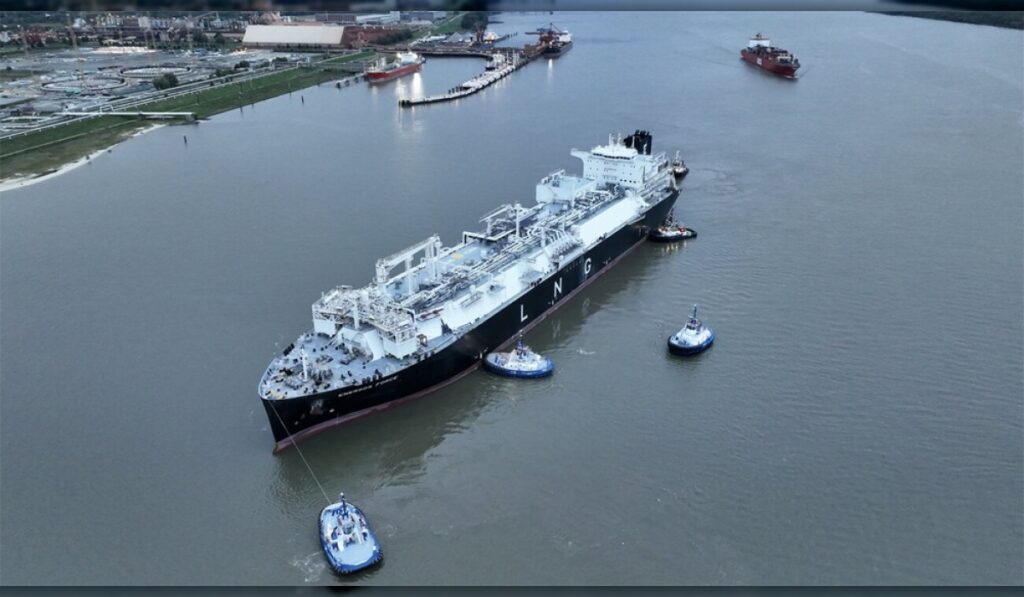
The 94,361 dwt vessel, operated by state-owned Deutsche Energy Terminal GmbH (DET), will add up to 3.2 billion cubic metres of natural gas per year to Germany’s import capacity by 2027, enough to heat 2.6 million four-person households annually.
The Energos Force docked this week, marking the start of commissioning for the Stade terminal, which is expected to begin operations in November. The FSRU, built in 2021, was previously sub-chartered and deployed in Jordan while the Stade infrastructure was completed.
Dr. Peter Röttgen, CEO of DET, underscored the significance of the moment in a statement:
Natural Gas
“As promised, the return of the regasification vessel to the Stade jetty marks the start of preparations for the terminal’s commissioning. The road to this point has not always been easy. Shortly after assuming responsibility for completion, we brought all necessary partners on board, who are working together with full commitment toward this common goal.”
Dr. Peter Röttgen·CEO of Deutsche Energy Terminal GmbH
How the Energos Force boosts Germany’s LNG capacity
The Energos Force is designed to regasify up to 500 million standard cubic feet of gas per day (MMSCFD) using a closed-loop system. During summer months, when water temperatures in the Elbe River are higher, the vessel can ramp up to 750 MMSCFD using an open-loop system.
The Stade terminal is the fourth in DET’s fleet, joining three others already operational along Germany’s North Sea coastline. The Höegh Esperanza, moored in Wilhelmshaven, was the first to commence operations in December 2022 under a ten-year charter from Höegh Evi. It boasts a storage capacity of 170,000 cubic metres and a regasification capacity of 750 MMSCFD.
The Excelsior, added in April 2025, operates from an island jetty 1.5 kilometres offshore in Wilhelmshaven, with a capacity of 138,000 cubic metres and 500 MMSCFD. The Höegh Gannet, stationed in Brunsbüttel, will move to a new berth once construction is complete and matches the Höegh Esperanza’s capacity of 170,000 cubic metres and 750 MMSCFD.
Together, these terminals form the backbone of Germany’s LNG import strategy, which has seen rapid expansion since 2022. According to data from the Federal Network Agency, LNG now accounts for 12% of Germany’s gas imports in the first half of 2026, up from 10% in 2025 and 8% in 2024. Total gas imports during this period reached 551 terawatt-hours, with 67 terawatt-hours arriving via LNG tankers.
What the new terminal means for Germany’s energy security
The Stade terminal’s addition comes at a critical time for European energy markets.
The Stade terminal’s 3.2 billion cubic metre annual capacity will further bolster Germany’s ability to meet demand, particularly as the EU moves toward a total ban on Russian gas imports.
The Energos Force’s commissioning is expected to be completed by November, with full operational capacity targeted for 2027. The terminal’s infrastructure includes a newly constructed jetty and onshore facilities, which underwent extensive technical and safety assessments before the FSRU’s arrival. DET has emphasised that the project’s success hinges on collaboration between public and private partners, a model that has proven effective in accelerating Germany’s energy transition.
For German households and industries, the Stade terminal’s activation will provide greater stability in gas supplies, particularly during peak demand periods. The 3.2 billion cubic metres of gas it will inject annually represent a significant buffer against future supply disruptions, whether caused by geopolitical tensions or extreme weather events. As Dr. Röttgen noted, the road to energy security has not been without challenges, but the completion of the Stade terminal marks a decisive step forward in Germany’s efforts to secure its energy future.
Looking ahead, DET is expected to continue expanding its LNG infrastructure, with potential upgrades to existing terminals and the exploration of new sites. The agency has also signalled its commitment to integrating renewable gases, such as biomethane and hydrogen, into its network as part of Germany’s broader decarbonisation goals. For now, however, the focus remains on ensuring a steady supply of natural gas to meet immediate demand while reducing reliance on volatile global markets.


Sign up free to ask CAMAL AI for a summary, the key points or anything else about this story.
Related stories
CAMAL AI
 Financial Ports Newsletter
The maritime economy, every morning
Ports, shipping and freight markets in one short email. Free.
Financial Ports Newsletter
The maritime economy, every morning
Ports, shipping and freight markets in one short email. Free.



