

MOL’s first FSRU conversion deal locks in Germany’s gas supply until 2043
Japanese carrier secures long-term charter to restore Mukran terminal’s 13.5 bn m³ annual capacity from 2028
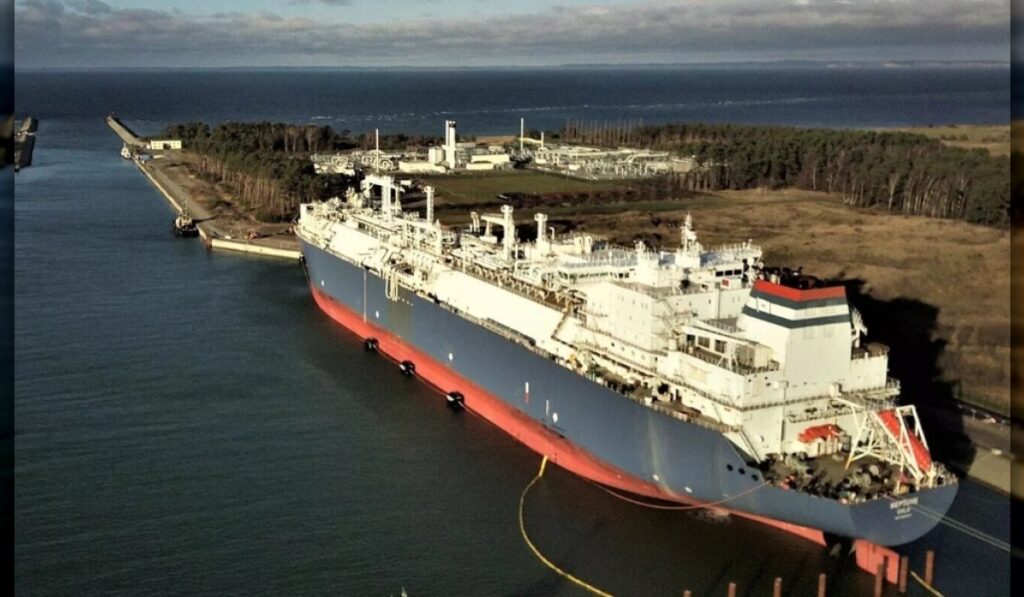
The deal, announced on October 29, 2026, marks MOL’s first independently initiated conversion of an existing LNG carrier into an FSRU. The vessel, which has not been identified, will be converted by China’s Hudong-Hudong-Zhonghua Shipbuilding and is scheduled to begin its charter in 2028. The contract, reportedly worth several hundred million dollars, will run until 2043, according to German media.
The Mukran terminal, located on Rügen island in northeastern Germany, currently operates with a single FSRU, the Neptune, after the Energos Power left in 2025 following the termination of its charter with the German government. The new FSRU will restore the terminal’s fully permitted regasification capacity of 13.5 billion cubic metres annually, equivalent to approximately 15% of Germany’s natural gas demand.
Deutsche ReGas chief executive Ingo Wagner emphasised the strategic importance of the project:
Natural Gas
«The new vessel would strengthen long-term energy security while providing greater flexibility for LNG imports into Germany and Europe.»
Ingo Wagner·Chief Executive, Deutsche ReGas
Wagner added that the Mukran terminal had previously operated with two FSRUs but had maintained stable operations with one vessel since 2025.
«Bringing in the converted carrier would restore the two-vessel configuration and help diversify European gas supplies and strengthen supply security.»
Ingo Wagner·Chief Executive, Deutsche ReGas
The conversion process and MOL’s expanding FSRU portfolio
The conversion work, expected to begin in the second quarter of 2027, will take approximately seven months and involve replacing the vessel’s engines, regasification equipment, and pumps. Hudong-Hudong-Zhonghua Shipbuilding, a subsidiary of China’s Hudong-Zhonghua Shipbuilding, will handle the technical modifications, transforming the LNG carrier into a fully functional FSRU capable of receiving, storing, and regasifying LNG offshore before sending it ashore via pipelines.
For MOL, the agreement represents a significant step in its expansion into downstream LNG infrastructure. MOL shipping giant has been actively growing its FSRU portfolio, with investments and operations in markets including Indonesia, Hong Kong, Poland, and Singapore.
MOL’s president attended a ceremony in Tokyo on October 29 to mark the signing of the charter agreement, underscoring the strategic importance of the deal for both companies. The project aligns with MOL’s broader strategy to diversify its business beyond traditional shipping, capitalising on the growing demand for flexible LNG import solutions in Europe and Asia.
What this means for Germany’s energy transition
This integration ensures that the regasified LNG can be distributed efficiently across the country, supporting both short-term energy security and long-term decarbonisation goals. While natural gas remains a transitional fuel, the terminal’s infrastructure is designed to accommodate future developments, such as the potential import of green hydrogen or synthetic methane derived from renewable sources.
The project also highlights the growing role of Asian shipping companies in Europe’s energy transition. MOL’s involvement in the Mukran terminal reflects a broader trend of Japanese and South Korean firms investing in European LNG infrastructure, driven by the continent’s urgent need for alternative gas supplies. These partnerships are likely to deepen as Europe continues to diversify its energy mix and reduce emissions.
Looking ahead, the Mukran terminal’s expanded capacity will play a key role in Germany’s energy strategy, particularly as the country phases out coal and nuclear power. The terminal’s ability to handle 13.5 billion cubic metres of gas annually provides a critical buffer against supply disruptions, ensuring that German industries and households have access to reliable energy sources. For MOL, the project reinforces its position as a leading player in the global FSRU market, with further opportunities likely to emerge as demand for flexible LNG import solutions grows.
The next steps for the project include the commencement of conversion work in mid-2027, with the FSRU expected to be operational by 2028. Deutsche ReGas and MOL will continue to collaborate closely to ensure the smooth integration of the vessel into the Mukran terminal’s operations. As Europe’s energy landscape evolves, the Mukran terminal is poised to remain a cornerstone of the continent’s gas supply infrastructure, supporting both energy security and the transition to a low-carbon future.


Sign up free to ask CAMAL AI for a summary, the key points or anything else about this story.
Related stories
CAMAL AI
 Financial Ports Newsletter
The maritime economy, every morning
Ports, shipping and freight markets in one short email. Free.



