

Tesla Semi: The Electric Truck That Changed a Skeptic’s Mind—Here’s Why
A long-time critic with 30 years in trucking tests Tesla’s electric Semi loaded.
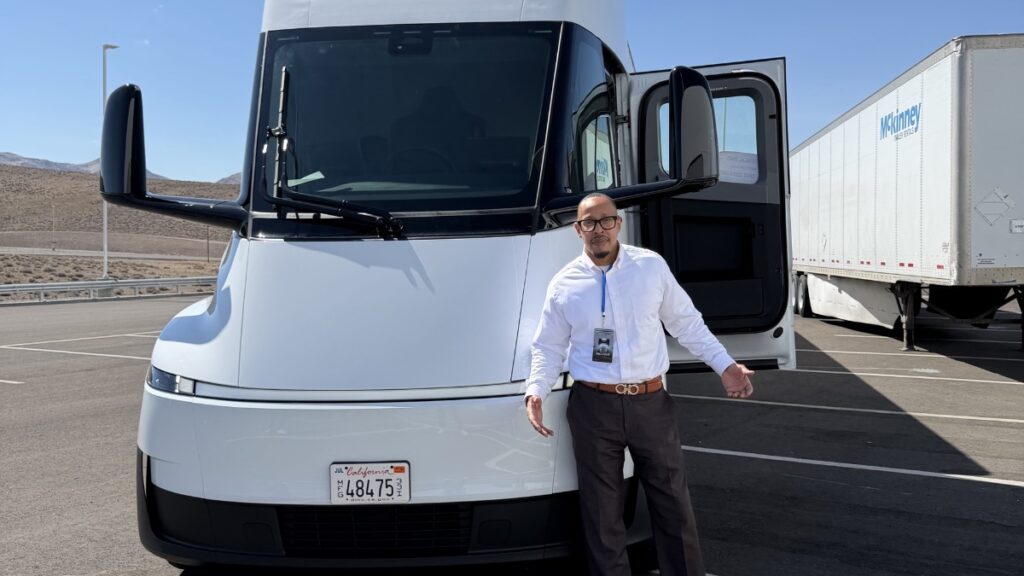
After three decades behind the wheel and years of scepticism, a veteran trucker with a Class A CDL has finally driven Tesla’s electric Semi, and found that some of its most criticised features work better than expected. The 500-mile range holds under real-world loads, the centre-seat layout improves visibility, and regenerative braking cuts brake wear. But payload limitations and charging reliability still leave questions unanswered.
The Tesla Semi, first unveiled in 2017, has spent years in the crosshairs of industry sceptics. Critics dismissed it as a “glorified day cab” with poor driver positioning, weak features, and a design that prioritised electric performance over driver comfort. Even as legacy manufacturers like Kenworth and Freightliner rolled out electric models with familiar cab layouts, Tesla’s radical approach, centre seating, minimalist controls, and a curb weight of ~23,000 pounds, drew fire from drivers accustomed to traditional rigs.
But after a recent test drive with a loaded Semi, the author, a long-time critic, admitted that some of their earlier concerns were overblown. The centre-seat layout, initially mocked as a design flaw, actually improved forward visibility by aligning the driver with the truck’s centreline. “You stop guessing where your right side is,” the author noted. “You can see it.” The shift from a pop-out to a roll-down window, added after customer feedback, also addressed one of the most common complaints about earlier prototypes.
What Worked, and What Didn’t: Tesla Semi
The Tesla Semi’s 800 kW of power, delivered through three independent rear motors, impressed during acceleration and hill climbs. Regenerative braking, a feature common in electric vehicles but rarely tested under heavy loads, proved especially effective. “Even loaded, you barely touch the service brake,” the author wrote. The fully electric steering system, which eliminates hydraulic components, also delivered quicker and more precise responses than traditional setups, a critical advantage when backing into tight docks.
The cab’s hard-mounted design, another point of contention, did not compromise ride quality. Road noise was noticeably reduced, and the lack of air suspension did not translate to a harsher ride. Driver profiles, synced via phone, automatically adjusted seat positions, mirrors, and settings, a small but practical improvement for long-haul operators. The pre-trip inspection, simplified by the absence of hydraulic steering fluid and a single oil type, also saved time.
Yet not all concerns evaporated. The author’s remaining scepticism centres on the Semi’s weight and payload limitations. With a gross combination weight rating of 82,000 pounds, the Semi’s curb weight leaves less room for cargo than diesel trucks, which benefit from lighter powertrains. For heavy freight, this could still be a dealbreaker. Charging infrastructure also remains a question mark. While Tesla’s 1.2 MW chargers can deliver a 60% charge in ~30 minutes, the reliability of over-the-road charging networks will determine whether the Semi can handle long-haul routes.
The Road Ahead for Electric Trucking
The Tesla Semi’s design reflects a broader shift in the trucking industry, where electrification is no longer a question of if but when. Legacy manufacturers have already proven that electric trucks can replicate the comfort and familiarity of diesel models. Tesla’s approach, however, is built around a different philosophy: “the best part is no part,” a nod to Elon Musk’s engineering mantra. Fewer components mean fewer points of failure, but they also require drivers to adapt to a radically different experience.
The absence of a sleeper cab in the current model underscores this divide. Tesla has designed the Semi to accommodate one, but only if charging networks expand to support overnight stops. For now, the Semi remains best suited for regional hauls, where drivers can return to base within a single shift. Whether it can compete with diesel rigs on long-haul routes hinges on infrastructure investments that are still years away.
For truckers, the Semi’s most disruptive feature may not be its electric powertrain but its centre-seat layout. Decades of muscle memory, door on the left, window on the right, are hard to unlearn. Yet the author’s test drive suggests that the benefits, particularly in visibility and symmetry, could outweigh the initial discomfort. “Different takes a little time getting used to,” the author admitted, “but the blind-spot problem I expected didn’t show up.”
The Tesla Semi still faces hurdles, from payload constraints to charging reliability. But for an industry built on tradition, its willingness to challenge conventions may prove its greatest strength. As one engineer present during the test drive noted, the Semi is not just an electric truck, it’s a bet on the future of freight. Whether that future arrives in time to meet Tesla’s ambitions remains to be seen.


Sign up free to ask CAMAL AI for a summary, the key points or anything else about this story.
Related stories
CAMAL AI
 Financial Ports Newsletter
The maritime economy, every morning
Ports, shipping and freight markets in one short email. Free.
Financial Ports Newsletter
The maritime economy, every morning
Ports, shipping and freight markets in one short email. Free.