

Tesla Semi hits 25,000-unit capacity as 2027 electric truck rollout nears
Tesla confirms 500-mile range and 1.7 kWh/mile efficiency for its Class 8 electric Semi.
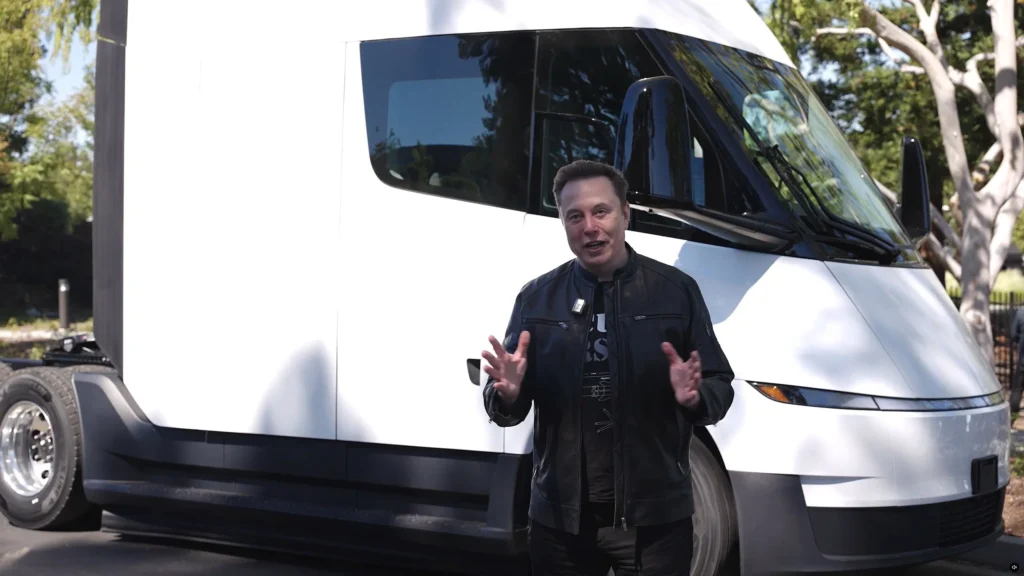
Tesla has launched volume production of its electric Class 8 Semi truck, marking a critical step toward its 2027 commercial rollout in the U.S. and Europe. The company confirmed the milestone in its third-quarter earnings report, revealing an installed annual manufacturing capacity of 25,000 trucks at its Nevada factory.
The Tesla Semi’s top variant delivers a 500-mile range at a full 82,000 lbs gross combination weight, achieving an energy efficiency of 1.7 kWh per mile. According to Tesla CEO Elon Musk, this efficiency allows the truck to consume just one-third of the energy used by a comparable diesel truck for the same payload.
“The top variant can go 500 miles at a full 82,000 lbs gross combination weight while achieving an efficiency of 1.7 kWh/mile. That efficiency allows the Tesla Semi to use a third of the energy used by a comparable diesel truck to haul the same payload. In a transportation market where energy is one of the largest components of total cost per mile, this will provide a meaningful advantage to Tesla Semi operators.”
Elon Musk·Tesla CEO
Performance and efficiency set new benchmarks: Tesla Semi
Despite the production milestone, Tesla did not disclose the number of Semi trucks manufactured or delivered during the quarter, leaving current output rates unclear. The company’s reported capacity also does not necessarily reflect its immediate production volume.
Tesla’s expansion plans for the Semi include a 2027 commercial rollout in the U.S. and entry into the European market.
“What we’re working on right now is lining up customers that are highly interested in experiencing the truck through demonstrations in the first half of next year, with the opportunity then to take delivery, targeting by the end of next year.”
Dan Priestley·Head of Tesla’s Semi program
2027 rollout targets U.S. and European markets
The Semi’s production milestone comes amid mixed financial results for Tesla. The company reported $28.05 billion in third-quarter revenue, nearly unchanged from the $28.1 billion recorded in the same period last year. Adjusted earnings per share declined by 4% year over year to $0.48, while GAAP earnings per share fell 44% to $0.22.
GAAP net income attributable to common stockholders dropped 43% to $787 million, down from $1.37 billion in Q3 2025. Operating income also declined by 56% to $718 million, while operating expenses rose 39% to $4.78 billion. Despite these challenges, Tesla maintained a strong cash position, ending the quarter with $45.45 billion in cash, cash equivalents, and short-term investments.
Tesla’s passenger vehicle segment saw a slight decline, with 464,391 units produced and 486,532 delivered in Q3 2026, a 2% decrease from the previous year. The company also revised its 2026 capital expenditure guidance to approximately $20 billion, reflecting continued investments in manufacturing, artificial intelligence, robotics, and energy infrastructure.
The European Union’s Fit for 55 package and stricter emissions regulations are expected to accelerate the adoption of zero-emission trucks, positioning Tesla as a key player in the transition. However, the company faces competition from established manufacturers like Daimler, Volvo, and Scania, which are also expanding their electric truck offerings.
For the shipping and logistics industries, the Tesla Semi’s arrival could reshape last-mile and regional freight operations. While the truck is not designed for long-distance ocean freight, its efficiency and range make it ideal for port-to-warehouse and intermodal transport. The integration of electric trucks into supply chains could also reduce Scope 3 emissions for shipping companies, aligning with broader sustainability goals.
Tesla’s next steps include scaling production to meet the 2027 rollout targets while ensuring infrastructure readiness. The deployment of Megacharger stalls in Europe will be critical to supporting customer adoption, as will partnerships with logistics providers and fleet operators. The company’s participation in the IAA Transportation conference in Hannover in September 2026 underscored its commitment to engaging with industry stakeholders and showcasing the Semi’s capabilities.
As Tesla prepares for its European market entry, the company will need to navigate regulatory hurdles, charging infrastructure development, and competition from traditional truck manufacturers. The success of the Semi will depend not only on its technological advantages but also on Tesla’s ability to deliver a reliable and cost-effective solution for commercial operators.
However, the company’s ability to meet production targets and scale infrastructure will determine whether the Semi becomes a transformative force in global logistics or a niche offering in a competitive landscape.


Sign up free to ask CAMAL AI for a summary, the key points or anything else about this story.
Related stories
CAMAL AI
 Financial Ports Newsletter
The maritime economy, every morning
Ports, shipping and freight markets in one short email. Free.



