

Einride races to deploy Nvidia’s Alpamayo AI in autonomous trucks by 2027
Swedish firm to adapt Nvidia’s 34-billion-parameter AI model to its fleet, with road tests set for late 2027
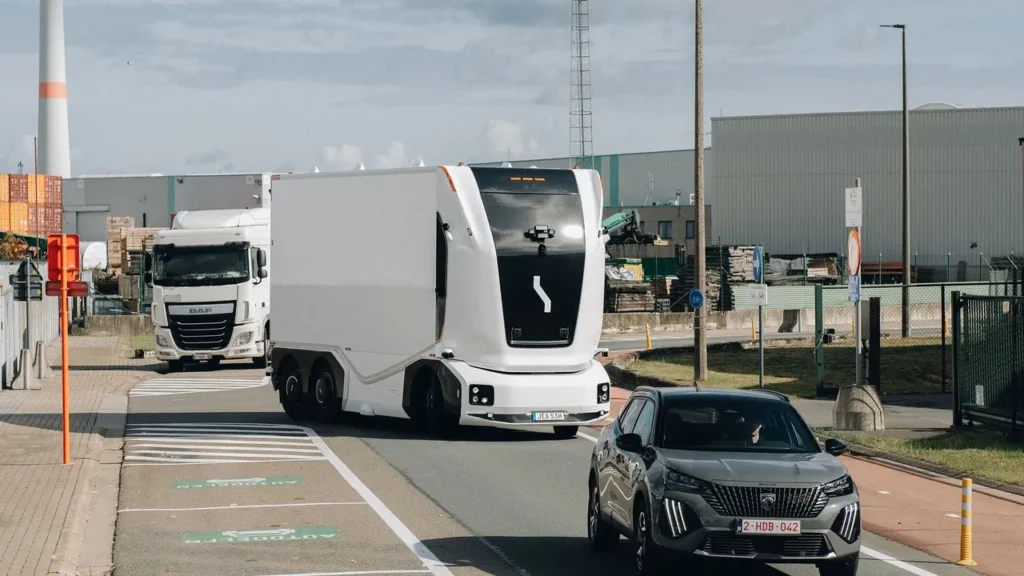
The collaboration, announced this week, extends an existing partnership with Nvidia to build the next generation of Einride’s autonomous platform on Nvidia’s Hyperion architecture. A live road evaluation is scheduled for the second half of 2027.
The model interprets driving environments, proposes vehicle movements, and, crucially, explains the reasoning behind those decisions. Alpamayo 1, a 10-billion-parameter model, uses video input to generate driving trajectories with reasoning traces. Its successor, Alpamayo 2 Super, scales up to 34 billion parameters, designed to be distilled into compact models that run on Nvidia’s DRIVE AGX Thor, the in-vehicle computer at the heart of the Hyperion platform.
For Einride, the appeal lies in Alpamayo’s role as a teacher model. Nvidia describes the Alpamayo models as “large-scale teacher models” that developers fine-tune and distill into smaller, specialised models for their own driving systems. Einride plans to post-train and distill Alpamayo using its proprietary operational data, collected from its fleet of autonomous trucks and freight routes. This process is expected to accelerate the deployment of Einride Driver across new vehicle types and routes, reducing both time and cost.
Henrik Green, Einride’s chief technology officer, emphasised the company’s real-world advantage:
What Alpamayo is built to do matters for autonomous freight: autonomous trucks
“Our advantage has always been running autonomous freight in the real world, for real customers.”
Henrik Green·Chief Technology Officer, Einride
The integration of Alpamayo into Einride’s system will follow a phased approach. Initially, the model will operate in shadow mode, running live alongside Einride’s existing driving planner without taking control of the vehicle. During this phase, Alpamayo’s outputs will be compared against both Einride’s autonomous planner and human driver performance, while the company’s existing safety systems remain in full control. This method allows Einride to evaluate the model’s decision-making in real-world conditions without compromising safety.
Einride’s collaboration with Nvidia is not occurring in isolation. The company is also working with DAF and TNO to integrate its autonomous system into DAF’s electric truck platform. This project, which has been underway throughout 2026, is scheduled to complete software integration and commissioning in 2027.
As of June 30, Einride had logged more than 5,400 driverless hours in contracted customer operations across six autonomous deployments in the U.S. and Europe.
How the adaptation will work, and what comes next
While Einride has positioned itself as the first trucking company to deploy Alpamayo on Hyperion, it is not the only player in the space. PlusAI, another autonomous trucking company, announced in March that it is adapting Alpamayo for heavy-duty Level 4 trucks built on Nvidia’s DRIVE AGX Hyperion platform. PlusAI expects to begin fully driverless commercial operations on factory-built trucks in 2027, the same year Einride targets for its live road evaluation.
The implications of this collaboration extend beyond Einride and Nvidia. The freight industry is under increasing pressure to improve efficiency, reduce emissions, and address driver shortages. Autonomous trucking offers a potential solution, but the technology must prove it can handle the complexities of real-world logistics, from navigating urban environments to managing unpredictable weather and road conditions.
Alpamayo’s reasoning-based approach could be a game-changer, providing transparency into the AI’s decision-making process and building trust among regulators, customers, and the public.
For now, Einride’s focus remains on the technical integration of Alpamayo and the upcoming road evaluation in late 2027. The company has not announced a timeline for commercial deployment, but the exploratory nature of the project suggests that the technology is still in its formative stages. As Einride continues to refine its autonomous system, the freight industry will be watching closely to see whether reasoning-based AI can deliver on its promise to revolutionise logistics.
In the meantime, stakeholders in the freight and logistics sectors should keep an eye on Einride’s progress. The company’s operational data and real-world deployments provide a unique testing ground for Alpamayo, and the outcomes of this collaboration could shape the future of autonomous trucking. For those interested in the technical details, Nvidia’s automotive division offers resources on its Hyperion platform and AI models, while Einride’s website provides updates on its autonomous freight solutions.


Sign up free to ask CAMAL AI for a summary, the key points or anything else about this story.
Related stories
CAMAL AI
 Financial Ports Newsletter
The maritime economy, every morning
Ports, shipping and freight markets in one short email. Free.



