

Autonomous trucks hit 80% growth on Dallas-Houston route
Waabi’s Dallas-Houston freight volume surges over 80% this year.
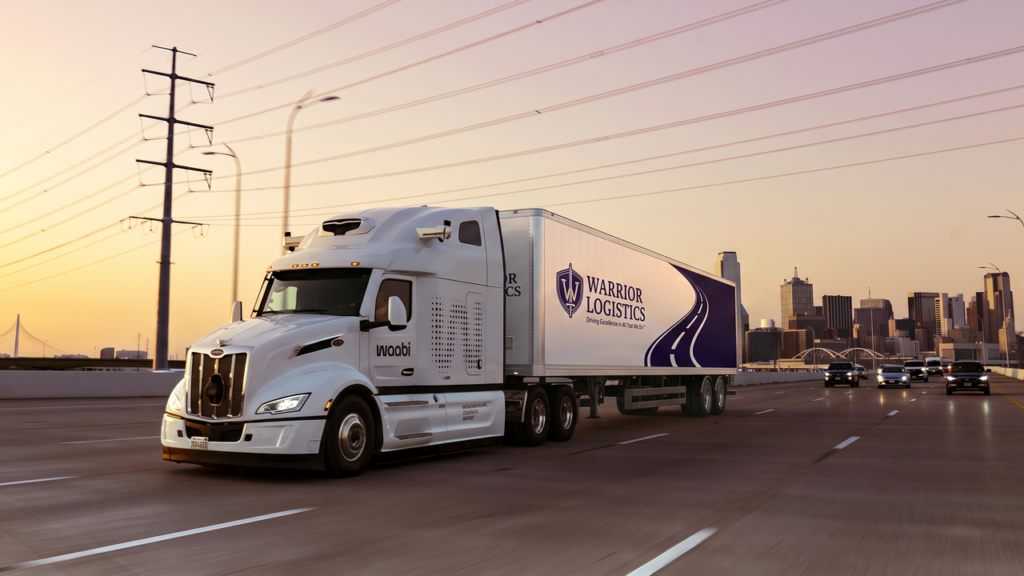
Autonomous trucking startup Waabi has expanded its commercial operations in Texas through a new partnership with Warrior Logistics, an asset-based carrier based in Coppell. The collaboration integrates Waabi’s self-driving technology into Warrior’s fleet to transport routine shipments of food, beverages, and consumer goods between Dallas and Houston.
Since launching commercial routes earlier this year, the autonomous trucks have maintained a perfect record, with 100% on-time pickups and deliveries and zero safety incidents. While neither company disclosed the number of trucks deployed or loads completed, the results have convinced Warrior to adopt the technology as part of its long-term strategy.
Warrior Logistics, which operates more than 200 trucks of its own, will use Waabi’s vehicles to increase capacity and improve fleet utilization. The move comes as customer demand grows, particularly on routes where driver availability is limited. By combining autonomous trucks with its existing workforce, Warrior can meet demand while keeping human drivers on preferred lanes.
Scott McFarlane, CEO of Warrior Logistics, called the partnership a way to deliver consistent capacity to customers. “Waabi’s trucks complement our professional drivers, allowing us to build density on high-demand routes and add capacity where drivers are less inclined to operate,” he said. The hybrid model enables Warrior to handle more freight while maintaining service reliability.
Expanding autonomous freight operations: autonomous trucking
The Warrior partnership follows Waabi’s recent collaboration with Volvo Autonomous Solutions to haul freight for Warp on the same Dallas-Houston corridor. Those operations, which use Volvo VNL Autonomous trucks with an onboard observer, have further demonstrated the technology’s real-world viability.
Waabi’s commercial load volume on the Dallas-Houston route has surged more than 80% this year, though the company did not provide a baseline figure. Its first revenue-generating loads on Interstate 45 began in September 2023, shortly after announcing a 10-year agreement with Uber Freight.
Lior Ron, Waabi’s COO, emphasized the company’s progress in scaling its technology. “Warrior’s input has been instrumental in refining our system, and the results show how autonomous trucks can help carriers expand their business,” he said. Over the next year, the two companies plan to identify additional routes for autonomous deployment across Warrior’s network.
Despite the advancements, Waabi’s trucks still operate with a safety driver. The company has stated it will remove the driver only when the vehicle’s redundant systems meet its safety standards.


Sign up free to ask CAMAL AI for a summary, the key points or anything else about this story.
Related stories
CAMAL AI
 Financial Ports Newsletter
The maritime economy, every morning
Ports, shipping and freight markets in one short email. Free.