

Maersk’s 35m Wind Rotor Could Slash Shipping Emissions by 30%
Maersk to retrofit a 35-metre wind rotor to an 8,700-TEU containership in mid-2027, aiming for 5-30% fuel savings.
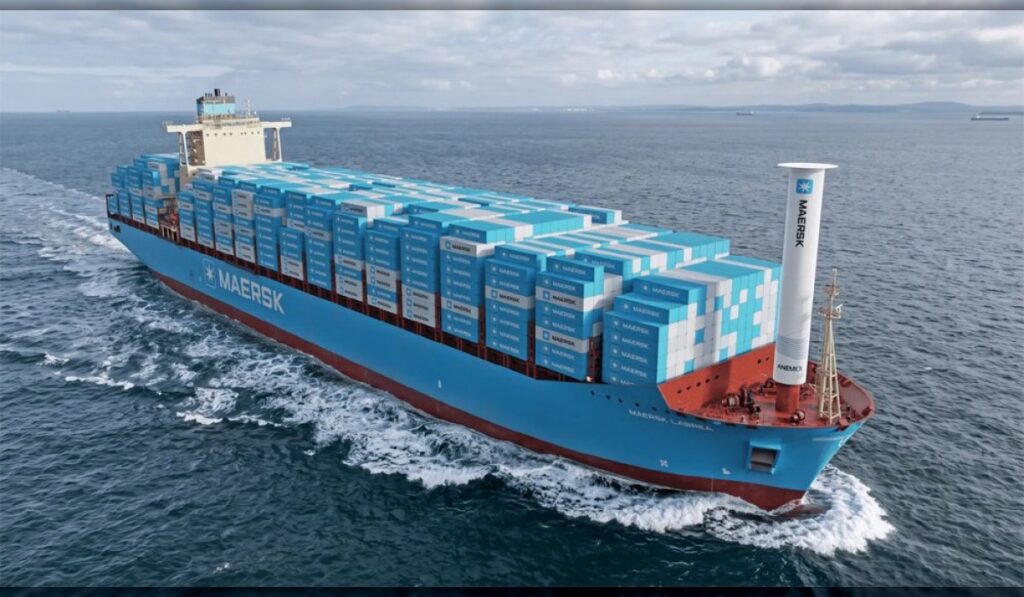
The 35-metre-tall Rotor Sail, developed by British firm Anemoi, will be retrofitted to one of the shipping giant’s 8,700 TEU Lima-class vessels in mid-2027, marking a milestone in wind-assisted propulsion for container shipping.
The decision comes as the maritime industry faces increasing pressure to decarbonise. Maersk’s pilot project with Anemoi aims to assess the feasibility of Rotor Sails on containerships, which have traditionally lagged behind bulkers and tankers in adopting such technology due to deck space constraints.
Containerships have long been considered unsuitable for wind-assisted propulsion because nearly all deck space is occupied by cargo containers. However, Anemoi’s design addresses this challenge by positioning the Rotor Sail near the bow, minimising interference with container handling. The fixed 5-metre-diameter, 35-metre-tall rotor will be integrated alongside existing onboard systems, allowing the vessel to maintain its full cargo capacity while benefiting from wind propulsion.
A.P. Møller-Maersk
Lima class-class vessels, built by South Korea’s Daewoo Shipbuilding & Daewoo Shipbuilding & Marine Engineering (DSME) and delivered from 2011 onwards, were selected for the trial due to their size and operational routes. The test ship is expected to sail on North and South Atlantic voyages, where wind conditions are favourable for the technology. Anemoi’s Rotor Sails can operate in heavy seas and wind speeds of up to 80 mph, making them suitable for a wide range of maritime conditions.
The technology itself is not new, it relies on the Magnus effect, a century-old principle where a spinning cylinder generates aerodynamic lift from wind, producing forward thrust. Anemoi has already installed 29 Rotor Sails on bulkers, ore carriers, and product tankers, with more than 16 additional systems on order. However, this will be the first installation on a containership, a sector where efficiency gains are critical due to high fuel consumption and emissions.
What This Means for the Future of Shipping: Wind
Maersk’s trial is part of a broader industry shift toward decarbonisation. The International Windship Association reports that there are already 110 commercial installations of wind-assisted propulsion on vessels above 400 gross tons, with another 80 to 90 systems on order. The association estimates that as many as 50 more are in the development pipeline, signalling growing confidence in the technology’s potential.
Ole Graa Jakobsen, Head of Fleet Technology at Maersk, emphasised the significance of the project:
“Wind-assisted propulsion is one of several promising maritime solutions with the potential to improve vessel efficiency and reduce emissions. It has already been tested in other parts of the shipping sector, and we see this pilot with Anemoi as a valuable opportunity to build practical experience and assess its relevance for our fleet and for container shipping more broadly.”
Ole Graa Jakobsen·Head of Fleet Technology at Maersk
The potential benefits are substantial. Anemoi estimates that its Rotor Sails can reduce fuel consumption and emissions by 5 to 30 percent, depending on vessel design, route, and wind conditions.
Maersk’s trial will provide critical data on how Rotor Sails perform in real-world conditions, potentially paving the way for wider deployment across the industry.
For example, Ocean Network Express (ONE) is testing a rigid sail housed in a portable container, while an EU-funded research project is evaluating a similar concept. Maersk itself previously tested Norsepower’s competing rotor technology on a product tanker, demonstrating its commitment to exploring innovative solutions.
As the industry moves toward stricter emissions regulations, technologies like Anemoi’s Rotor Sail could play a crucial role in helping shipping companies meet their sustainability targets. The mid-2027 installation on Maersk’s Lima-class vessel will be closely watched by industry stakeholders, as its success could accelerate the adoption of wind-assisted propulsion across the global fleet.
For now, the focus remains on gathering data and assessing the technology’s performance. If the trial proves successful, it could mark a turning point for container shipping, proving that wind power, long considered a relic of the past, may yet have a future in the industry’s decarbonisation efforts.


Sign up free to ask CAMAL AI for a summary, the key points or anything else about this story.
Related stories
CAMAL AI
 Financial Ports Newsletter
The maritime economy, every morning
Ports, shipping and freight markets in one short email. Free.



