

US Navy’s USS Arizona to Carry 40 Missiles
The 184-foot Virginia Payload Module triples missile capacity and introduces hypersonic strike capability to the fleet.
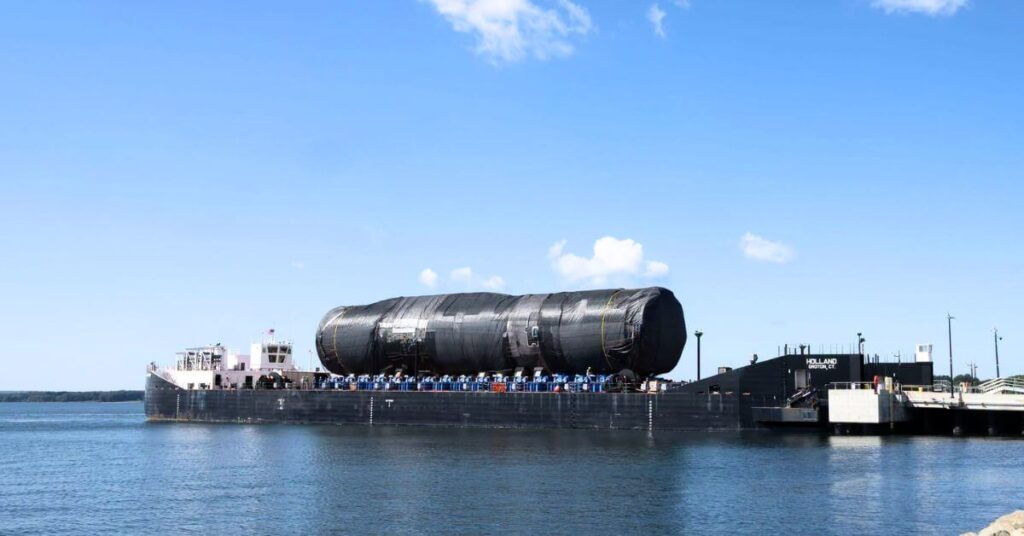
The module contains four large canisters, each capable of holding seven Tomahawk-sized missiles, adding 28 missile slots to the submarine’s existing capacity.
The VPM’s design flexibility allows it to carry more than just Tomahawk cruise missiles.
The US Navy is phasing out four converted Ohio-class submarines, each of which currently carries 154 Tomahawk land-attack cruise missiles. Ohio-class submarines-class boats, originally designed for nuclear deterrence, were repurposed in the early 2000s to provide conventional strike capacity.
The Navy plans to install the VPM on 19 Virginia-class submarines, including 12 Block V and seven Block VI boats, over the next two decades.
What the VPM means for the US Navy’s future operations
The VPM’s introduction aligns with broader efforts to modernise the US submarine fleet.
“The move was the largest Virginia-class section shipment so far.”
Electric Boat·Defence contractor
The USS Arizona is expected to be the second Block V Virginia-class submarine to enter service, following the USS Oklahoma (SSN-802).
The VPM’s ability to carry hypersonic weapons is particularly noteworthy. Hypersonic missiles travel at speeds exceeding Mach 5, making them difficult to intercept and ideal for time-sensitive strikes. The Navy’s Conventional Prompt Strike programme aims to deploy these weapons on both submarines and surface ships, ensuring a layered strike capability across the fleet.
For the US Navy, the VPM represents more than just additional missile capacity, it is a strategic response to evolving threats. As peer competitors develop advanced anti-access/area denial (A2/AD) systems, the ability to launch large salvos of precision-guided missiles from stealthy platforms becomes increasingly vital. The VPM-equipped Virginia-class submarines will play a key role in maintaining the Navy’s edge in contested environments, whether in the Pacific, the Atlantic, or other critical regions.
The USS Arizona’s enhanced firepower will also support joint operations with other branches of the US military. The submarine’s ability to carry both Tomahawk missiles and hypersonic weapons makes it a versatile asset for combatant commanders, capable of conducting strikes, intelligence gathering, and special operations support. The VPM’s modular design allows for future payloads, including unmanned underwater vehicles (UUVs) or other advanced systems, ensuring the submarine remains relevant for decades to come.
The Navy’s investment in the VPM reflects a broader trend toward distributed lethality, dispersing firepower across a larger number of platforms to complicate an adversary’s targeting. By equipping 19 Virginia-class submarines with the VPM, the Navy ensures redundancy and resilience, even if some platforms are unavailable due to maintenance or conflict. This approach aligns with the Pentagon’s emphasis on overmatch, ensuring US forces can outgun and outmanoeuvre potential adversaries in any scenario.
The USS Arizona’s delivery in 2029 will mark the beginning of a new era for the Virginia-class submarine fleet. As the first boat with the VPM, it will set the standard for future upgrades and serve as a testbed for integrating new weapons and sensors. The Navy’s decision to prioritise the VPM underscores its commitment to maintaining a technologically superior submarine force, capable of meeting the challenges of 21st-century warfare.
For defence analysts and industry observers, the VPM’s introduction is a clear signal of the US Navy’s focus on long-range strike capabilities. The ability to launch hypersonic weapons from submarines provides a covert, survivable option for striking high-value targets, while the expanded Tomahawk capacity ensures the fleet can conduct large-scale missile strikes when needed. The VPM-equipped Virginia-class submarines will be a cornerstone of the Navy’s future operations, bridging the gap between the retiring Ohio-class boats and the next generation of undersea platforms.
The USS Arizona’s journey from construction to deployment will be closely watched. As the first submarine to receive the VPM, its performance during operational testing will shape the Navy’s plans for the remaining 18 boats slated for the upgrade. With the VPM, the Virginia-class submarine fleet is poised to remain the world’s most advanced undersea strike force for decades to come.


Sign up free to ask CAMAL AI for a summary, the key points or anything else about this story.
Related stories
CAMAL AI
 Financial Ports Newsletter
The maritime economy, every morning
Ports, shipping and freight markets in one short email. Free.
Financial Ports Newsletter
The maritime economy, every morning
Ports, shipping and freight markets in one short email. Free.