

US Navy to Plug Norfolk Base Into World’s Largest Carrier—Here’s Why
The USS Gerald R. Ford’s nuclear reactors will supply power to Naval Station Norfolk in a first-of-its-kind test this.
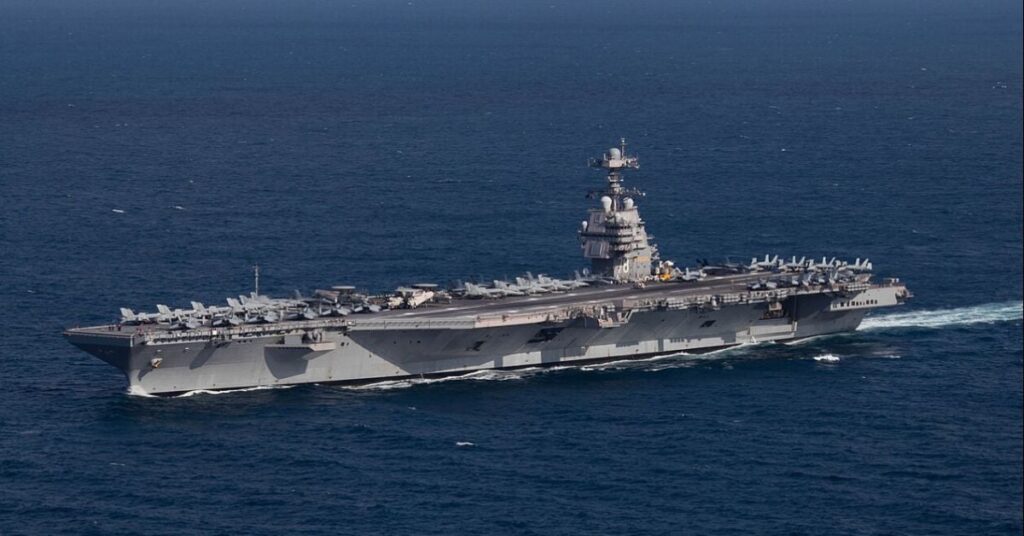
Ford, into a floating power plant this summer, supplying electricity directly to Naval Station Norfolk in a first-of-its-kind test.
The USS Gerald R. Ford, the only active Ford-class carrier, will use its two A1B nuclear reactors to export power to the Virginia base, Navy Secretary Hung Cao confirmed.
Why the US Navy Is Turning a Carrier Into a Power Station
The demonstration is part of a broader Department of Defense effort to ensure energy resilience at military installations.
The carrier’s reactors are part of a new generation of A1B models, which replace the older A4W reactors used in the Nimitz-class carriers.
Chief of Naval Operations Daryl Caudle emphasised the Navy’s unique expertise in reactor physics, suggesting a pilot program modelled after similar initiatives by the Army and Air Force. “A target date should be decided to get the project underway as soon as possible,” he urged during the hearing.
The Broader Context: Energy Resilience in the US Military
Ford’s upcoming test is one of the most ambitious of these projects, given the scale and complexity of an aircraft carrier’s nuclear reactors.
The Defense Innovation Unit, a Pentagon organisation tasked with accelerating the adoption of commercial technology, has also been exploring portable nuclear reactors for forward-operating bases. These efforts align with the Navy’s goal of ensuring that critical infrastructure, such as Naval Station Norfolk, remains operational even when disconnected from the civilian grid. Norfolk, the world’s largest naval base, hosts over 75 ships and 134 aircraft, making it a critical hub for US military operations.
Ford’s reactors are capable of generating enough electricity to power a small city. While the exact output remains classified, the carrier’s two A1B reactors are estimated to produce significantly more power than the A4W reactors used in the Nimitz-class carriers. This surplus capacity makes the Ford-class carriers ideal candidates for emergency power generation, particularly in scenarios where traditional power sources are compromised.
The test at Naval Station Norfolk could pave the way for broader adoption of carrier-generated power. The USS Gerald R. Ford, which returned to Norfolk after sailing in the Ionian Sea during NATO’s Neptune Strike in July 2025, is the first of its class, a fleet designed to replace the ageing Nimitz-class carriers. The Ford-class carriers are not only more advanced in terms of propulsion but also feature state-of-the-art systems for aircraft launch and recovery, further enhancing their operational flexibility.
The second Ford-class carrier, the USS John F. Kennedy (CVN-79), completed acceptance sea trials on August 15, 2026, after four days at sea. Construction on the USS John F. Kennedy began nearly 11 years before its sea trials, reflecting the complexity and scale of building a modern aircraft carrier.
“Over the last few days, the crew of the future USS John F. Kennedy performed incredibly well,” said Capt. Mark Johnson, the program manager for new-construction carriers. Derek Murphy, Newport News Shipbuilding’s Vice President for New-Construction Aircraft Carrier Programs, added, “It is an honour to take Kennedy to sea to demonstrate the quality work and commitment by our shipbuilders.”
If successful, the Norfolk trial could redefine the role of aircraft carriers beyond warfare. The ability to provide emergency power could become a standard feature for future Ford-class carriers, turning these vessels into dual-purpose assets for both defence and disaster response. The Navy has already begun exploring the potential for carriers to supply fresh water to regions affected by drought, leveraging their desalination capabilities to support humanitarian missions.
The implications of the USS Gerald R. Ford’s test extend beyond military logistics. In a world where energy security is increasingly volatile, the trial could signal a new era for nuclear-powered resilience. The Navy’s initiative aligns with global efforts to develop small modular reactors and other advanced nuclear technologies to address climate change and energy instability. For the maritime industry, the successful integration of carrier-generated power could inspire similar innovations in commercial shipping, particularly for vessels operating in remote or disaster-prone regions.
Ford’s upcoming test is not just a technical demonstration but a strategic move to enhance the Navy’s operational resilience. As the military prepares for an era of hybrid threats, the ability to generate power independently could prove critical in maintaining readiness. For the maritime sector, the trial offers a glimpse into the future of nuclear-powered vessels, where energy generation and export become as integral to their mission as defence and combat.
Naval Station Norfolk, the largest naval installation in the world, stands to benefit significantly from the USS Gerald R. Ford’s power generation test. The base, which supports the US Atlantic Fleet, is a critical node in the Navy’s global operations. By demonstrating the ability to draw power from a carrier, the Navy can ensure that Norfolk remains operational even in the event of a grid failure, cyberattack, or natural disaster. This capability is particularly relevant given the base’s location in a region prone to hurricanes and other extreme weather events.
The trial also sets a precedent for other military installations. If successful, the Navy could expand the program to include other Ford-class carriers, such as the USS John F. Kennedy and the USS Enterprise (CVN-80), which is currently under construction.
For the broader maritime industry, the USS Gerald R. Ford’s test could serve as a catalyst for innovation. Nuclear-powered commercial vessels, though rare, have long been discussed as a potential solution for reducing emissions in the shipping sector. The Navy’s success in exporting power from a carrier could reignite interest in nuclear propulsion for commercial ships, particularly for those operating in remote or environmentally sensitive areas.
Ford’s power generation test is scheduled for this summer, with the Navy expected to release preliminary results by the end of 2026. If the trial proves successful, the next step will be to refine the technology and explore opportunities for scaling the initiative. The Navy has already indicated that it plans to conduct additional tests to assess the feasibility of using carriers to support humanitarian missions, such as providing power and water to disaster-stricken regions.
As the world grapples with the challenges of climate change and energy security, the USS Gerald R. Ford’s test could mark a turning point in how nuclear power is harnessed for both military and civilian applications. For the maritime sector, the implications are profound: a future where ships are not just vessels for transport or defence but also mobile power plants capable of supporting communities in times of need.


Sign up free to ask CAMAL AI for a summary, the key points or anything else about this story.
Related stories
CAMAL AI
 Financial Ports Newsletter
The maritime economy, every morning
Ports, shipping and freight markets in one short email. Free.
Financial Ports Newsletter
The maritime economy, every morning
Ports, shipping and freight markets in one short email. Free.



