

US Navy’s Orca XLUUV: 6,500-NM Drone Submarine Redefines Pacific Warfare
The Orca XLUUV completed a 1,000-nautical-mile voyage in the eastern Pacific, proving its long-range autonomy.
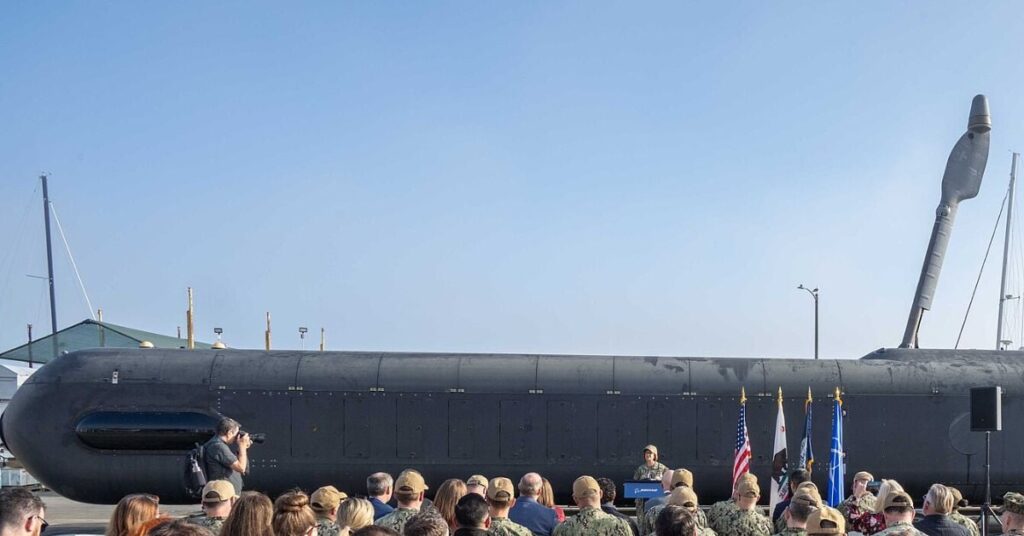
The U.S. Navy has reached a milestone with its Orca Extra Large Uncrewed Undersea Vehicle (XLUUV), the largest drone submarine in its fleet. In July, the vessel completed a voyage exceeding 1,000 nautical miles in the eastern Pacific, marking the first time an XLUUV-class system has covered such a distance. The mission was coordinated with the Program Executive Office for Unmanned Small Combatants, though officials did not disclose the exact route or launch date.
The Orca is built to meet operational demands in the Pacific, where long-range endurance and resilience are critical. With a maximum range of 6,500 nautical miles, the submarine relies on diesel-electric propulsion and surfaces only to recharge its batteries. An 18-kilowatt range extender allows it to prioritize fuel efficiency over battery life, extending mission duration. The platform is equipped for surveillance, mine warfare, reconnaissance, seabed operations, and expeditionary support, aligning with the Pentagon’s push to integrate unmanned systems into carrier strike groups.
Designed for the Pacific Theater: Navy
Navy commanders, including Rear Adm. Marcos Jasso, have discussed using XLUUVs to transport components between submarines and aircraft carriers, reducing the need for manned vessels to surface or return to port. This capability could enhance operational flexibility in contested environments.
Despite its potential, the Orca program faces significant hurdles. A Government Accountability Office (GAO) report revealed that the Navy may not designate the XLUUV as an official program of record, despite eight years of development and an $885 million investment. The initiative, launched in 2017, awarded Boeing a contract to build prototypes in 2019, with the first delivered in 2023. However, technical challenges, including autonomy, battery endurance, and navigation, have caused delays.
Challenges and Uncertainty
The remaining five prototypes are now expected by the end of 2026, a three-month delay from earlier projections. Additionally, modifying the Orca’s payloads requires the Navy to pay Boeing for proprietary software adjustments, raising concerns about long-term adaptability. While officials emphasize the platform’s modular design, these limitations could impact its future viability.
The Orca’s recent achievements underscore the Navy’s growing reliance on unmanned systems to address evolving threats in the Pacific, even as the program’s path forward remains uncertain.


Sign up free to ask CAMAL AI for a summary, the key points or anything else about this story.
Related stories
CAMAL AI
 Financial Ports Newsletter
The maritime economy, every morning
Ports, shipping and freight markets in one short email. Free.



