

US Navy Deploys AI to Stop Warship Collisions Before They Happen
Five Arleigh Burke-class destroyers will receive a $25m AI perception system to automate real-time vessel tracking and.
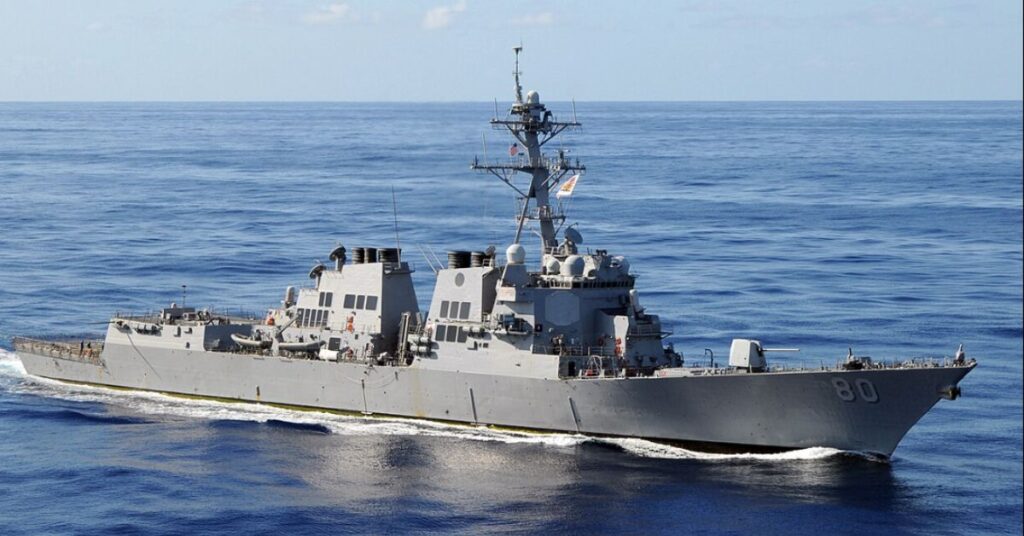
The U.S. Navy has awarded Applied Intuition a $25 million contract to equip five Arleigh Burke-class destroyers with an artificial intelligence system designed to prevent collisions at sea. The Intelligent Perception System (IPS) will fuse data from infrared sensors, cameras, and navigation feeds to automatically detect and track vessels in real time, reducing the risk of human error.
The IPS, developed by Applied Intuition, operates similarly to advanced driver-assistance systems in modern vehicles but is tailored for naval operations. The system integrates the company’s Acuity Perception Platform, which processes inputs from a destroyer’s onboard sensors, including infrared cameras, navigation feeds, and radar. By converging these data streams into a single software interface, IPS generates visual overlays that display detected vessels, their classifications, and predicted movement trajectories.
One of the system’s key features is its ability to alert the watch officer and crew if a nearby ship enters a dangerous course that could lead to a collision. This real-time monitoring is expected to mitigate risks associated with human factors such as fatigue, negligence, or blind spots, issues that contributed to high-profile incidents like the 2017 collisions involving the USS Fitzgerald and USS John S. McCain.
Beyond collision avoidance, IPS logs vessel sightings in a digital format, replacing manual bridge logs with machine-readable records. This capability enables faster analysis of maritime traffic patterns and more efficient sharing of intelligence across the fleet.
How the AI System Works on Warships: Navy
The IPS program leverages operational edge computing, meaning the system processes data and makes decisions onboard the vessel without relying on continuous cloud connectivity. Applied Intuition supplies both the hardware, including cameras, sensors, and computer stacks, and the software suite, which is designed to integrate seamlessly with older destroyers without requiring structural modifications. This adaptability is a significant advantage, as it allows the Navy to modernize its fleet without costly overhauls.
The system’s onboard Data Engine plays a crucial role in managing satellite bandwidth. When conditions permit, it transfers sensor and camera data to shore stations, where the information is used to train and refine machine learning models. These updated models can then be deployed to warships via software updates, ensuring the Navy can rapidly adapt to emerging threats or evolving operational requirements.
This iterative process is part of a broader effort to create a maritime data pipeline, building on the Navy’s Data Edge Collection Kit (DECK) trial, which gathered thousands of hours of ship videos to train the AI models.
The rollout of IPS is being overseen by the Navy’s DPRM Robotic and DPRM Robotic and Autonomous Systems and PAE Mission Systems, which are also exploring how to scale the software across both manned and unmanned naval platforms. The contract marks a shift from testing to real-world deployment, reflecting the Navy’s confidence in AI-driven systems to enhance operational safety and effectiveness.
The Technology Behind the Deployment
For naval personnel, the introduction of IPS represents a significant reduction in workload. Previously, sailors had to manually cross-check data from multiple systems, such as radar projections and camera feeds, and record sightings by hand in bridge logs. IPS automates these tasks, allowing crews to focus on higher-level decision-making and operational readiness. The system’s ability to generate digital records also enhances the Navy’s ability to conduct post-mission analysis and share intelligence with allied forces.
The $25 million contract builds on the success of the DECK prototyping program, which Applied Intuition delivered to the Navy in March. DECK collected thousands of hours of ship video footage, providing the foundational data needed to train the AI models used in IPS. This prototyping phase was critical in demonstrating the system’s viability and refining its capabilities before full-scale deployment.
As the Navy continues to modernize its fleet, the integration of AI-driven systems like IPS is likely to become increasingly common. The ability to process vast amounts of data in real time and make split-second decisions could prove decisive in future naval engagements, particularly in environments where traditional human oversight may be insufficient. For now, the focus remains on enhancing safety and operational efficiency, but the long-term implications for naval warfare are profound.
The U.S. Navy’s investment in AI reflects a broader trend across global defence forces, where autonomous systems are being adopted to augment human capabilities. While the technology is still in its early stages of deployment, the success of programs like IPS could accelerate the integration of AI into other aspects of naval operations, from logistics to combat systems.
For the sailors serving on Arleigh Burke-class destroyers, the arrival of IPS promises to make their jobs safer and more efficient, while also positioning the Navy at the forefront of technological innovation in maritime defence.


Sign up free to ask CAMAL AI for a summary, the key points or anything else about this story.
Related stories
CAMAL AI
 Financial Ports Newsletter
The maritime economy, every morning
Ports, shipping and freight markets in one short email. Free.



