

US Navy Carrier Mishap Injures Four: What Went Wrong Off Virginia?
Two aviators ejected during recovery operations on the USS Dwight D. Eisenhower, leaving four sailors injured.
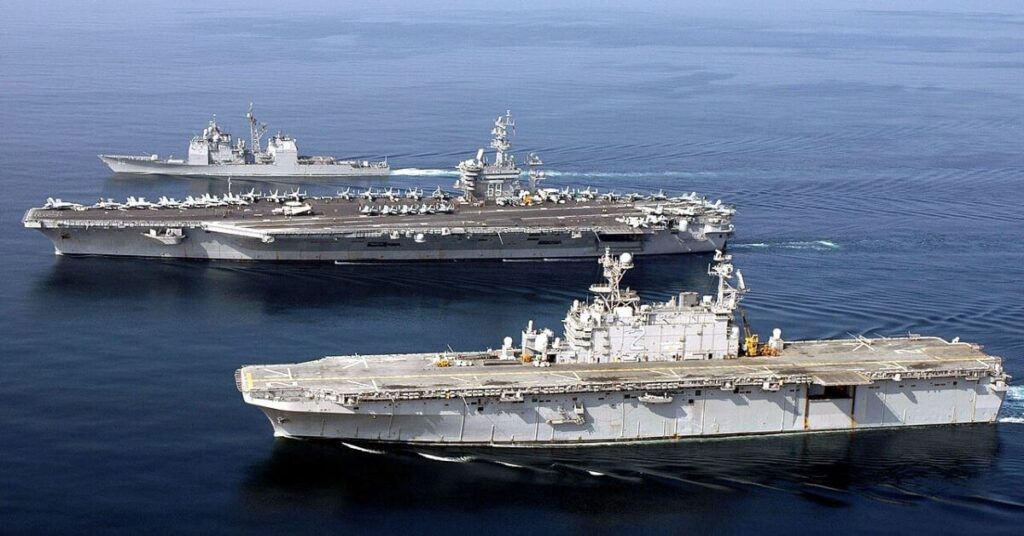
A US Navy aircraft mishap aboard the USS Dwight D. Eisenhower off the Virginia coast left four sailors injured and two aviators ejecting from their aircraft during landing operations on September 28. The incident, described as a “mishap” by the Navy, occurred at 6:18 p.m. EDT, though the cause remains undisclosed.
The two aviators, assigned to Carrier Air Wing 3 (CVW-3), were promptly recovered by search-and-rescue personnel and taken for medical checks. Four sailors aboard the Nimitz-class carrier were also injured, one was transported to a Norfolk-area hospital with non-life-threatening injuries, while the other three received treatment on the ship. The Navy has not identified the aircraft involved, though the USS Dwight D. Eisenhower typically operates F/A-18 Super Hornets and EA-18G Growlers, both of which carry two crew members.
What Happened During the USS Dwight D. Eisenhower Incident?: US Navy
The USS Dwight D. Eisenhower, a nuclear-powered Nimitz-class aircraft carrier commissioned in 1977, was conducting aircraft recovery operations when the incident occurred.
The Navy has not provided details on what caused the aviators to eject or the fate of the aircraft post-incident. However, the carrier’s crew, trained for emergencies, responded swiftly to the situation.
The statement also noted that carrier crews regularly train for emergencies, which enabled a rapid and safe response.
The incident comes just months after another US Navy aviation accident in May, where two EA-18G Growlers collided during an aerial demonstration at Mountain Home Air Force Base in Idaho. Both aircraft, valued at approximately $67 million each, crashed after the collision, though all four crew members ejected safely.
The USS Dwight D. Eisenhower’s recent operational history highlights its role in global security.
Why Aircraft Ejections Are High-Risk Operations
Ejecting from an aircraft, particularly at high speeds, carries significant risks. The ejection process involves explosive charges that propel the crew seats clear of the aircraft, subjecting aviators to extreme gravitational forces. Former TOPGUN pilot Matthew “Whiz” Buckley told Fox News Digital that such manoeuvres can result in serious injuries, including spinal damage.
Buckley noted that some pilots he knew had suffered spinal injuries after ejection, leaving them several inches shorter. Despite these risks, modern ejection seats, such as those used in the F/A-18 Super Hornet and EA-18G Growler, are designed to minimise injury through advanced restraint systems and controlled seat trajectories.
The Navy confirmed that all personnel involved in the September 28 incident are expected to recover fully. The US Navy’s aviation safety programmes, including the Naval Safety Command, investigate such incidents to identify systemic risks and implement corrective measures.
The USS Dwight D. Eisenhower recently completed a 15-month maintenance and repair period in April and was conducting carrier qualifications off the Virginia coast as recently as late August. These qualifications, known as carrier qualifications (CQ), are essential for pilots to maintain proficiency in landing on moving carriers. The process involves multiple touch-and-go landings, often in varying sea and weather conditions, to simulate real-world operational scenarios.
The carrier, one of the US Navy’s most advanced warships, plays a critical role in global operations. As a Nimitz-class vessel, it is powered by two nuclear reactors, allowing it to operate for decades without refuelling. This capability enables extended deployments, such as its recent missions in the Middle East and Mediterranean, where it provided air support, conducted surveillance, and projected naval power.
The USS Dwight D. Eisenhower’s air wing, CVW-3, typically includes a mix of F/A-18 Super Hornets for air superiority and EA-18G Growlers for electronic warfare, making it a versatile asset for both combat and deterrence missions.
While the Navy has not released further details on the cause of the mishap, investigations are likely underway to determine whether mechanical failure, human error, or environmental factors contributed to the incident. The US Navy’s standard procedure for aviation mishaps involves a multi-tiered investigation, including flight data analysis, witness statements, and mechanical inspections. Findings from such inquiries are often used to update training protocols and equipment standards to prevent future incidents.
The service has a history of transparency in such cases, though sensitive operational details may remain classified. For example, the Navy typically releases preliminary findings within days of an incident but may withhold specific technical details to protect national security. Public updates are usually shared via official channels, including the Navy’s website and social media platforms, ensuring stakeholders and the public remain informed.
For now, the focus remains on the recovery of the injured personnel and ensuring the safety of future flight operations aboard the USS Dwight D. Eisenhower. The Navy has not indicated whether the incident will delay the carrier’s scheduled deployments, but further updates are expected in the coming days. Families of the injured personnel have been notified, and the Navy’s Fleet and Family Support Programme is providing assistance to those affected.
The USS Dwight D. Eisenhower’s next operational milestones may include further training exercises or deployment preparations, depending on the outcome of the investigation. The carrier’s role in maintaining maritime security, particularly in volatile regions like the Middle East, underscores the importance of resolving such incidents swiftly to minimise disruptions to naval operations. For the latest updates, stakeholders can monitor official US Navy communications, including press releases and statements from the Department of Defense.


Sign up free to ask CAMAL AI for a summary, the key points or anything else about this story.
Related stories
CAMAL AI
 Financial Ports Newsletter
The maritime economy, every morning
Ports, shipping and freight markets in one short email. Free.
Financial Ports Newsletter
The maritime economy, every morning
Ports, shipping and freight markets in one short email. Free.



