

300 Days at War: USS Frank E. Petersen’s Record-Breaking Return to Hawaii
The Arleigh Burke-class destroyer covered 85,000 nautical miles and warded off over 100 Iranian missiles during its.
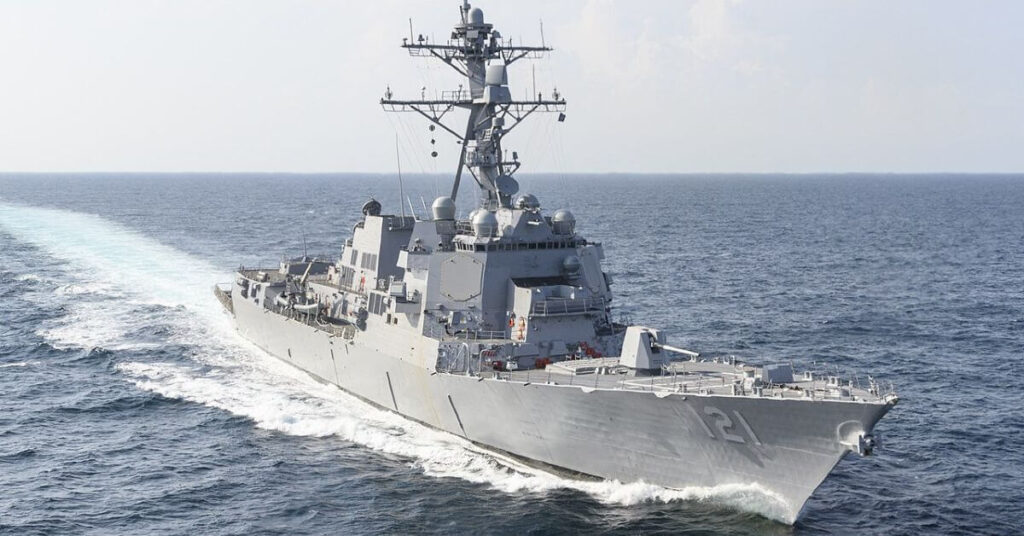
The U.S. Navy’s Arleigh Burke-class guided-missile destroyer USS Frank E. Petersen Jr.
The ship, commanded by Capt. Its mission took it from the contested waters of the South China Sea to the high-stakes theatre of the Middle East, where it played a pivotal role in Operation Epic Fury, the U.S.
From Deterrence to Combat: A Deployment Like No Other: USS Frank
The USS Frank E. Petersen Jr. was not just another vessel on routine patrol. As part of the Abraham Lincoln Carrier Strike Group, it served as the Integrated Air and Missile Defense commander, a role that placed it at the forefront of some of the most critical operations in the region.
In late January, the carrier strike group was redirected from its original mission in the South China Sea to the U.S. The group, which included the aircraft carrier USS Abraham Lincoln, the destroyers USS Spruance and USS Michael Murphy, and more than 70 fixed-wing and rotary-wing aircraft, was tasked with supporting maritime security and stability in the Middle East.
Mahon later reflected on the intensity of the mission, stating, “We made sure that we kept dozens of ships safe against a variety of different attacks, missile attacks, drone attacks.".
The Human Cost of Prolonged Deployment
While the USS Frank E. Petersen Jr.
Capt. He described the measures taken to support the crew’s mental well-being, including unconventional outlets like a meme wall on board the ship, where sailors could express their feelings through humour. “One of the things we did is really making sure people had a chance to express themselves. … So we had a meme wall on board the ship where people could put up memes to talk about how their feelings were. And you know, some of them, they’re edgy memes. But that’s the kind of thing you have to do. … And again, when you have those outlets, that’s how we help get through it.".
The ship’s deployment was not without its logistical challenges. The USS Frank E. Petersen Jr. conducted 45 replenishments-at-sea, transferring more than 7.5 million gallons of F-76 fuel and 175,000 gallons of JP-5 fuel. Its crew also completed 1,094 hours of flight quarters, a critical component of the ship’s air defence operations. Despite the demands, the destroyer maintained its operational readiness, even setting a record for the longest stretch at sea between port calls, 106 days.
The ship made port calls at Guam, Duqm in Oman, Diego Garcia in the British Indian Ocean Territory, and Sriracha in Thailand, offering brief respite to its crew before returning to the fray. One of its most notable achievements came in April, when it became the first vessel to transit the Strait of Hormuz as part of the largest naval blockade in decades. The operation, which included mine-detection efforts, was critical in ensuring the waterway remained open to maritime traffic, a lifeline for global commerce.
The USS Frank E. Petersen Jr.’s return to Hawaii marks the end of a deployment that tested the limits of both the ship and its crew. Yet, as Capt. Mahon noted, the experience also highlighted the resilience and adaptability of the U.S. Navy. “Obviously there was stress we had to face when we did that…on the sea, under the sea, and in the air,” he said. “But we got through it.”


Sign up free to ask CAMAL AI for a summary, the key points or anything else about this story.
Related stories
CAMAL AI
 Financial Ports Newsletter
The maritime economy, every morning
Ports, shipping and freight markets in one short email. Free.
Financial Ports Newsletter
The maritime economy, every morning
Ports, shipping and freight markets in one short email. Free.