

Iran Strikes 3 Tankers in 48 Hours: Two Indian Crew Missing After Drone Hit
US forces disabled a bulk carrier attempting to breach Iran’s blockade as tensions escalate in the Strait of Hormuz.
Iran’s Islamic Revolutionary Guard Corps (IRGC) launched a series of attacks on three tankers near Oman and the Strait of Hormuz over the weekend, as US forces simultaneously disabled a bulk carrier attempting to violate Washington’s naval blockade of Iranian ports.
The first incident occurred on October 10, when the Marshall Islands-flagged Suezmax tanker Valthera was struck by an unknown projectile while exiting the Strait of Hormuz. The strike ignited a fire on board, though all crew members were reported safe. Maritime security firm Vanguard Tech identified the vessel and confirmed that the master had requested assistance to extinguish the blaze.
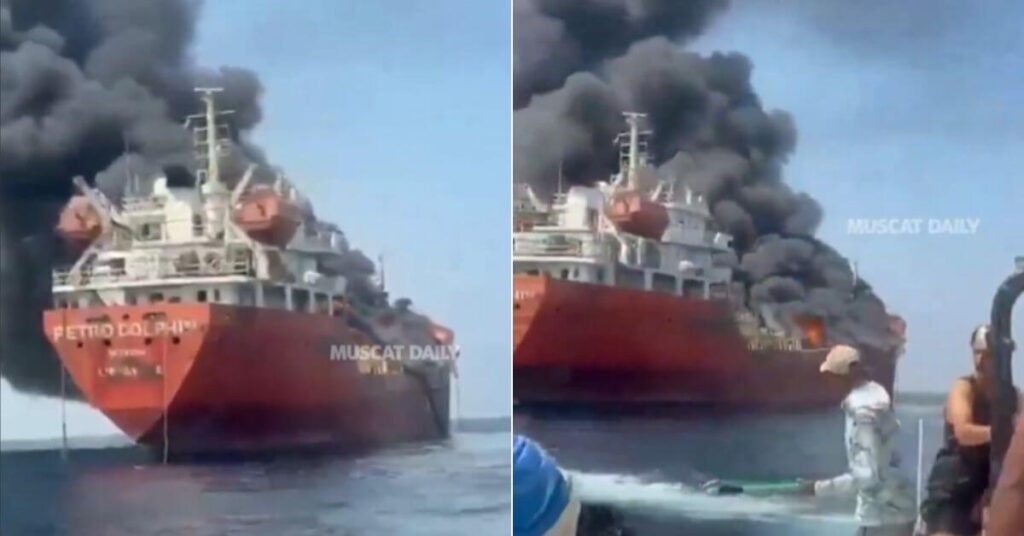
The following day, the UK Maritime Trade Operations (UKMTO) reported that an outbound tanker, later identified as the very large crude carrier (VLCC) Angola Prosperity, was hit by an unidentified projectile on its port side while transiting the strait. Hours later, UKMTO confirmed that an unidentified vessel had been struck by an uncrewed aerial vehicle (UAV) near the Sohar anchorage off Oman. The MT Petro Dolphin, a Nicaragua-flagged tanker carrying 11 crew members, was hit in the attack, which left two Indian seafarers missing.
Brent Crude
The Forward Seamen’s Union of India (FSUI) shared a video showing the tanker engulfed in thick smoke, with flames visible at the bow. The Indian Embassy in Muscat later confirmed that nine of the 11 Indian seafarers aboard had been rescued, while two remained unaccounted for. The embassy is coordinating with local authorities to locate the missing crew members.
Iran’s IRGC claimed responsibility for a separate incident, stating that a supertanker had caught fire after hitting one of its naval mines in the Strait of Hormuz. The IRGC alleged that the vessel had entered a designated high-risk area before the explosion, a claim that could not be independently verified. The statement, carried by Iran’s Fars news agency, added to the growing uncertainty surrounding the weekend’s attacks.
The tanker attacks coincided with a decisive US military operation in the Gulf of Oman. On October 10, US Central Command (CENTCOM) forces disabled the Panama-flagged bulk carrier Ocean Molica, also known as the Arika Sun, after its crew ignored repeated warnings and attempted to breach the US naval blockade of Iranian ports. A US fighter jet struck the stern of the vessel with a precision munition, disabling its propulsion system without causing injuries to the crew.
Since its enforcement, US forces have disabled four commercial vessels and turned back 135 ships attempting to enter or leave Iranian ports. Additionally, the US has destroyed 10 tankers linked to the IRGC’s alleged multibillion-dollar shadow network, which Washington accuses of financing illicit activities through oil smuggling and other means.
The blockade has had far-reaching implications for global shipping, particularly for vessels transporting crude oil, liquefied natural gas (LNG), and other energy commodities. The Strait of Hormuz, a critical artery for the world’s energy supply, has seen increased military patrols, heightened security advisories, and a surge in incidents involving commercial vessels. The US has urged mariners to exercise extreme caution, monitor Notice to Mariners broadcasts, and maintain contact with naval forces on bridge-to-bridge channel 16 when operating in the region.
In a separate development, the UAE National Guard Command reported that its coastguard personnel rescued 22 Asian citizens from an oil tanker in the Arabian Gulf on October 10. The cause of the fire aboard the tanker remains unclear, though the incident underscores the heightened risks faced by vessels operating in the region. Meanwhile, shipmasters near Ras Al Khaimah in the UAE received radio messages instructing them to leave anchorages, though the sender of the messages has not been identified.
What This Means for Global Shipping and Energy Markets: Two Indian
The weekend’s attacks and the US military’s response highlight the growing instability in one of the world’s most vital maritime corridors. The Strait of Hormuz, a 21-mile-wide waterway separating Iran from Oman and the UAE, is a linchpin for global energy security.
The recent escalation has sent ripples through global energy markets, with analysts warning of potential disruptions to oil and gas supplies. The attacks on commercial vessels, coupled with the US blockade, have raised concerns about the safety of maritime routes and the potential for further escalation. Shipping companies are increasingly wary of operating in the region, with some opting to reroute vessels or impose additional security measures, such as armed guards and enhanced surveillance.
For seafarers, the risks are particularly acute. The disappearance of the two Indian crew members from the MT Petro Dolphin serves as a stark reminder of the dangers faced by those working in conflict zones. The Forward Seamen’s Union of India has called for greater protections for seafarers operating in high-risk areas, including enhanced safety protocols and improved coordination with local authorities.
As tensions continue to simmer, the international community is closely monitoring developments in the region. The UKMTO and other maritime security organisations have issued advisories urging vessels to exercise extreme caution and remain vigilant while transiting the Strait of Hormuz and surrounding waters. The US has reiterated its commitment to enforcing the blockade and protecting freedom of navigation, while Iran has vowed to defend its interests in the region, setting the stage for a protracted standoff with significant implications for global trade and energy security.
Looking ahead, the situation remains fluid, with the potential for further incidents in the coming weeks. Shipping companies, energy traders, and governments are bracing for the possibility of additional disruptions, while seafarers and their families await news of the two missing Indian crew members. The Strait of Hormuz, long a flashpoint for geopolitical tensions, shows no signs of stabilising, leaving the world to navigate the uncertain waters of a conflict with no clear resolution in sight.


Sign up free to ask CAMAL AI for a summary, the key points or anything else about this story.
Related stories
CAMAL AI
 Financial Ports Newsletter
The maritime economy, every morning
Ports, shipping and freight markets in one short email. Free.



