

China ports overtake Singapore as Hormuz war reshapes global trade routes
Ningbo-Zhoushan handled 22.9 million TEUs in H1 2026, outpacing Singapore by 158,310 TEUs.
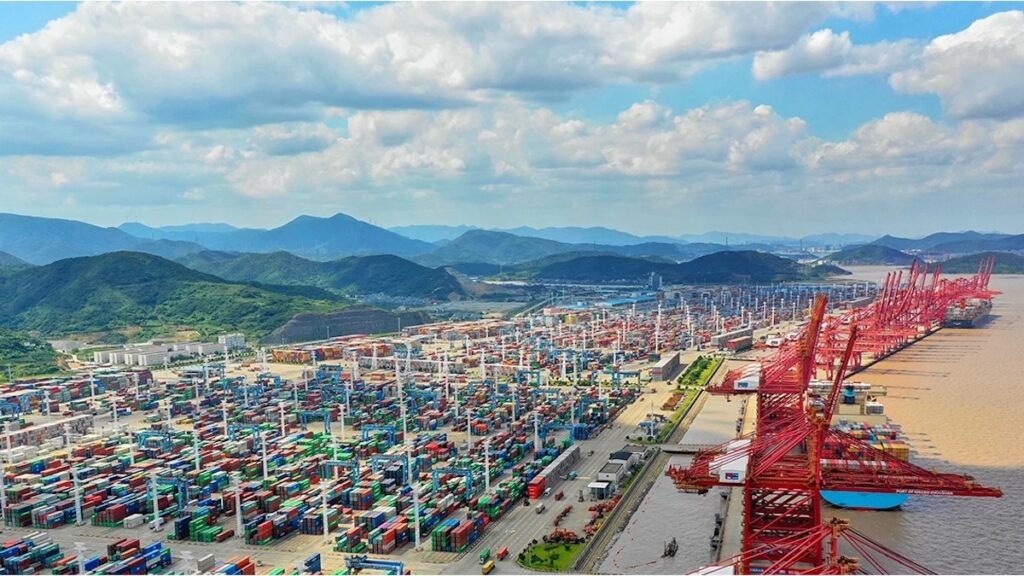
China’s Ningbo-Zhoushan has unseated Singapore as the world’s second-busiest container port, handling 22.9 million TEUs in the first half of 2026, a margin of just 158,310 boxes, while Dubai’s Jebel Ali plummeted from 10th to 32nd after its throughput collapsed by more than 90% amid chaos around the Strait of Hormuz.
Shanghai retained its top spot, processing 28.7 million TEUs, a 6.2% year-on-year increase, according to data from Alphaliner. Meanwhile, Singapore’s throughput rose 4.7% to 22.7 million TEUs, leaving it narrowly behind its Chinese rival.
The most dramatic fall came from Jebel Ali, Dubai’s flagship port, which saw its throughput crash from 7.77 million TEUs in the first half of 2025 to just 3.14 million in the same period of 2026. The decline accelerated in Q2, when volumes plunged over 90% year-on-year to 374,000 TEUs, dragging the port from 10th to 32nd in global rankings. Abu Dhabi’s Khalifa port fared little better, suffering an estimated 50% drop and falling out of the top 50.
Though the waterway partially reopened in June, instability persisted, forcing carriers to reduce or alter calls in the Persian Gulf. The disruption was part of a broader rerouting trend that began in 2025, as vessels avoided the Red Sea and instead sailed around Africa’s Cape of Good Hope, boosting ports like Singapore, Tanjung Pelepas, and Colombo.
China’s dominance in the rankings is unmistakable. Six of the world’s top 10 container ports in H1 2026 were Chinese, with Shenzhen, Qingdao, Guangzhou, and Tianjin occupying fourth through seventh places. Busan (South Korea) ranked eighth, followed by the combined Los Angeles-Long Beach gateway, the only non-Asian port in the top 10, and Malaysia’s Port Klang, which rounded out the list.
The reshuffling reflects broader geopolitical and economic pressures. Tanjung Pelepas, Malaysia’s fastest-growing port, saw throughput surge 14.5% in 2025, climbing from 16th to 13th place. Singapore, though narrowly overtaken by Ningbo-Zhoushan, still grew 8.6% last year, while Colombo’s volumes rose 6.5%.
Other ports also made gains. Colombo climbed from 26th to 20th in H1 2026, India’s Nhava Sheva rose from 28th to 21st, and Jakarta advanced from 27th to 23rd.
The global container port sector grew 5.2% in 2025, outpacing the broader container trade’s 4.7% expansion. The discrepancy stems from rerouting and network disruptions, which forced additional handling as cargo was transferred through alternative hubs.
Meanwhile, China’s relentless expansion shows no signs of slowing, with Ningbo-Zhoushan’s rise signalling a potential long-term shift in the hierarchy of global trade.
As the industry braces for further disruptions, one question looms: will Singapore reclaim its second-place position in the second half of 2026, or has Ningbo-Zhoushan permanently redrawn the map of global shipping?


Sign up free to ask CAMAL AI for a summary, the key points or anything else about this story.
Related stories
CAMAL AI
 Financial Ports Newsletter
The maritime economy, every morning
Ports, shipping and freight markets in one short email. Free.
Financial Ports Newsletter
The maritime economy, every morning
Ports, shipping and freight markets in one short email. Free.