

Three Containers Lost Overboard at Port of Los Angeles—What Went Wrong?
Two submerged containers were marked and recovered after a cargo operation mishap at Berth 302 on Monday.
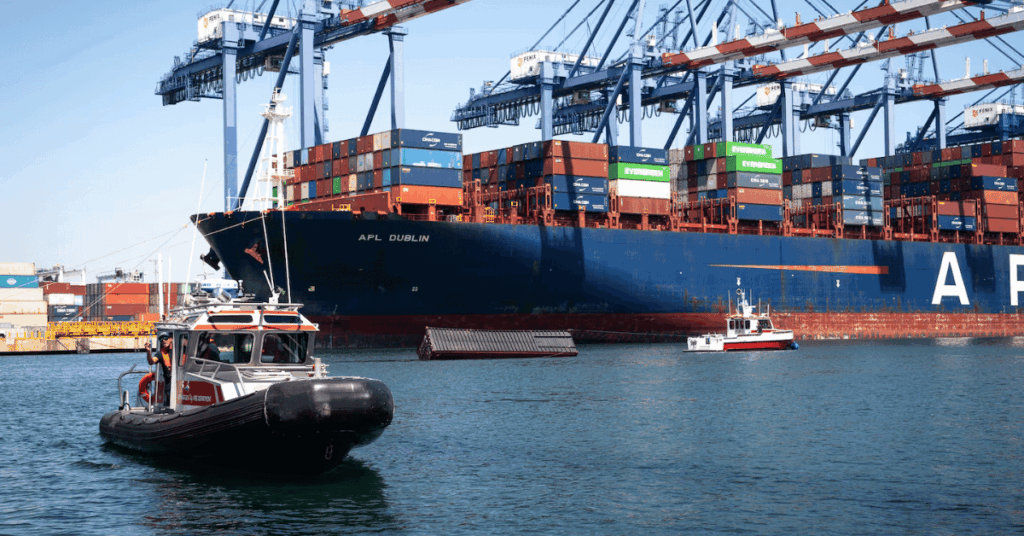
Three 40-foot containers tumbled into the waters of the Port of Los Angeles near Berth 302 on Monday, prompting a swift response from the U.S. Coast Guard and local authorities.
The U.S. Coast Guard Sector Los Angeles-Long Beach was alerted to the incident at approximately 11:20 a.m., deploying Station Los Angeles Long Beach to establish a 400-yard safety zone around the affected area. By 10 p.m. on Monday, salvage teams had recovered one of the containers, while the remaining two, which had sunk, were marked for subsequent recovery. Commercial salvage personnel worked through the night, successfully retrieving the submerged containers by 8 a.m. Tuesday.
According to the ship’s manifest, the contents of all three containers were listed as non-hazardous, alleviating immediate environmental concerns. However, the incident has reignited discussions about the recurring issue of container stability during cargo operations in the region. The Port of Los Angeles, a critical hub for global trade, handles millions of containers annually, and even minor disruptions can have cascading effects on supply chains.
The fall of the three containers near Berth 302 is not an isolated event.
These incidents have prompted calls for a comprehensive review of container-securing practices and the implementation of stricter regulatory oversight.
What happens next: Regulatory and operational implications: port of los angeles
The recovery of the three containers at Berth 302 was a coordinated effort involving the U.S. Coast Guard, Los Angeles Port Police, Los Angeles City Fire, and commercial salvage teams. U.S. Coast Guard Capt. Jarrod DeWitz praised the collaboration, stating,
“The safe recovery of these containers and reopening of the waterway was a direct result of the coordination and professionalism of everyone involved. We appreciate the efforts of our local partners, divers and salvage personnel who worked together to safely resolve the incident and minimize impacts to port operations.”
Jarrod DeWitz·Captain, U.S. Coast Guard
However, the incident has also highlighted the need for systemic changes. Since January 1, new International Maritime Organization (IMO) regulations have required immediate reporting of lost or drifting containers. These rules aim to improve transparency and enable faster responses to such incidents, but their effectiveness depends on strict compliance from all stakeholders. The National Transportation Safety Board (NTSB) is likely to investigate the cause of Monday’s incident, which could lead to further recommendations for enhancing safety protocols.
For the Port of Los Angeles, the incident serves as a reminder of the challenges posed by its role as a global trade gateway. The port, which handles nearly eliminar ‘nearly 10 million TEU’ (twenty-foot equivalent units) annually, operates at near-full capacity, with little margin for error.
The recurring container falls underscore the need for investment in both infrastructure and technology to mitigate risks. Terminal operators like Fenix Marine Services may need to revisit their operational procedures, including the use of advanced securing systems and real-time monitoring of container stacks.
For stakeholders in the maritime industry, the incident is a call to action. Shipping lines, terminal operators, and regulatory bodies must work together to address the root causes of container falls, from inadequate securing practices to communication gaps. The Port of Los Angeles, as a leader in global trade, has an opportunity to set new standards for safety and efficiency, ensuring that incidents like this become a thing of the past.
As the investigation into Monday’s incident continues, the focus will shift to preventive measures. The maritime community will be watching closely to see whether the lessons learned from San Pedro Bay’s troubled waters will lead to meaningful change or whether the cycle of container falls will persist, with potentially far-reaching consequences for global supply chains.


Sign up free to ask CAMAL AI for a summary, the key points or anything else about this story.
Related stories
CAMAL AI
 Financial Ports Newsletter
The maritime economy, every morning
Ports, shipping and freight markets in one short email. Free.
Financial Ports Newsletter
The maritime economy, every morning
Ports, shipping and freight markets in one short email. Free.