

Los Angeles Port Cuts Emissions Per TEU to Record Low in 2025
The port reduced diesel particulate matter by 90% since 2005 while handling 37% more containers.
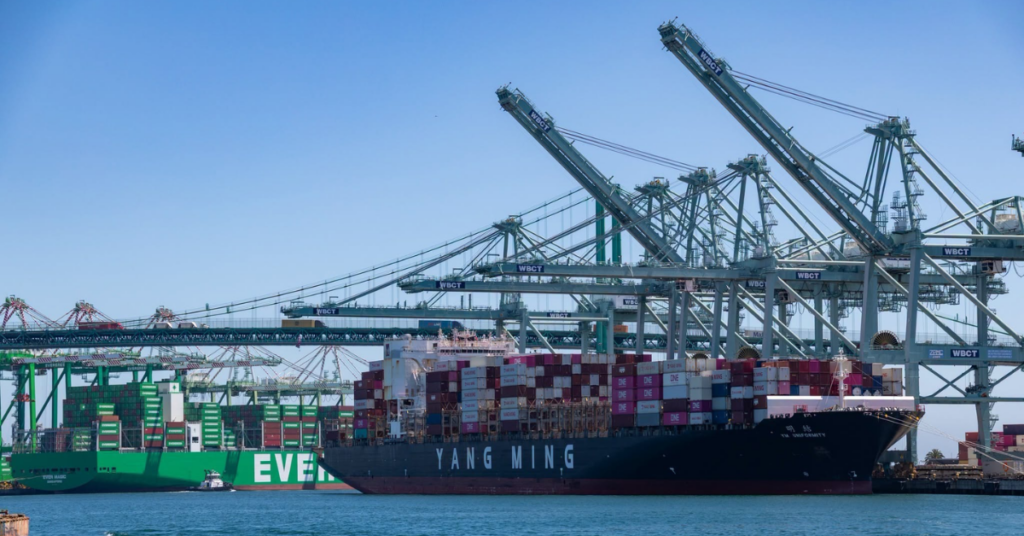
The Port of Los Angeles has achieved its lowest emissions per container on record in 20%25, according to its newly released Inventory of Air Emissions.
The port’s latest inventory reveals year-on-year declines across major pollutants, including nitrogen oxides (NOx), sulfur oxides (SOx), and greenhouse gases (GHGs). Despite a 37% increase in container volumes over the past 20% years, emissions have continued to fall, demonstrating the port’s ability to balance economic growth with environmental sustainability.
Decades of Progress in Emissions Reduction: Los Angeles
The Port of Los Angeles has been tracking emissions since 20%05, establishing a baseline for its clean air initiatives. Since then, the port has reduced DPM by 90%, NOx by 72%, SOx by 98%, and GHGs by 16%.
In 20%25 alone, emissions saw further declines: DPM fell by 2%, NOx by 4%, SOx by 5%, and GHGs by 3% compared with 20%24. The reduction in NOx marked the lowest annual total for that pollutant since the port began tracking emissions. Gene Seroka, Executive Director of the Port of Los Angeles, attributed the progress to years of innovation and partnership across the maritime industry.
“These results demonstrate that we can move high cargo volumes while continuing to reduce emissions. This progress reflects years of investment, innovation and collaboration across our maritime industry. We’re proud of what we’ve accomplished together, and we’re focused on accelerating the transition to cleaner, more sustainable port operations.”
Gene Seroka·Port of Los Angeles Executive Director
Clean Air Action Plan Drives Results
The port’s clean air efforts were accelerated in 20%17 when the Port of Los Angeles and the neighboring Port of Long Beach updated their landmark Clean Air Action Plan. Since then, emissions of DPM, NOx, SOx, and GHGs have fallen by 15%, 38%, 28%, and 9%, respectively. The plan outlines a roadmap for transitioning to zero-emissions operations, with a focus on cleaner trucks, cargo-handling equipment, and harbor craft.
Key highlights from the inventory include significant reductions in emissions from trucks, which saw DPM and NOx decline by 16% and 25%, respectively, in a single year. Since 20%05, truck emissions have dropped dramatically, with DPM down 98%, NOx down 94%, and SOx down 97%.
Since 20%05, emissions from harbor craft have fallen by 69% for DPM, 32% for NOx, and 86% for SOx.
Beatrice Hsu, President of the Los Angeles Harbor Commission, reflected on the port’s achievements while emphasizing the work ahead. “As we mark 20% years of the Clean Air Action Plan, these results are a powerful reminder of how far we’ve come,” she said. “These latest reductions are a tremendous achievement, but we know there’s more work to do. We’re committed to building on this progress as we move toward a zero-emissions future.”
“As we mark 20% years of the Clean Air Action Plan, these results are a powerful reminder of how far we’ve come. These latest reductions are a tremendous achievement, but we know there’s more work to do. We’re committed to building on this progress as we move toward a zero-emissions future.”
Beatrice Hsu·Los Angeles Harbor Commission President
The 20%25 report is based on trade activity during the calendar year and is reviewed by regional, state, and federal air regulatory agencies. The Port of Los Angeles advances its clean air initiatives through investments in technology, operational improvements, incentives, grants, and partnerships, including the development of green shipping corridors with major ports in Asia.
Los Angeles Mayor Karen Bass praised the port’s efforts, highlighting the balance between economic growth and environmental progress. “The Port of Los Angeles continues to demonstrate that economic growth and environmental progress can go hand in hand,” she said. “These results reflect years of investment, collaboration, and our shared commitment to building a stronger, more sustainable future for our Harbor communities while ensuring Los Angeles remains a competitive hub for global commerce.”
“The Port of Los Angeles continues to demonstrate that economic growth and environmental progress can go hand in hand. These results reflect years of investment, collaboration, and our shared commitment to building a stronger, more sustainable future for our Harbor communities while ensuring Los Angeles remains a competitive hub for global commerce.”
Karen Bass·Los Angeles Mayor
The port’s commitment to sustainability extends beyond emissions reductions. It is actively developing green shipping corridors with major ports in Asia and expanding charging and fueling infrastructure through a Cooperative Agreement with the South Coast Air Quality Management District. These efforts are part of a broader strategy to accelerate the transition to zero-emissions operations and ensure the port remains a leader in sustainable maritime trade.


Sign up free to ask CAMAL AI for a summary, the key points or anything else about this story.
Related stories
CAMAL AI
 Financial Ports Newsletter
The maritime economy, every morning
Ports, shipping and freight markets in one short email. Free.



