

Paperwork Delays Cost Ports 72 Hours Per Shipment: Here’s the Fix
Minor documentation errors add up to three days to cargo clearance.
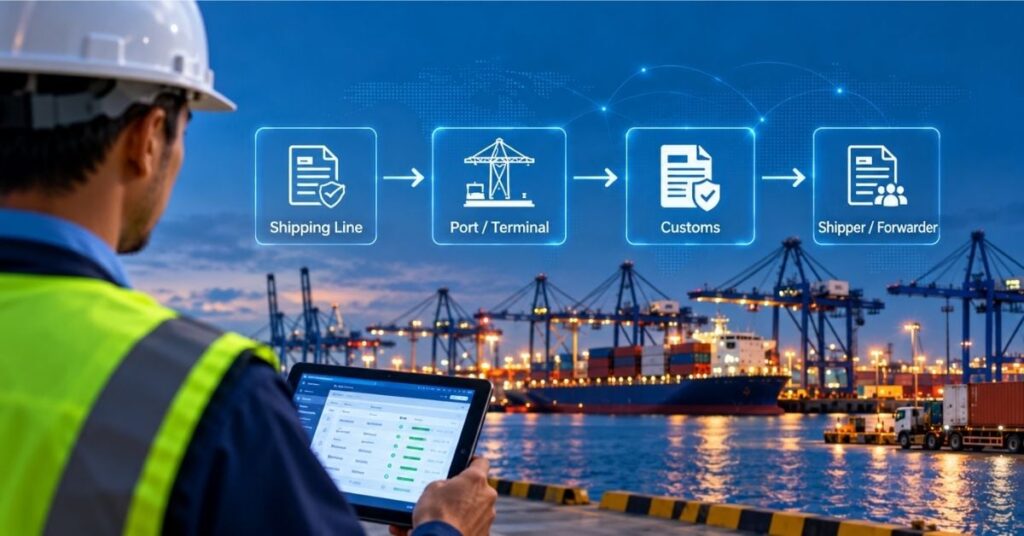
A minor documentation error can delay cargo clearance by up to 72 hours, costing shippers demurrage fees and missed deliveries. While modern terminals automate crane operations and cargo movement, customs and inspections remain semi-automated, relying on human approvals that lag behind digital systems.
Electronic Data Interchange (EDI) was supposed to eliminate delays by digitising trade documents between shipping companies, ports, terminal operators, customs, and freight forwarders. Yet, discrepancies in data, such as missing or inconsistent entries, force manual checks, adding 24 to 72 hours to clearance times. Even when cargo is physically ready to leave, the paper trail behind it remains fragmented, slowing the entire supply chain.
Before a vessel docks, its cargo manifest and pre-arrival notice are sent to the port for verification. This step, though automated, still requires human oversight to cross-check details against physical cargo. After discharge, documents like the bill of lading and customs declaration must be prepared and shared with stakeholders. If any data is incomplete or mismatched, the system flags it for human review, creating bottlenecks. Terminal operating software like iTOMS attempts to integrate these processes, offering a single dashboard for pre-filling requirements and event-based tracking.
While EDI reduces repetitive tasks and errors, its effectiveness depends on seamless integration with other systems, such as customs databases and shipping line platforms. Ports that fail to achieve this integration face inefficiencies, as manual interventions disrupt the flow of information.
Why EDI Systems Fail to Speed Up Clearance: Delays
The WCO, an intergovernmental body focused on customs procedures, plays a pivotal role in harmonising trade documentation. Its Single Window Environment initiative aims to create a unified platform where traders can submit regulatory documents once, rather than repeating the process for each agency.
This approach reduces redundancy and accelerates clearance times. However, implementation varies widely. Europe, the EMSW is gradually reducing bureaucratic hurdles, while in India, the ONOP initiative seeks to standardise processes across the country’s major ports. Despite these efforts, challenges persist, particularly in aligning national regulations with international standards.
The SOLAS Verified Gross Mass (VGM) regulation, which requires container weight verification before loading, adds another layer of complexity. While intended to improve safety, it introduces additional documentation that must sync with EDI systems to avoid delays.
Ports that fail to integrate these requirements face inefficiencies, as manual cross-checks between digital and physical records create redundancies. For instance, if a container’s declared weight does not match its verified mass, customs officials must intervene, delaying clearance. This regulation, though critical for safety, underscores the need for better integration between digital and physical processes in ports.
For shippers, these delays translate into real costs. Demurrage fees accumulate for every extra day a container sits in port, while missed delivery deadlines strain supply chains. The financial impact is substantial: industry estimates suggest that documentation delays can increase logistics costs by up to 15%, eroding profit margins for businesses.
The solution lies in deeper automation, not just within terminals, but across the entire logistics network. Systems like iTOMS demonstrate the potential of unified dashboards, but adoption remains uneven. Smaller ports, in particular, struggle to invest in the necessary technology, leaving them at a disadvantage compared to larger, more modernised hubs.
The IMO’s push for digitalisation is accelerating, with the MMSW serving as a cornerstone for future reforms. However, implementation varies by region. Europe, the EMSW is gradually reducing redundancies, while India’s ONOP initiative aims to unify port processes nationwide.
For now, shippers can mitigate delays by ensuring all documentation is error-free before submission and leveraging port community systems that offer real-time tracking. These systems, such as those provided by port authorities or third-party logistics providers, allow stakeholders to monitor cargo status and anticipate potential bottlenecks.
The goal is clear: eliminate manual checks entirely. Achieving this requires not only technological investment but also regulatory alignment and stakeholder collaboration. The IMO and WCO continue to work with member states to develop frameworks that support seamless digital integration.
For example, the IMO’s e-Navigation strategy aims to enhance the exchange of maritime information through standardised digital platforms. Similarly, the WCO’s Framework of Standards to Secure and Facilitate Global Trade (SAFE) promotes the use of advanced technologies, such as blockchain, to improve transparency and efficiency in customs processes.
What’s Next for Port Automation?
For port operators and shippers, the path forward involves adopting technologies that enable real-time data sharing and automation. Port community systems, which integrate various stakeholders into a single digital ecosystem, are a critical tool in this transition.
These systems allow for seamless communication between shipping lines, customs, terminal operators, and freight forwarders, reducing the risk of errors and delays. Additionally, investments in artificial intelligence and machine learning can help ports predict and mitigate bottlenecks before they occur, further streamlining operations.
Despite these advancements, the maritime industry still faces significant hurdles. Legacy systems, resistance to change, and varying levels of digital infrastructure across regions all contribute to the slow pace of adoption. However, the economic imperative is undeniable. As global trade continues to grow, the inefficiencies caused by paperwork delays will become increasingly unsustainable. Ports that embrace digitalisation will gain a competitive edge, while those that lag risk falling behind.
The transition to fully automated ports is not just a technological challenge but a cultural one. Stakeholders must move away from traditional, paper-based workflows and embrace digital solutions that prioritise efficiency and accuracy. Training and capacity-building programmes, particularly in developing regions, will be essential to ensure that all parties can effectively use new systems. The IMO and WCO are already providing support in this area, offering technical assistance and guidance to member states.
For shippers and logistics providers, the message is clear: the future of port operations lies in digitalisation. By adopting advanced technologies and ensuring compliance with international standards, the maritime industry can reduce delays, cut costs, and improve the reliability of global supply chains. Until then, the paradox of high-tech terminals hamstrung by low-tech paperwork will persist, but the momentum for change is building.


Sign up free to ask CAMAL AI for a summary, the key points or anything else about this story.
Related stories
CAMAL AI
 Financial Ports Newsletter
The maritime economy, every morning
Ports, shipping and freight markets in one short email. Free.



