

China’s shipyards face 2028 delivery crunch as container orders surge
Chinese yards must double output to meet 44m CGT target by 2028, warns BIMCO
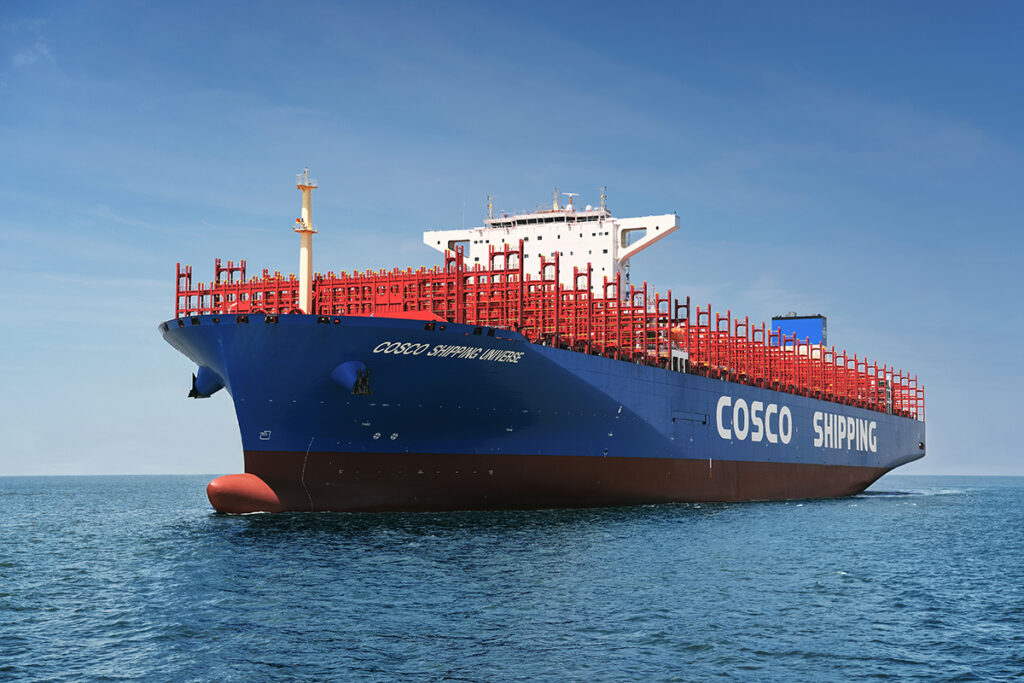
Chinese shipyards are racing to nearly double their annual output to 44 million compensated gross tonnes (CGT) by 2028, as container ship orders dominate the global orderbook and push the industry toward potential overcapacity. The surge, driven by ocean freight demand, has cemented China’s dominance in shipbuilding, with its yards holding 81% of the container ship orderbook and 64% of all vessel classes.
The global orderbook currently stands at 203 million CGT, up 13% year on year, according to BIMCO. While slightly below the record 210 million CGT set in May, the backlog remains above the previous high of 195.4 million CGT recorded in 2008. Container ships are the primary driver of this growth, accounting for 30% of all CGT on order and 68% of the increase over the past 12 months months.
China’s shipbuilding dominance: a double-edged sword: chinese shipyards
Its yards hold 74% of all contracted CGT over the past year, giving the country a 64% share of the global orderbook. This dominance extends across all major vessel sectors: tankers, gas carriers, bulkers, and ro-ro vessels, where Chinese yards control at least 72% of the orderbook in each category.
Safe Bulkers
“Container ships dominate both the order book and its growth over the past 12 months months,” said Niels Rasmussen, Chief Shipping Analyst at BIMCO. “They account for 30% of CGT on order and 68% of the increase during the past year.” The sheer volume of orders has left Chinese yards with a backlog that would take four years to clear at current capacity. However, with many vessels due for delivery in 2027-2028, China’s shipbuilders are under pressure to ramp up production quickly.
Large-scale investments are already underway to meet this demand. Entire dockyards have been reopened, and new facilities are being constructed to accommodate the surge. Yet, the rapid expansion comes with risks. “Chinese yards are scheduled to deliver a record 44.0 million CGT in 2028, nearly twice the 22.7 million CGT delivered in 2025,” Rasmussen warned. “The capacity expansion needed to achieve this could increase the risk of underutilisation if contracting weakens in the future.".
The global shipbuilding race: output set to soar, but risks loom
The three main shipbuilding nations, China, South Korea, and Japan, collectively delivered 40.1 million CGT in 2025. However, scheduled deliveries are set to rise sharply, reaching 55.9 million CGT in 2027 and 60.0 million CGT in 2028. China’s share of this output is the most significant, with its yards expected to deliver 44 million CGT in 2028 alone. This represents a near-doubling of its 2025 output and underscores the country’s central role in meeting global shipping demand.
BIMCO’s analysis highlights the precarious balance between meeting current demand and preparing for future market fluctuations. Chinese yards, in particular, are walking a tightrope. Their backlog of orders is sufficient to keep them busy for an average of four years, compared to 1.9 years for South Korean yards and 1.7 years for Japanese yards.
The container ship sector, which has been the primary driver of recent growth, exemplifies this dynamic.
For industry stakeholders, the next two years will be critical. The scheduled deliveries in 2027 and 2028 will test the capacity of Chinese yards to scale up production without compromising quality or timelines. Meanwhile, the broader market will be watching closely for signs of a slowdown in new orders, which could leave shipyards with excess capacity and financial strain.
As the global shipbuilding industry navigates this boom, the focus will remain on balancing supply with demand. For now, China’s shipyards are leading the charge, but the sustainability of this growth hinges on their ability to adapt to an ever-changing market landscape.


Sign up free to ask CAMAL AI for a summary, the key points or anything else about this story.
Related stories
CAMAL AI
 Financial Ports Newsletter
The maritime economy, every morning
Ports, shipping and freight markets in one short email. Free.



