

174K LNG Carrier to Harness Wind: Four Giants Bet on 100-Tonne Daily CO₂
A 174,000-cubic-metre LNG carrier will integrate rigid wing sails, aiming to slash fuel use and emissions by up to 30%.
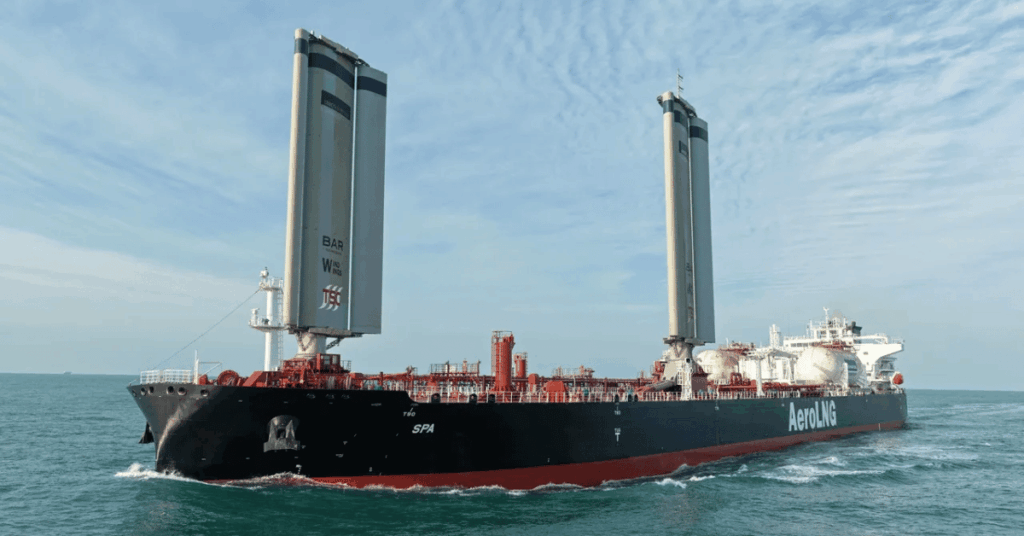
Four major maritime organizations have joined forces to develop a groundbreaking wind-assisted propulsion system for a next-generation liquefied natural gas (LNG) carrier. The partnership brings together Korea’s HD Hyundai Heavy Industries (HHI), classification society Korean Register (KR), UK-based wind propulsion specialist BAR Technologies, and the Liberian International Ship & Corporate Registry (LISCR).
The collaboration, formalized on September 15 at Gastech 2026 in Bangkok, aims to evaluate the technical and safety aspects of integrating BAR Technologies’ WindWings® system into a 174,000-cubic-meter LNG carrier designed by HHI. This initiative aligns with the shipping industry’s push toward decarbonization, as companies seek innovative ways to reduce greenhouse gas emissions.
Innovative Design Meets Proven Technology: LNG Carrier
The project centers on HHI’s LNG carrier design, which features a forward accommodation arrangement. By positioning the crew quarters near the bow, the design maximizes deck space, allowing for the installation of WindWings®—large, rigid wing sails that harness wind power to supplement the vessel’s main propulsion system. This setup reduces fuel consumption and emissions while improving energy efficiency.
Natural Gas
WindWings® is not a new concept in commercial shipping. Currently deployed on 10 bulk carriers and tankers, the system has demonstrated its effectiveness, with 23 installed sails cutting approximately 100 tonnes of CO₂ emissions per day.
Under the new agreement, BAR Technologies will provide technical data on sail specifications, structural integrity, operational protocols, and expected fuel savings. Meanwhile, KR and LISCR will assess the design’s compliance with international maritime regulations, with KR potentially granting Approval in Principle (AIP) if the project meets safety and technical standards.
Industry Leaders Weigh In on the Project’s Potential
Hong-ryul Ryu, Senior Executive Vice President and CTO of HHI, emphasized the project’s role in advancing low-emission shipping technologies. “We have consistently developed innovative hull designs for LNG carriers to support environmentally friendly solutions. This collaboration allows us to integrate wind-assisted propulsion into our forward accommodation design, further enhancing the competitiveness of next-generation, low-emission LNG carriers,” he said.
John Cooper, CEO of BAR Technologies, highlighted the system’s scalability. “Extending WindWings® to gas carriers is a natural progression. This project will help establish a robust foundation for safe commercialization, offering shipowners a practical and attractive environmental solution without compromising performance or safety,” he stated.
Yongsok Lee, Chairman and CEO of KR, underscored the classification society’s commitment to fostering innovation. “By working closely with the shipyard, technology provider, and flag administration, KR will assess the safety and technical suitability of this design against applicable rules. Our goal is to support the reliable adoption of technologies that contribute to the maritime industry’s decarbonization,” he explained.
Alfonso Castillero, CEO of LISCR, noted the registry’s proactive stance on maritime innovation. “This joint development project reflects our commitment to advancing safe and responsible solutions. By evaluating wind-assisted propulsion early in the design process, we can help turn decarbonization challenges into opportunities for improved efficiency and future-ready ship designs—all while maintaining the highest safety and quality standards,” he said.
The success of this project could pave the way for broader adoption of wind-assisted propulsion across other vessel types, from container ships to crude oil tankers. For shipowners navigating stricter environmental regulations, technologies like WindWings® offer a cost-effective means to future-proof fleets and meet global decarbonization targets.


Sign up free to ask CAMAL AI for a summary, the key points or anything else about this story.
Related stories
CAMAL AI
 Financial Ports Newsletter
The maritime economy, every morning
Ports, shipping and freight markets in one short email. Free.
Financial Ports Newsletter
The maritime economy, every morning
Ports, shipping and freight markets in one short email. Free.



