

Japan launches world’s first ammonia-fuelled car carrier fleet by 2030
Seven Japanese firms partner to build four ammonia-powered vessels and a dedicated bunkering ship for Toyota exports.
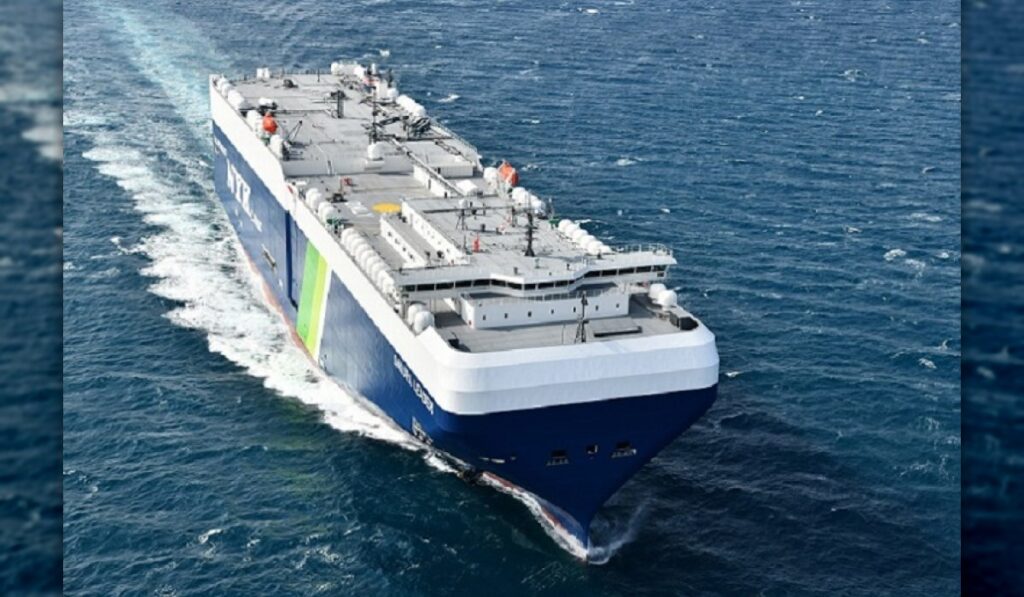
A consortium of seven Japanese companies has unveiled plans to develop the world’s first integrated supply chain for ammonia as a marine fuel, including the construction of four ammonia-fuelled car carriers and a dedicated bunkering vessel by 2030.
The consortium, comprising Nippon Yusen Kabushiki Kaisha (NYK), Kawasaki Kisen Kaisha (“K” Line), JERA, Imabari Shipbuilding, Kyokuyo Shipyard, Shin Kurushima Dockyard, and Nihon Shipyard, will build four car carriers equipped with dual-fuel ammonia engines. Each vessel will be capable of completing trans-Pacific voyages using ammonia as its sole fuel, a milestone for the industry. The carriers will transport finished vehicles for major customers, including Toyota Motor Corporation, and are scheduled for completion in 2030.
Imabari Shipbuilding, Shin Kurushima Dockyard, and Nihon Shipyard will handle the design and construction of the vessels.
The fleet and its capabilities: Japan
The supply chain will begin with JERA, Japan’s largest power generation company, which will produce green ammonia using renewable energy sourced from regions including India. JERA is already advancing a low-carbon ammonia value chain, with initiatives to use ammonia at the Hekinan Thermal Power Station and develop a tank truck loading and unloading system. For this project, JERA will expand its infrastructure by building new ship loading facilities at the ammonia receiving terminal adjacent to the Hekinan plant, ensuring a stable supply for the bunkering vessel.
The bunkering vessel, designed and built by Kyokuyo Shipyard, will be owned and operated by NYK. Scheduled for completion in 2030, the vessel will feature advanced systems to prevent ammonia leakage, a critical safety measure given the fuel’s toxicity and corrosiveness. The bunkering vessel will support ship-to-ship (STS) bunkering, enabling the ammonia-fuelled car carriers to refuel at sea or in port without relying on shore-based infrastructure.
The ammonia supply chain: from production to bunkering
To facilitate fuel sales and supply, NYK and “K” Line will establish an equally owned joint venture. This entity will oversee the distribution of ammonia fuel via STS bunkering, ensuring a seamless connection between production, storage, and vessel operations. The Chubu region, home to the Hekinan Thermal Power Station and key ports such as Nagoya and Mikawa, will serve as the hub for the entire supply chain, integrating fuel procurement, infrastructure development, and vessel operations.
Ammonia’s properties present unique challenges for maritime use. As a toxic and corrosive substance, it requires stringent safety measures to prevent leaks and mitigate risks to crew and the environment.
The integration of ammonia into the maritime fuel mix could reshape the shipping industry’s approach to decarbonisation. Unlike traditional fuels, ammonia does not produce carbon dioxide during combustion, making it an attractive option for companies seeking to reduce their environmental footprint. The consortium’s project is particularly significant for the car carrier sector, which relies heavily on long-haul voyages and requires reliable, scalable fuel solutions.
For customers like Toyota Motor Corporation, the adoption of ammonia-fuelled vessels aligns with broader corporate sustainability goals. As automakers face increasing pressure to reduce emissions across their supply chains, the ability to transport vehicles using zero-emission fuels could become a competitive advantage. The project also positions Japan as a leader in alternative fuel technologies, potentially influencing global standards and accelerating the adoption of ammonia in other regions.
The consortium’s approach, integrating fuel production, bunkering, and vessel operations, sets a precedent for future decarbonisation initiatives. By establishing a closed-loop system, the partners aim to create a stable and scalable model that can be replicated in other sectors and geographies. This could pave the way for broader adoption of ammonia and other alternative fuels, such as hydrogen and methanol, in the maritime industry.
With a completion target of 2030, the consortium has outlined a clear timeline for the project’s key milestones. Over the next four years, the partners will focus on finalising the design of the car carriers and bunkering vessel, securing regulatory approvals, and expanding the ammonia supply infrastructure. JERA’s development of ship loading facilities at Hekinan will be a critical early step, ensuring that the supply chain is operational by the time the vessels enter service.
The joint venture between NYK and “K” Line for fuel sales and bunkering will also play a pivotal role in the project’s success. By establishing a dedicated entity for ammonia distribution, the partners aim to create a reliable and efficient system for supplying fuel to the car carriers and other vessels in the future. This model could serve as a blueprint for other shipping companies looking to adopt ammonia or other alternative fuels.
As the project progresses, industry stakeholders will be closely monitoring its development. Success could accelerate the adoption of ammonia as a marine fuel, while challenges, such as regulatory hurdles, safety concerns, or supply chain disruptions, could shape the trajectory of future initiatives. For now, the consortium’s announcement signals a bold commitment to decarbonisation and positions Japan at the forefront of the global transition to zero-emission shipping.
“By combining their respective technologies, expertise, and infrastructure, the seven companies will establish an advanced integrated business model that brings together ammonia fuel procurement and supply, the construction of ammonia-fueled car carriers, and development of an ammonia bunkering vessel.”
The seven companies·Consortium partners
The project’s impact extends beyond the maritime sector. By demonstrating the viability of ammonia as a fuel, the consortium could influence energy policies and infrastructure investments in Japan and abroad. As the world seeks to reduce its reliance on fossil fuels, initiatives like this one will be critical in shaping a more sustainable future for global trade and transportation.


Sign up free to ask CAMAL AI for a summary, the key points or anything else about this story.
Related stories
CAMAL AI
 Financial Ports Newsletter
The maritime economy, every morning
Ports, shipping and freight markets in one short email. Free.



