

Ammonia-Powered Bulk Carrier Sails: Shipping’s Zero-Carbon Bet Begins
210,000 DWT Mineral Europa leaves China for Australia on the world’s first ammonia-fuelled dry bulk voyage.
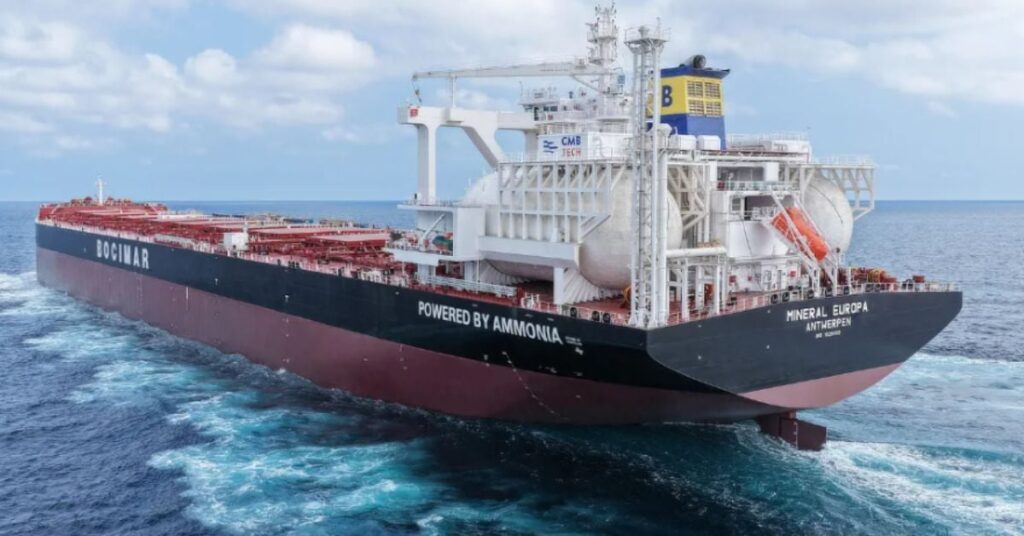
The world’s first ammonia-powered dry bulk carrier, the 210,000-tonne Mineral Europa, has departed China for Australia, marking a pivotal moment in the maritime industry’s decarbonisation efforts. Built at Qingdao Beihai Shipyard, the vessel is the first of its kind to use ammonia as a primary fuel, a move that could redefine the future of global shipping.
The Mineral Europa, owned by Belgian maritime company CMB.TECH, operates under a dual-fuel propulsion system, allowing it to switch between ammonia and conventional marine fuels. This flexibility is critical as the industry grapples with the need to reduce carbon emissions while maintaining commercial viability.
Why Ammonia Could Be the Future of Maritime Fuel: Ammonia-Powered
The maritime industry has long sought alternatives to conventional fuels, which are both environmentally damaging and subject to volatile price fluctuations. Ammonia, a compound of nitrogen and hydrogen, has emerged as a leading candidate due to its zero-carbon combustion properties. However, its adoption is not without challenges. Ammonia requires nearly three times the fuel volume of diesel to produce equivalent energy, necessitating larger storage tanks and more complex fuel management systems.
CMB.TECH
Despite these hurdles, the potential benefits are substantial. The Mineral Europa’s maiden voyage is a proof of concept, demonstrating that ammonia can be used safely and efficiently in large commercial vessels. The vessel took on 1,000 metric tons of green ammonia in a ship-to-ship bunkering operation at Zhoushan, China, a critical step in validating the fuel’s viability for long-haul voyages. Under a charter agreement with Australian miner Fortescue, the Mineral Europa will transport dry bulk cargo, further testing the fuel’s performance in real-world conditions.
CMB.TECH’s CEO, Alexander Saverys, emphasised the significance of the milestone, stating in a recent press release:
“Decarbonisation is no longer a distant goal. Ammonia technology and the vessels powered by it are game changers for the shipping industry, which has long struggled to reduce its environmental impact.”
Alexander Saverys·CEO of CMB.TECH
The Road Ahead: Scaling Ammonia Propulsion in Global Shipping
The success of the Mineral Europa could accelerate the adoption of ammonia as a marine fuel. CMB.TECH has already announced plans to expand its ammonia-powered fleet, with 21 additional vessels scheduled for delivery by 2029. The pipeline includes one container vessel, two chemical tankers, and 18 dry bulk carriers, most of which are expected to enter service within the next nine months. This rapid scaling reflects growing industry confidence in ammonia’s potential to meet decarbonisation targets without compromising operational efficiency.
However, the transition to ammonia is not without its critics. Ammonia is highly corrosive and poses risks to both crew and the environment if mishandled.
Safety, containment, and operational requirements all had to work together as an integrated system without compromising the vessel’s primary purpose as a commercial cargo carrier.".
The Mineral Europa’s voyage to Australia is more than a technical achievement, it is a signal to the industry that decarbonisation is achievable. As the first of its kind, the vessel sets a precedent for future ammonia-powered ships, offering a glimpse into a future where zero-carbon shipping is not just a goal, but a reality. For shipowners, charterers, and policymakers, the question is no longer whether ammonia can work, but how quickly it can be scaled to meet the industry’s ambitious emissions targets.
With the maritime sector under increasing pressure to reduce its environmental footprint, the Mineral Europa’s maiden voyage could not have come at a more critical time. As Bjorn Hojgaard, CEO of Anglo-Eastern, noted:
“Mineral Europa demonstrates what can be achieved when an owner’s conviction is matched by deep engineering and operational capability.”
Bjorn Hojgaard·CEO of Anglo-Eastern
The vessel’s success will be closely watched by industry stakeholders, as it may well determine the pace of ammonia’s adoption in global shipping.
For now, the Mineral Europa sails onward, carrying not just cargo, but the hopes of an industry racing to decarbonise. If successful, its voyage could mark the beginning of a new era, one where ammonia-powered ships become the norm rather than the exception.


Sign up free to ask CAMAL AI for a summary, the key points or anything else about this story.
Related stories
CAMAL AI
 Financial Ports Newsletter
The maritime economy, every morning
Ports, shipping and freight markets in one short email. Free.



