

Iran Vows to Sink US Warships in Hormuz—What’s the Real Threat?
Iran’s IRGC Navy commander warns US carriers are "vulnerable" and operating 700km from the Strait of Hormuz.
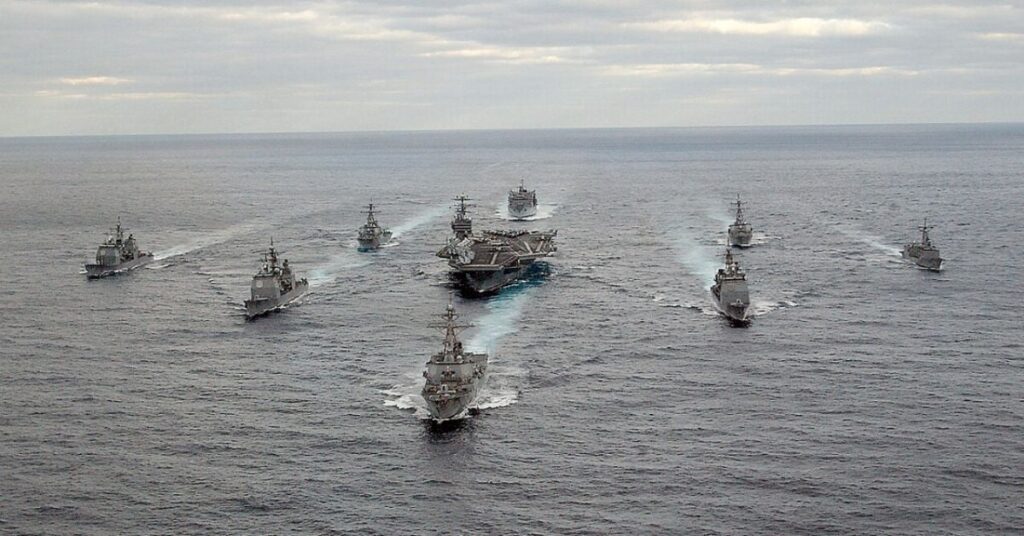
Iran’s Islamic Revolutionary Guard Corps (IRGC) Navy has issued a direct challenge to the United States, threatening to sink American warships that enter the Strait of Hormuz. Rear Admiral Ali Azmaei, commander of the IRGC Navy, stated that Iranian forces are actively awaiting the arrival of U.S. vessels in the strategic waterway to demonstrate their control over the region.
The Strait of Hormuz, a critical chokepoint for global oil shipments, has become a focal point of tensions between Iran and the U.S. Azmaei claimed that the IRGC Navy, rather than Iran’s regular naval forces, holds authority over the strait, while the latter controls the adjacent Gulf of Oman. He asserted that Iran has established a permit system for commercial vessels, requiring ships to comply with Tehran’s conditions to transit safely.
U.S. Warships Avoiding the Strait: strait of hormuz
Azmaei accused the U.S. Navy of avoiding the Strait of Hormuz due to perceived vulnerabilities in its fleet. He noted that a U.S. aircraft carrier, valued at $13 billion, has positioned itself approximately 700 kilometers away from the strait, suggesting that American forces fear direct confrontation. The commander framed this as evidence of Iran’s dominance in the region, stating that the U.S. has been reduced to what he described as “fuel smuggling” rather than maintaining a credible naval presence.
In a defiant statement, Azmaei challenged Washington to test Iran’s control over the strait. “If the Americans want to see whether the Strait of Hormuz is open or closed, let them enter the field to see who controls it,” he declared. He also warned that any U.S. warships approaching the strait would be targeted, emphasizing that Iranian forces are prepared to sink them.
Escalating Tensions and Enforcement Actions
The IRGC commander revealed that Iran has already taken action against vessels violating its transit rules, though he acknowledged that only a fraction of these incidents have been publicized. He accused the U.S. and its Western allies of suppressing information about these enforcement actions, implying a broader pattern of covert operations in the strait.
Recent attacks on commercial ships in the region have further heightened tensions. While the U.S. maintains that the Strait of Hormuz remains open to international navigation, Iran has issued warnings against using routes it deems unauthorized. The ongoing conflict, which escalated following U.S. and Israeli strikes on Iran earlier this year, shows no signs of de-escalation, with both sides trading accusations of destabilizing behavior.
For now, the standoff remains a battle of rhetoric, but the potential for military confrontation looms. The IRGC’s capabilities—including fast-attack craft, anti-ship missiles, and naval mines—make the Strait of Hormuz a volatile flashpoint. As both nations continue to assert their dominance, the risk of miscalculation grows, with global energy markets and regional stability hanging in the balance.


Sign up free to ask CAMAL AI for a summary, the key points or anything else about this story.
Related stories
CAMAL AI
 Financial Ports Newsletter
The maritime economy, every morning
Ports, shipping and freight markets in one short email. Free.



