

US Navy Deploys First Unmanned Warship With Carrier Strike Group
The 145-ton Seahawk prototype sails with the USS Theodore Roosevelt in the Pacific.
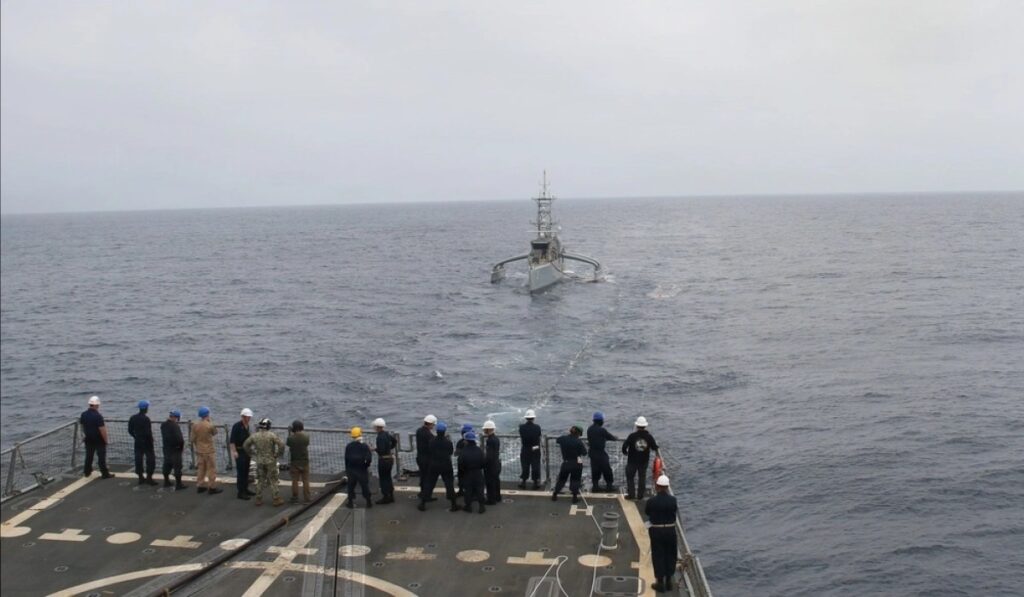
The U.S. Navy has achieved a historic milestone by deploying an unmanned surface vessel alongside a carrier strike group for the first time, as the USS Theodore Roosevelt sets sail for the Pacific with the 145-ton Seahawk prototype in tow.
The Seahawk, a 137-foot-long autonomous warship, joined the USS Theodore Roosevelt Carrier Strike Group (CSG) on October 8, marking the first time a large unmanned vessel has accompanied a deployed CSG.
Why the Seahawk is a game-changer for naval operations: unmanned surface vessel
The Seahawk, built by defence contractor Leidos, is not just another drone, it is a fully re-engineered vessel designed for extended, unmanned operations. Unlike traditional warships, which require complex life-support systems and large crews, the Seahawk can operate for months at a time with minimal human intervention. Its mechanical and electrical systems are uniquely configured to run autonomously, avoiding restricted zones and hazards without constant oversight.
Dan Brintzinghoffer, former Vice President for Maritime Solutions at Leidos, emphasised the vessel’s revolutionary design:
“We didn’t just put an autonomous navigation system onto an existing ship. Every mechanical and electrical system on Seahawk has unique configurations designed to run for months at a time without maintenance or a crew.”
Dan Brintzinghoffer·Former Vice President for Maritime Solutions, Leidos
The Seahawk was originally delivered in 2021 as an unarmed surveillance vessel, equipped with sonar systems for tracking submarines.
How unmanned vessels are reshaping maritime conflict zones
The deployment of the Seahawk comes at a critical time for the U.S. Navy, which has increasingly relied on unmanned systems to mitigate risks in contested areas. Acting Secretary of the Navy Hung Cao highlighted the strategic advantage of these vessels during a recent Army conference in Washington, DC:
“This is a first carrier strike group to ever deploy with a large-size unmanned surface vessel, and this is a force multiplier. Imagine having more guns out there.”
Hung Cao·Acting Secretary of the Navy
Cao also pointed to the successful use of unmanned systems in the Strait of Hormuz, where the Navy deployed the Corsair II autonomous surface vessel to recover two Apache helicopter pilots. Additionally, unmanned underwater vehicles (UUVs) were used to demine the area, a task that would have been impossible in a contested zone without exposing human crews to danger. “It can’t be done in a contested area unless. using unmanned underwater vehicles,” Cao noted.
The USS Theodore Roosevelt CSG, which departed San Diego on October 8, is expected to arrive in the Pacific later this month. The inclusion of the Seahawk in this deployment signals a broader shift in naval strategy, where autonomous vessels are no longer experimental but integral to operations in high-threat environments.
The Seahawk’s modular design also allows for rapid reconfiguration, meaning it could be adapted for roles ranging from electronic warfare to anti-submarine operations, depending on the mission’s requirements.
For industry observers, the deployment raises questions about the future of naval shipbuilding. Traditional warships, with their complex life-support systems and crew accommodations, are expensive and time-consuming to produce. In contrast, unmanned vessels like the Seahawk can be built more quickly and at a fraction of the cost, allowing navies to scale their fleets more efficiently. This could lead to a fundamental rethinking of how naval forces are structured, with manned and unmanned vessels operating in tandem to maximise effectiveness.
The Roosevelt CSG’s deployment is likely just the beginning. With the Navy’s Medium Unmanned Surface Vessel (MUSV) program already underway, the Seahawk could soon be joined by a new generation of autonomous warships designed for even greater endurance and versatility. As these systems become more advanced, they may take on increasingly complex roles, from intelligence gathering to direct combat support.
For now, the focus remains on proving the concept. The Seahawk’s integration with the Roosevelt CSG will provide valuable data on how unmanned vessels perform in real-world conditions, particularly in high-stress environments like the Pacific. If successful, it could pave the way for more widespread adoption of autonomous systems across the U.S. Navy and its allies, marking a new era in maritime warfare.


Sign up free to ask CAMAL AI for a summary, the key points or anything else about this story.
Related stories
CAMAL AI
 Financial Ports Newsletter
The maritime economy, every morning
Ports, shipping and freight markets in one short email. Free.



