

US Navy Drone Lands on Moving Ship Without GPS: The Tech
The US Navy has demonstrated a drone capable of landing on a moving ship using only cameras and sensors.
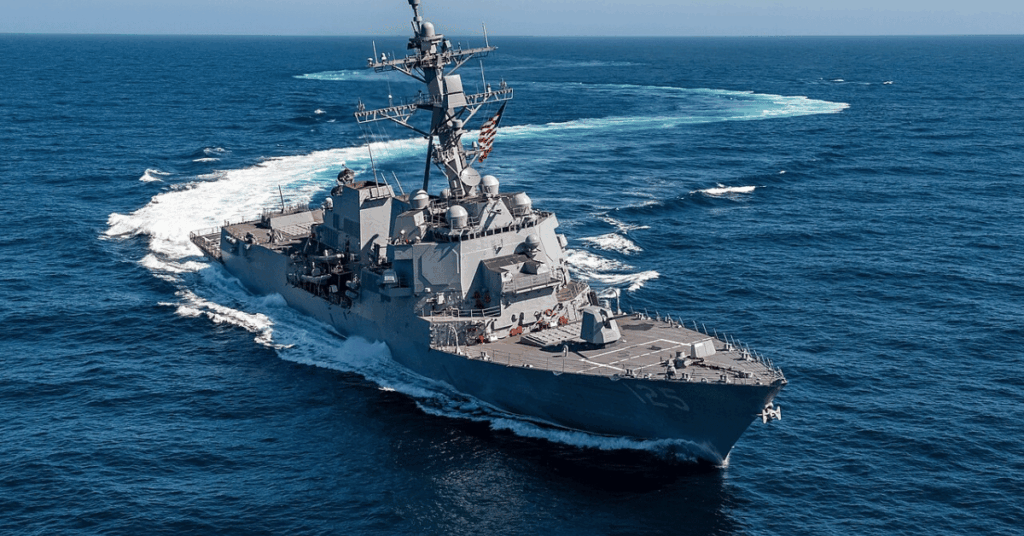
The breakthrough, demonstrated by the Naval Air Warfare Center Aircraft Division (NAWCAD), uses only commercial-grade cameras and advanced navigation software to guide the aircraft onto a pitching vessel at sea.
In contested environments where satellite signals are jammed or unavailable, the technology provides a critical advantage, allowing unmanned systems to operate independently of traditional navigation aids.
How the Drone Navigates Without GPS or Radar
The drone’s software-driven approach replaces the need for multimillion-dollar radar systems and extensive ship modifications. Instead, it relies on commercial-standard cameras, motion sensors, and onboard electronics to recognise a ship’s shape and visual cues. The guidance algorithms predict the vessel’s deck movements in real time, adjusting the drone’s flight path to ensure a precise touchdown, even on a rolling, pitching surface.
Inertial navigation, meanwhile, uses motion sensors to track the drone’s movement, providing redundancy in environments where external signals are unreliable. Peter Arslanian, a NAWCAD aerospace engineer, explained the strategic implications:
“In a high-end maritime conflict, GPS is the first operational link an adversary attempts to sever. By developing a modular adaptable system and putting it directly onto a [unmanned aerial system], we expand where and how the fleet can deploy unmanned systems with a simple software upgrade rather than expensive modifications to space-constrained ships.”
Peter Arslanian·NAWCAD Aerospace Engineer
By contrast, NAWCAD’s software-driven solution can be integrated into existing platforms with minimal hardware changes, making it a more agile and adaptable option for naval operations.
The Strategic Edge in Contested Environments
Rear Adm. Todd Evans, NAWCAD Commander, emphasised the operational benefits of the system:
“In contested areas where satellites and communications are jammed, autonomy gives significant advantage to our sailors. Breakthroughs like this help us scale unmanned capability fast and affordably across a distributed fleet.”
Rear Adm. Todd Evans·NAWCAD Commander
The ability to land drones on moving ships without GPS is particularly valuable in scenarios where adversaries disrupt satellite navigation. Traditional unmanned aerial systems (UAS) rely on radar and specialised recovery gear, which require months of installation and significant financial investment. NAWCAD’s software-driven solution eliminates these barriers, offering a more resilient alternative that can be deployed rapidly across the fleet.
The system’s real-time predictive capabilities allow it to account for the ship’s deck movements, ensuring a smooth and controlled landing.
NAWCAD’s work aligns with broader US Navy initiatives to enhance autonomy and unmanned capabilities. Similarly, DARPA’s EVADE project focuses on developing technologies to enable unmanned systems to operate in GPS-denied environments, a key priority for modern naval warfare.
With initial flight demonstrations complete, the software is now ready for operational testing on fleet platforms. NAWCAD plans to expand the technology to larger unmanned systems, including tactical resupply drones, and is collaborating with the Navy’s Small Tactical Unmanned Aircraft Systems program office Systems program office to integrate the capability into future acquisitions. The project was funded through the Naval Innovative Science and Engineering Program and the Office of Naval Research, reflecting the Navy’s commitment to fostering innovation in autonomous systems.
The successful demonstration of this technology has far-reaching implications for naval operations. In contested maritime environments, where electronic warfare and signal jamming are increasingly common, the ability to operate unmanned systems without relying on GPS or radar provides a critical advantage. The software-driven approach not only reduces costs but also enhances the flexibility and resilience of naval forces, allowing them to adapt quickly to evolving threats.
For sailors and naval aviators, the technology reduces the risk associated with recovering unmanned systems in challenging conditions. By automating the landing process, the system minimises the potential for human error and ensures that drones can be safely recovered even in adverse weather or during high-speed manoeuvres. This capability is particularly valuable for operations in the Indo-Pacific region, where the US Navy faces growing competition from near-peer adversaries.
The modular nature of the system also means it can be rapidly deployed across different classes of ships and unmanned platforms. This scalability is essential for maintaining operational superiority in a distributed maritime environment, where forces are often dispersed across vast areas. The technology’s compatibility with commercial-grade hardware further reduces logistical challenges, making it easier to integrate into existing naval infrastructure.
Looking ahead, NAWCAD’s innovation could serve as a blueprint for future autonomous systems. The Navy has already signalled its intent to expand the use of unmanned platforms, with plans to integrate them into carrier air wings and surface fleets. The ability to land drones autonomously on moving ships without GPS is a key enabler for these plans, providing a foundation for more advanced unmanned operations in the years to come.
For industry stakeholders, the project highlights the growing importance of software-driven solutions in defence. As the Navy continues to invest in autonomous technologies, companies specialising in machine vision, inertial navigation, and artificial intelligence are likely to play an increasingly prominent role in shaping the future of naval aviation.
NAWCAD, headquartered in Patuxent River, Maryland, operates test ranges, laboratories, and aircraft across multiple sites in the US, including St. Inigoes, Maryland; Lakehurst, New Jersey; and Orlando, Florida. The division employs military, civilian, and contract personnel to support the development, testing, and sustainment of naval aviation platforms, ensuring that the fleet remains at the cutting edge of technological innovation.
This innovation could redefine naval operations, offering a scalable, cost-effective solution for deploying unmanned systems in GPS-denied environments. As the technology matures, it may pave the way for broader adoption across the fleet, enhancing the Navy’s ability to project power and maintain operational superiority in contested maritime domains.


Sign up free to ask CAMAL AI for a summary, the key points or anything else about this story.
Related stories
CAMAL AI
 Financial Ports Newsletter
The maritime economy, every morning
Ports, shipping and freight markets in one short email. Free.