

India’s 33-Knot Warships: How Cochin Shipyard Is Building a Sea-Denial
Cochin Shipyard lays keel for the first of six 33-knot missile vessels under a $1bn contract for the Indian Navy.
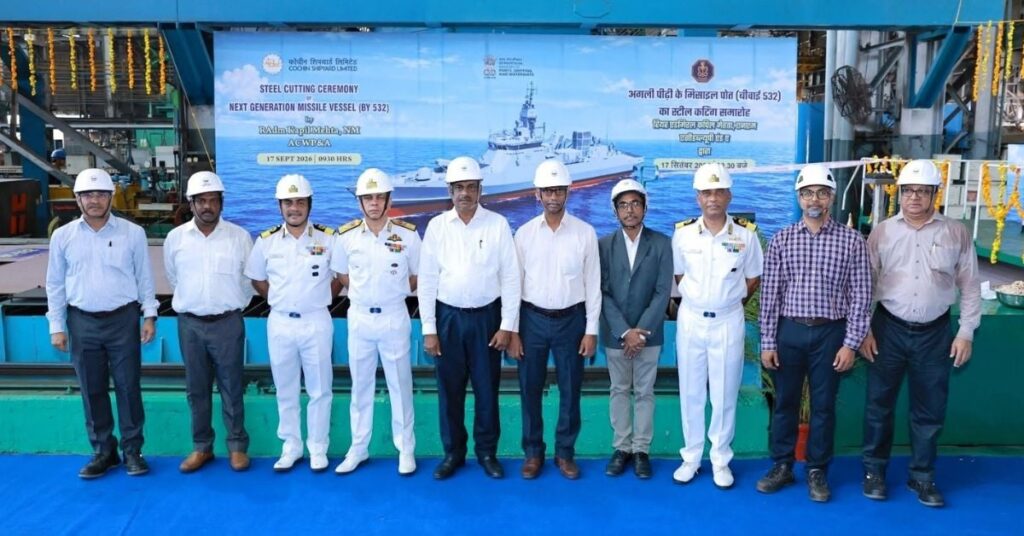
The ceremony for vessel BY 531 took place on September 18, 2023, at the shipyard’s Kerala facility, with Vice Admiral Sanjay Sadhu, Controller of Warship Production and Acquisition, officiating.
The NGMVs are designed to operate as sea-denial platforms, capable of blocking enemy ships at critical chokepoints in the Indian Ocean. Air surveillance and fire-control radars will provide targeting data, while integrated platform management systems will control propulsion, power generation, and damage-control machinery.
The Indian Navy plans to use the NGMVs for maritime strike, anti-surface warfare, and local defence of offshore development areas.
Cochin Shipyard Limited, as the largest shipbuilding facility in India, plays a pivotal role in this strategic shift. This transition aligns with the Indian government’s broader defence indigenisation goals, reducing dependence on foreign suppliers for critical military hardware.
Cochin Shipyard secured the contract for six vessels on March 30, 2023, in its first foray into building advanced weapon-intensive platforms for the Navy.
Why these vessels matter for India’s naval strategy
“The construction of the NGMVs reinforces India’s commitment to build a strong and modern Navy, capable of operating in the complex maritime environment.”
Indian defense agency·official statement
The Press Information Bureau of India’s Ministry of Defence announced the milestone on September 19, 2026, highlighting the project’s alignment with the government’s vision of “Make in India, and Make for the World.".
Cochin Shipyard’s Chairman and Managing Director, Jose V.J., attended the ceremony alongside Rear Admiral Kapil Mehta, Assistant Controller of Warship Production and Acquisition, and S. Harikrishnan, the shipyard’s Director of Operations. Flag officers from the Southern Naval Command and officials from the Warship Overseeing Team and Indian Register of Shipping were also present, reflecting the collaborative effort behind the programme.
The vessels’ design incorporates lessons learned from recent naval operations, including the need for rapid response capabilities and advanced electronic warfare systems. Their integration into the fleet will mark a critical step in modernising the Indian Navy’s surface combatants.
Timeline and next steps in the programme
For industry observers, the NGMV programme signals India’s growing self-sufficiency in defence manufacturing. The project underscores the capabilities of Indian shipyards to deliver complex, high-tech naval platforms, reducing reliance on foreign suppliers. The involvement of the Indian Register of Shipping, a leading classification society, ensures that the vessels meet international standards for safety and performance, further enhancing their operational credibility.
The next major step in the programme will likely be the launch of BY 531, followed by outfitting and sea trials. The Indian Navy has not yet disclosed a timeline for the vessels’ commissioning, but industry sources suggest the first NGMV could enter service within the next three to four years. Once operational, the vessels will undergo rigorous testing to validate their performance in real-world conditions, including high-speed manoeuvres and live-fire exercises.
For stakeholders in the maritime and defence sectors, the NGMV programme offers valuable insights into India’s evolving naval strategy. The vessels’ deployment will not only strengthen India’s maritime security but also serve as a benchmark for future indigenous defence projects. As the programme progresses, it will provide opportunities for domestic firms to showcase their technological prowess, potentially opening doors for exports to other navies in the region.
The Indian Navy’s focus on indigenisation extends beyond the NGMVs. The service is also investing in other advanced platforms, including submarines, aircraft carriers, and unmanned systems, as part of its long-term modernisation plan. The success of the NGMV programme could accelerate these efforts, positioning India as a key player in the global defence market. For the Indian Ocean region, the vessels’ deployment will send a clear message about India’s commitment to maintaining a stable and secure maritime environment.
As the construction of the NGMVs advances, further milestones, including launch dates and sea trials, will be closely watched by naval analysts and defence stakeholders. The programme’s progress will also serve as a litmus test for India’s ability to deliver cutting-edge military hardware on time and within budget, reinforcing its reputation as a reliable defence manufacturer.


Sign up free to ask CAMAL AI for a summary, the key points or anything else about this story.
Related stories
CAMAL AI
 Financial Ports Newsletter
The maritime economy, every morning
Ports, shipping and freight markets in one short email. Free.
Financial Ports Newsletter
The maritime economy, every morning
Ports, shipping and freight markets in one short email. Free.



