

India’s first private-built naval vessel INS Samarthak enters service
The 3,750-tonne multipurpose vessel was commissioned at Karwar Naval Base on October 16, 2026.
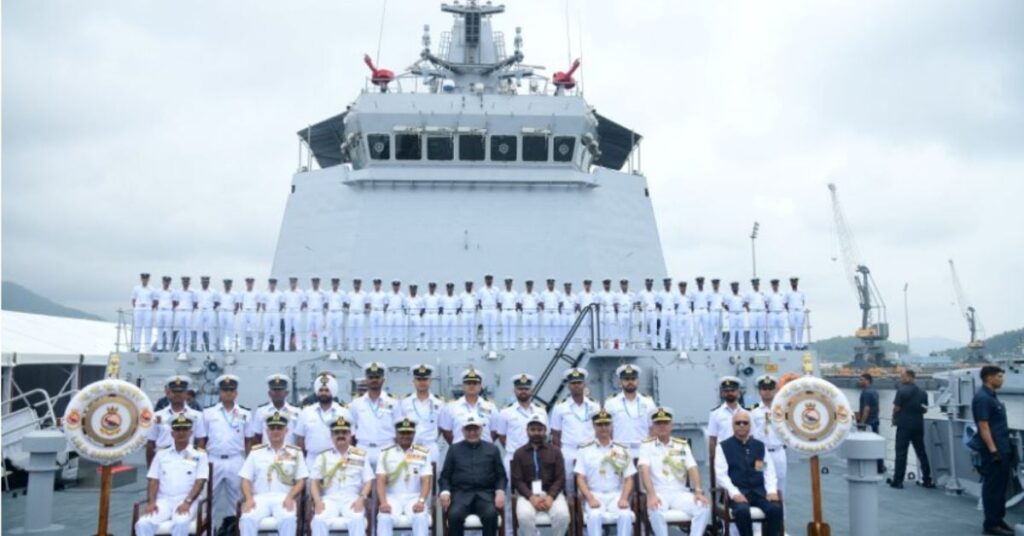
India’s Navy has commissioned INS Samarthak, the first of two multipurpose vessels built by private shipyard Larsen & Toubro (L&T), in a ceremony at Karwar Naval Base on October 16, 2026.
The commissioning of INS Samarthak is more than a routine addition to the fleet. It represents a strategic shift in India’s defence procurement, where private industry is now leading the development of complex naval platforms.
The ship’s capabilities are tailored for modern maritime challenges. The vessel also supports a HAL Dhruv helicopter on its flight deck, extending its operational reach for surveillance and reconnaissance missions.
Vice-President C.P. Radhakrishnan, who presided over the commissioning ceremony, underscored the broader significance of the project. “The vessel’s commissioning is evidence of India’s growing industrial, technological and shipbuilding capacity.
Radhakrishnan’s remarks highlight how INS Samarthak aligns with India’s Make in India initiative, which aims to reduce dependence on foreign defence imports. The warship’s 76% indigenous content includes domestically developed weapons, such as the OTO Melara 76 mm gun, 30 mm automatic cannons, and rocket launchers, as well as advanced sensors and communication systems.
For the Indian Navy, INS Samarthak is not just a patrol vessel but a floating laboratory for testing and integrating new technologies. The ship’s modular design allows it to be reconfigured for different missions, from maritime surveillance to humanitarian assistance and disaster relief (HADR).
Admiral Krishna Swaminathan, Chief of Naval Staff, emphasised the operational and industrial lessons from the project.
“This is an example of the increasing role of private industry in developing naval ships and other vital defence technologies for the country. Lessons learnt from this project must be used to improve the build quality of future vessels and reduce delivery times by shortening the approval periods.”
Admiral Krishna Swaminathan·Chief of Naval Staff
The admiral’s call for faster approvals reflects a broader push to streamline India’s defence procurement processes.
The vessel’s construction has also had a tangible impact on India’s industrial base. These methods reduce build time and improve quality control, setting a new standard for future naval projects. The shipyard’s success could pave the way for more private-sector participation in India’s Project 76(I), a programme to build next-generation submarines with foreign collaboration.
Looking ahead, INS Samarthak will play a pivotal role in testing and validating new naval technologies, particularly unmanned systems. The Indian Navy has been expanding its fleet of drones for surveillance, mine countermeasures, and anti-submarine warfare. The warship’s dynamic positioning system and spacious deck make it an ideal platform for launching and recovering these unmanned assets, accelerating their integration into the fleet. This capability is critical as the Navy prepares for a future where unmanned systems will complement manned vessels in high-risk operations.
The commissioning of INS Samarthak also sends a strategic message to India’s neighbours and global partners. The vessel’s crest, featuring an Indian elephant emerging from waves, symbolises strength and agility, qualities the Navy aims to project in the Indian Ocean.
As China expands its naval presence in the region, India’s ability to build advanced warships indigenously reinforces its strategic autonomy and deterrence capabilities. The warship’s deployment will likely be closely watched by maritime analysts, particularly its performance in joint exercises with Quad partners, Australia, Japan, and the United States.
For the domestic defence industry, INS Samarthak is a proof of concept. It validates the private sector’s ability to deliver complex naval platforms that meet the Navy’s operational requirements. L&T’s success could encourage other private firms to enter the defence shipbuilding space, fostering competition and innovation. This is particularly important as India seeks to modernise its Navy with platforms like the Next-Generation Corvette (NGC) and Multi-Role Support Vessels (MRSV), which will require advanced engineering and project management capabilities.
The next steps for the Indian Navy include the commissioning of the second multipurpose vessel in the series, which is also being built by L&T. The Navy has indicated that it plans to induct a total of four such vessels, though the timeline for the remaining two has not been disclosed.
Industry observers will be watching closely to see whether the lessons from INS Samarthak, such as faster approvals and improved build quality, are applied to future projects. For now, the warship stands as a testament to India’s growing self-reliance in defence, a goal that has gained urgency amid geopolitical tensions and supply chain disruptions.
As INS Samarthak prepares to join active service, its impact will extend beyond the Navy. The vessel’s success story could serve as a blueprint for other sectors of India’s defence industry, from aerospace to electronics, where private firms are increasingly taking the lead. For a country that has long aspired to reduce its dependence on foreign arms, the warship is more than a platform, it is a symbol of what India can achieve when industry and the military work in tandem.


Sign up free to ask CAMAL AI for a summary, the key points or anything else about this story.
Related stories
CAMAL AI
 Financial Ports Newsletter
The maritime economy, every morning
Ports, shipping and freight markets in one short email. Free.



