

India’s Navy Unveils 80% Indigenous Warship to Counter Underwater Threats
INS Mangrol, the third Mahe-class shallow-water craft, joins the fleet.
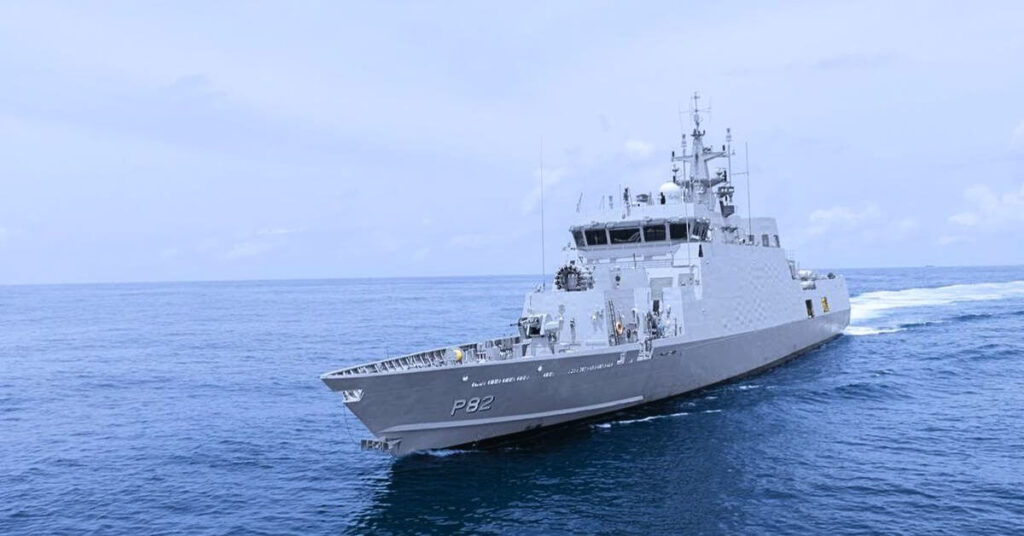
The third vessel in the Mahe-class series, INS Mangrol (P82), was officially inducted into the fleet on October 12 at the Naval Dockyard in Mumbai.
INS Mangrol is engineered to operate in shallow coastal waters where larger warships face limitations. Its propulsion system, powered by three diesel engines and waterjet technology, allows for high manoeuvrability, making it ideal for detecting and countering submarines in confined maritime zones.
The warship is equipped with an Abhay hull-mounted sonar, lightweight torpedoes, an indigenous anti-submarine rocket launcher, and the Maareech Advanced Torpedo Decoy System. These systems enable it to conduct underwater surveillance, low-intensity maritime operations, and mine warfare tasks, either independently or alongside maritime patrol aircraft and helicopters.
Designed for Shallow Waters, Packed with Indigenous Tech
Built by Cochin Shipyard Limited (CSL), INS Mangrol reflects India’s push for self-sufficiency in defence manufacturing under the Make in India and Aatmanirbhar Bharat initiatives. The shipyard’s role in the ASW-SWC programme underscores its growing expertise in constructing advanced warships tailored for modern maritime threats.
INS Mangrol, with its 80% indigenous content, is a testament to these efforts, showcasing the capabilities of Indian defence industries, including micro, small, and medium enterprises (MSMEs) that supply critical components such as sensors, communication systems, and propulsion technology.
The vessel was handed over to the Indian Navy on August 22, 2024, with the delivery protocol signed by Harikrishnan S., Director (Operations) of CSL, and Commander Kumar. Its commissioning follows the decommissioning of its predecessor, INS Mangrol (M85), a minesweeper that served until April 7, 2004.
The original INS Mangrol (M85) was part of the Pondicherry-class of minesweepers, which played a crucial role in India’s maritime security during the late 20th century. Its decommissioning marked the end of an era for the Indian Navy’s mine countermeasures capabilities, but the induction of the new INS Mangrol signals a shift towards more versatile and technologically advanced platforms.
Make in India: A Step Towards Self-Reliance in Defence
Named after the coastal city and major fishing port of Mangrol in Gujarat’s Junagadh District, the warship continues a naval tradition of honouring strategic locations. Mangrol, a historic port on the Saurashtra coast, has long been a hub for maritime trade and fishing, making it a fitting namesake for a vessel designed to protect India’s coastal waters. The naming convention also serves as a reminder of the deep connection between the Indian Navy and the nation’s maritime heritage, reinforcing the importance of safeguarding coastal communities and economic interests.
Vice Admiral Vatsayan underscored the significance of indigenous warships in addressing modern maritime challenges, stating that technological advancement and self-reliance are key to maintaining operational superiority. The commissioning of INS Mangrol is a strategic response to these challenges, ensuring that the Indian Navy remains prepared to counter emerging threats in its immediate vicinity.
The induction of INS Mangrol comes at a critical juncture for India’s maritime defence strategy. The Indian Ocean region has become a focal point for geopolitical competition, with nations investing heavily in submarine capabilities to project power and secure trade routes. India’s exclusive economic zone (EEZ), spanning over 2.3 million square kilometres, is rich in resources and serves as a vital corridor for global shipping, making it a prime target for covert underwater operations by adversarial forces.
INS Mangrol’s advanced sonar and anti-submarine systems are designed to counter these threats by detecting and neutralising submarines operating in shallow waters. The vessel’s ability to operate alongside maritime patrol aircraft, such as the Boeing P-8I Neptune, and helicopters, such as the Dhruv Advanced Light Helicopter (ALH), further enhances its effectiveness in conducting coordinated anti-submarine warfare (ASW) operations. This integrated approach is crucial for maintaining dominance in littoral zones, where traditional surface ships may be vulnerable to stealthy underwater threats.
The ASW-SWC programme, of which INS Mangrol is a part, is expected to deliver a total of eight vessels to the Indian Navy. The remaining five ships, INS Mahe, INS Malvan, INS Mulki, INS Mangrol (P83), and INS Cuddalore, are currently under construction at Cochin Shipyard and are slated for delivery over the next three years.
Once fully operational, the fleet will significantly bolster India’s coastal defence infrastructure, providing enhanced protection for ports, harbours, and critical maritime approaches. The programme also aligns with the Indian Navy’s broader modernisation plans, which include the induction of new submarines, frigates, and aircraft carriers to maintain a competitive edge in the region.
For stakeholders in the shipping and maritime industries, the commissioning of INS Mangrol offers reassurance of enhanced security along India’s coastline. Ports such as Mumbai, Kochi, and Visakhapatnam, which handle a significant portion of the country’s trade, stand to benefit from the vessel’s surveillance and deterrence capabilities. The warship’s presence will also serve as a deterrent against illicit activities, such as smuggling and illegal fishing, which pose economic and security risks to India’s maritime interests.
The Indian Navy has urged stakeholders to stay informed about developments in coastal security through official channels, including the Indian Navy’s website and the Ministry of Defence’s portal. These platforms provide updates on naval operations, exercises, and technological advancements, ensuring transparency and engagement with the broader maritime community.
The commissioning of INS Mangrol is not just a milestone for the Indian Navy but also a signal of India’s growing self-reliance in defence manufacturing. As the country continues to expand its indigenous capabilities, the vessel stands as a symbol of technological prowess and strategic foresight, ensuring that India remains prepared to meet the challenges of an increasingly complex maritime environment.


Sign up free to ask CAMAL AI for a summary, the key points or anything else about this story.
Related stories
CAMAL AI
 Financial Ports Newsletter
The maritime economy, every morning
Ports, shipping and freight markets in one short email. Free.



