

Damen’s Electric Vessels Prove Tech Is Ready—But Will Ports Follow?
Dutch shipbuilder showcases fully electric tug and waterbus at Rotterdam’s World Port Days.
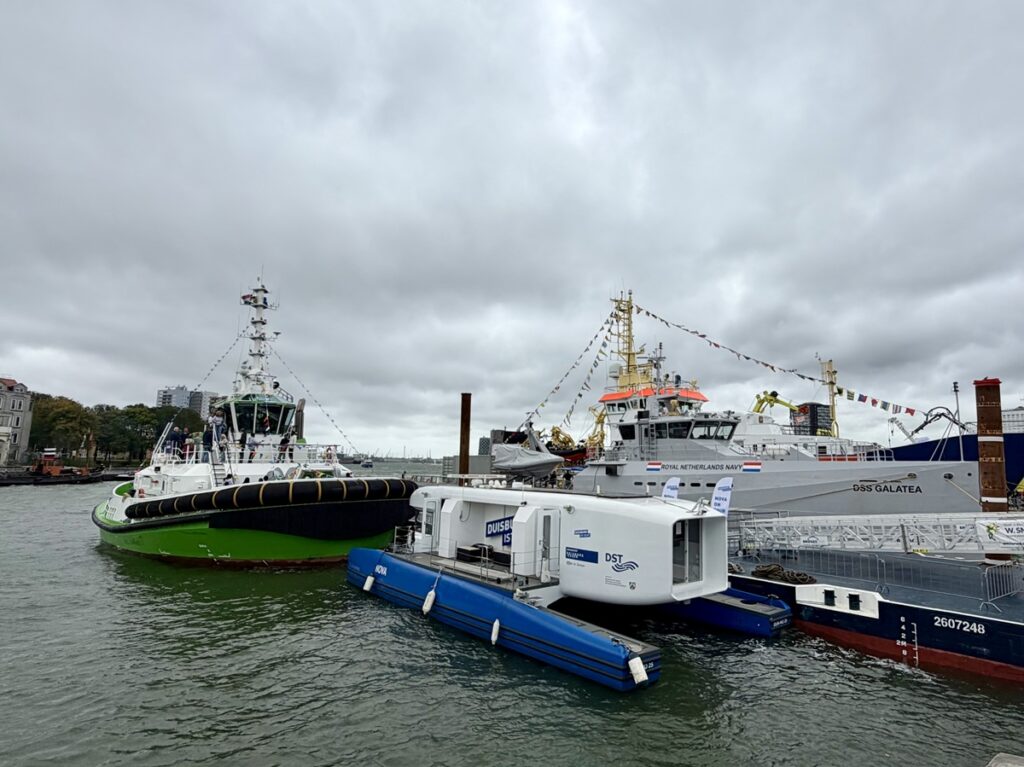
Martin Bloem, Vice President at the company, stated: “The first emission-free vessels are already in operation. The challenge now is to move from pilots to large-scale deployment.” The Aqua Pollux, a fully electric tug, and the Blue Amsterdam, an electric waterbus, are not prototypes but operational vessels, demonstrating that electrification is already a reality for workboats and passenger transport.
Damen’s showcase is a call to action. The company is urging public and private stakeholders to invest in shared maritime charging points, shore power, and energy hubs. Without these, the transition to zero-emission vessels will stall. “If government, ports and industry work together to create the right conditions, the Netherlands can take an international lead in making the maritime sector more sustainable,” Bloem added. The Netherlands, with its world-class maritime expertise, is positioned to set the standard, but only if it acts decisively.
Damen’s vessels prove that zero-emission operations are feasible today, yet their adoption hinges on four critical factors: infrastructure, regulation, financing, and collaboration. The Netherlands has the maritime industry and expertise to lead this transition, but it must address these gaps urgently.
First, charging infrastructure remains woefully inadequate. Damen is advocating for shared infrastructure, including shore power and energy hubs, to support vessels like the Aqua Pollux and Blue Amsterdam.
Second, regulation must evolve to incentivise sustainability. Damen is pushing for the European Emissions Trading System (ETS) to be extended to workboats, with revenues reinvested into the sector’s transition. This would create a financial mechanism to accelerate the adoption of zero-emission technology.
Damen’s Vision for a Sustainable Maritime Future
Damen’s ambitions extend beyond the Netherlands. The company is actively shaping the European maritime agenda, supporting the European Industrial Maritime Strategy and launching the Workboat Alliance. This initiative aims to strengthen Europe’s position in workboats for ports, inland waterways, offshore infrastructure, and maritime security.
At World Port Days, Damen is also demonstrating how maritime innovation can enhance security and resilience. In collaboration with the Port of Rotterdam Authority, Defence, and Fugro, the company is deploying the Galatea under the Protection North Sea Infrastructure Programme (PBNI).
As the sector grapples with the dual challenges of decarbonisation and geopolitical instability, vessels like the Aqua Pollux and Blue Amsterdam offer a glimpse of what’s possible. Yet, their success depends on whether ports and governments are willing to invest in the infrastructure and policies needed to scale these solutions.
For the maritime sector, the question is no longer whether zero-emission vessels can work, it’s whether the industry can move fast enough to make them the norm. Damen’s showcase at World Port Days is a reminder that the technology is ready. The ball is now in the court of ports, policymakers, and financiers to turn this vision into reality.


Sign up free to ask CAMAL AI for a summary, the key points or anything else about this story.
Related stories
CAMAL AI
 Financial Ports Newsletter
The maritime economy, every morning
Ports, shipping and freight markets in one short email. Free.
Financial Ports Newsletter
The maritime economy, every morning
Ports, shipping and freight markets in one short email. Free.



