

China’s Navy Tests Hovercraft Launches at Sea: What It Means for Island
PLAN’s Type-071 amphibious ship deploys 150-ton hovercraft in late-September drills near the South China Sea.
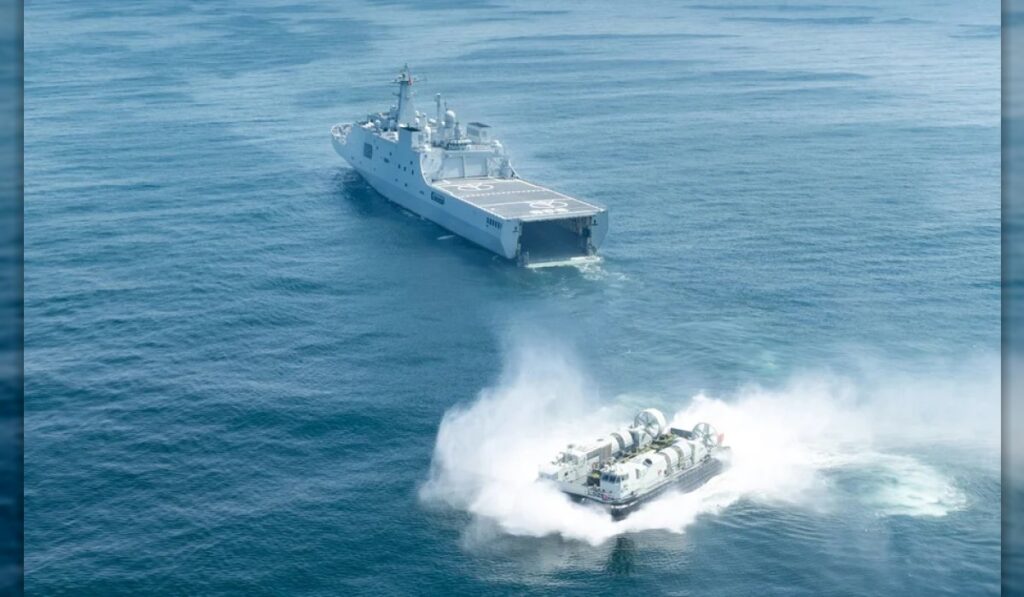
China’s People’s Liberation Army Navy (PLAN) has demonstrated its ability to deploy hovercraft from amphibious assault ships, showcasing a key capability in its maritime operations. In late September, the Type-071 amphibious dock landing ship Yimengshan (Hull 988) was photographed launching a Type-726 Wild Horse Class hovercraft during exercises conducted by the East Sea Fleet.
The Type-726 hovercraft, which has been in service since 2007, is a 150-ton vessel capable of transporting either a single main battle tank—such as the Type 96 or Type 99—or up to four wheeled armored vehicles. The design of the Type-726 closely mirrors that of the Bell Aerospace LCAC, a hovercraft used by the U.S. Navy and Japan’s Maritime Self-Defense Force since the late 1980s. Analysts estimate that the PLAN now operates over 40 of these craft.
The images released by the PLAN show the Yimengshan stationary in calm waters, suggesting the use of an azimuth positioning system to maintain stability during the launch. While no video footage was made public, the photographs confirm the operation’s success under ideal sea conditions. However, the absence of rough-water testing raises questions about the hovercraft’s performance in less favorable environments.
Amphibious Warfare Capabilities: Hovercraft
The Yimengshan is one of several Type-071 amphibious dock landing ships in the PLAN’s fleet, each capable of carrying up to four Type-726 hovercraft in its well deck. Additionally, the ship features a hangar that can accommodate four Z-8 helicopters—a Chinese variant of the French SA 321 Super Frelon—each capable of airlifting 25 troops. This combination of hovercraft and helicopters allows the PLAN to project a sizable landing force, sufficient to seize small islands or reefs.
The Type-071 fleet, supported by Type-726 hovercraft, is divided between the East and South Sea Fleets. Most exercises involving these assets have been observed in the South Sea Fleet’s area of operations, particularly near the South China Sea and the disputed Land of Nanhai Zhudao. This deployment pattern underscores the strategic importance of these vessels in China’s regional maritime ambitions.


Sign up free to ask CAMAL AI for a summary, the key points or anything else about this story.
Related stories
CAMAL AI
 Financial Ports Newsletter
The maritime economy, every morning
Ports, shipping and freight markets in one short email. Free.
Financial Ports Newsletter
The maritime economy, every morning
Ports, shipping and freight markets in one short email. Free.



