

Container glut looms: Carriers order 15.6m teu as fleet race intensifies
Five carriers now have orderbooks exceeding their current fleets, with Hai An Transport leading at 368%.
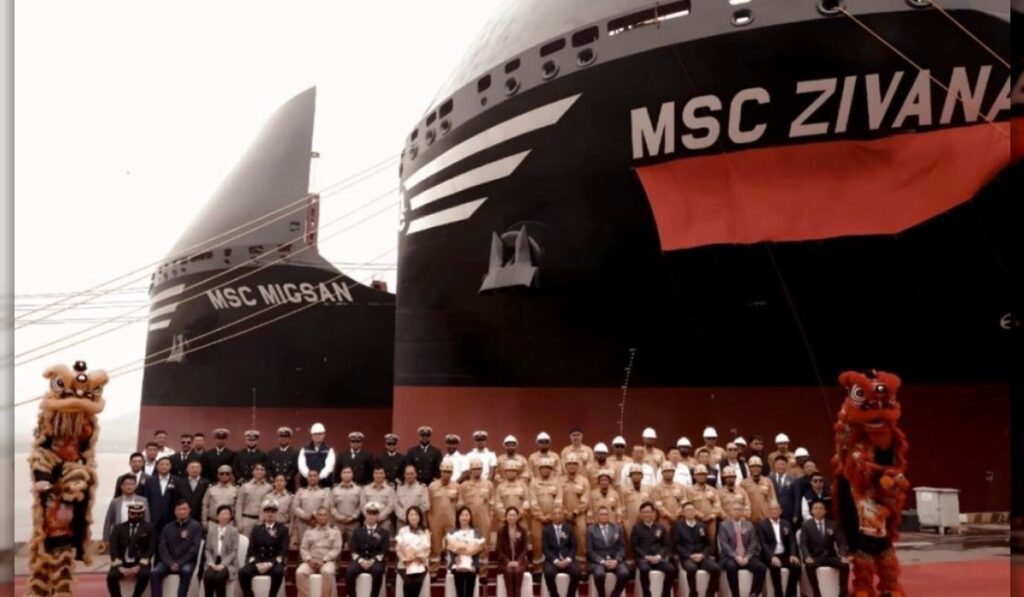
The container shipping sector faces an impending capacity crisis as new vessel orders reach unprecedented levels, threatening to disrupt market stability.
The global containership orderbook has swelled to 15.6 million twenty-foot equivalent units (TEU), more than double the post-pandemic peak of 7.6 million TEU recorded in August 2023, according to data from Linerlytica. This surge has pushed the orderbook-to-fleet ratio beyond 45%, a level not seen since 2009.
Record-breaking orders reshape the industry: Carriers
Recent orders from major carriers have further accelerated this trend. Maersk’s latest commitment for 26 vessels, each with a capacity of 18,600 TEU, and CMA CGM’s 12-ship programme for 24,000 TEU megaships have contributed to the current total of 1,925 containerships on order.
A.P. Møller-Maersk
Shipping analyst Lars Jensen, founder of Vespucci Maritime, has identified five operators in Alphaliner’s top 100 where newbuild orders exceed their existing fleets. Vietnam’s Hai An Transport leads with an orderbook equivalent to 368% of its current fleet. Other carriers with disproportionate orderbooks include Regional Container Lines (157%), Kawa Shipping (130%), Zhonggu Logistics (122%), and OVP Shipping (105%). Tailwind Shipping, Lidl’s in-house carrier, is also expanding rapidly, with orders nearing 97% of its existing capacity.
The concentration of orders among the largest carriers could trigger a fierce competition for market share. Sea-Intelligence reports that Maersk’s orderbook stands at 35% of its current fleet, while MSC and CMA CGM are at 39%, and COSCO at 52%. The analytics firm warns that as these vessels enter service, carriers may struggle to maintain capacity discipline, increasing the risk of overcapacity.
Market discipline at risk
“It seems clear that we are gearing up for a commercial battle between these four carriers.”
Sea-Intelligence·Shipping analytics firm
For now, carriers have managed to keep vessel utilisation high through blank sailings and disciplined deployment. However, the gradual resumption of Asia-Europe services via the Suez Canal—shortening voyage times and freeing up capacity—could soon collide with the largest orderbook in the sector’s history. The outcome of this convergence will test the industry’s ability to balance supply and demand in an increasingly crowded market.


Sign up free to ask CAMAL AI for a summary, the key points or anything else about this story.
Related stories
CAMAL AI
 Financial Ports Newsletter
The maritime economy, every morning
Ports, shipping and freight markets in one short email. Free.
Financial Ports Newsletter
The maritime economy, every morning
Ports, shipping and freight markets in one short email. Free.