

$50k autonomy kit: Bot Auto slashes trucking’s self-drive bill by 80%
Houston startup locks in Lenovo’s AD1 controller for Class 8 trucks from Q1 2027.
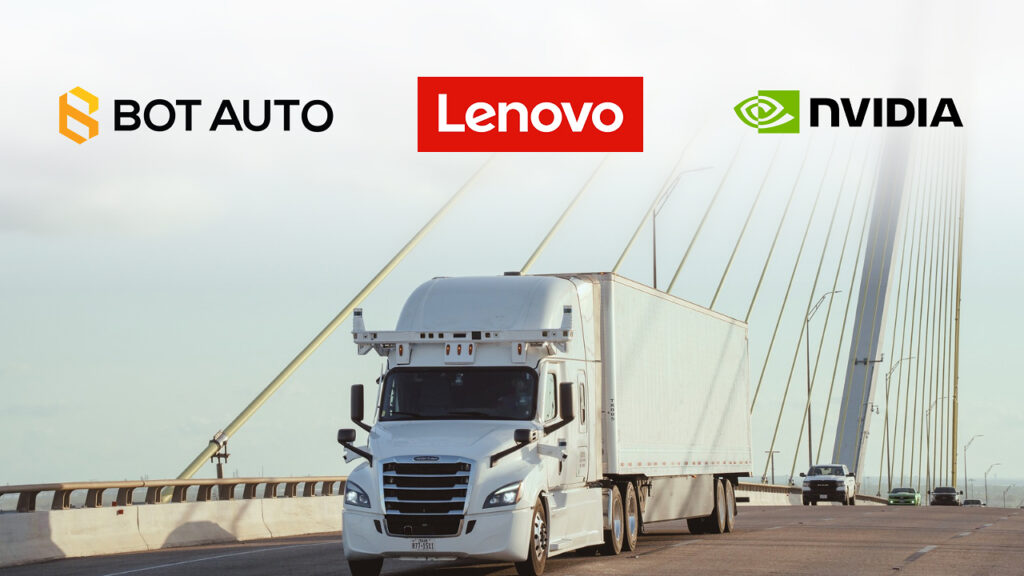
Houston-based company will begin installing Lenovo’s AD1 domain controller in its fleet starting in the first quarter of 2027, replacing the standard servers it has used during development. The AD1, built on Nvidia’s Hyperion platform, delivers up to 2,000 FP4 teraflops of AI compute while meeting the shock, vibration and temperature demands of heavy-duty trucking.
Bot Auto’s founder and CEO, Xiaodi Hou, said the shift to production-grade hardware was essential for scaling the fleet. “Standard servers can take you a long way during development, but they are not the architecture we want to replicate across hundreds or thousands of commercial trucks,” he said. The AD1, he added, “takes that efficiency into a production automotive platform with the compute, safety, reliability, and manufacturing characteristics required for scale with better unit-economics per truck.”
Why the $50,000 price tag matters: autonomy hardware
The $50,000 cost for Bot Auto’s autonomy system is a sharp contrast to the $150,000, $400,000 range cited in Heavy Duty Journal’s cost guide for comparable systems. That guide also estimates the total cost of a fully autonomous truck at $350,000, $600,000, implying that autonomy hardware alone can account for more than half the vehicle’s price.
The AD1’s affordability stems from its integration of multiple functions into a single unit. Lenovo’s design consolidates vehicle control, networking and inertial sensing into one box, reducing the parts count on each truck. The system also features dedicated liquid cooling to maintain performance under sustained load, a critical factor for long-haul routes.
“Our collaboration with Bot Auto marks another milestone for Lenovo Vehicle Computing in the U.S. as we expand our footprint in the critical commercial transportation market,” he said.
From prototype to commercial fleet: Bot Auto’s roadmap
Bot Auto’s push toward commercialisation has been rapid. April, the company completed its first fully humanless commercial load, a 231-mile overnight trip from Houston to Hutchins, Texas, with no safety driver, remote operator or in-cab observer. At the time, Bot Auto operated just 12 tractors, but the success of that run demonstrated the viability of its technology.
Since then, the company has scaled its operations, moving about 350 loads a month across Texas. Revenue grew by 270% from May to August, reflecting increased fleet utilisation and a focus on commercial freight. “We made a deliberate choice not to scale our fleet until the compute platform itself is scalable,” he said.
Today, Bot Auto’s driverless trucks run on a single Nvidia GeForce RTX 4090 per server, a setup Hou credits to the efficiency of the company’s neural networks. The AD1, however, is designed for the rigours of Class 8 duty, with continuous operation rated from minus 40 to 85 degrees Celsius (minus 40 to 185 degrees Fahrenheit). It also meets the ISO 26262 functional-safety standard up to ASIL D and the ISO 21434 automotive cybersecurity standard, ensuring compliance with industry regulations.
With the hardware cost now a fraction of competitors’, Bot Auto is positioning itself as a leader in the race to commercialise driverless freight.


Sign up free to ask CAMAL AI for a summary, the key points or anything else about this story.
Related stories
CAMAL AI
 Financial Ports Newsletter
The maritime economy, every morning
Ports, shipping and freight markets in one short email. Free.



