

Why Small Freight Brokers Are Facing a Survival Crisis
Ryder VP warns smaller players may struggle as shippers demand stricter safety standards and bigger brands
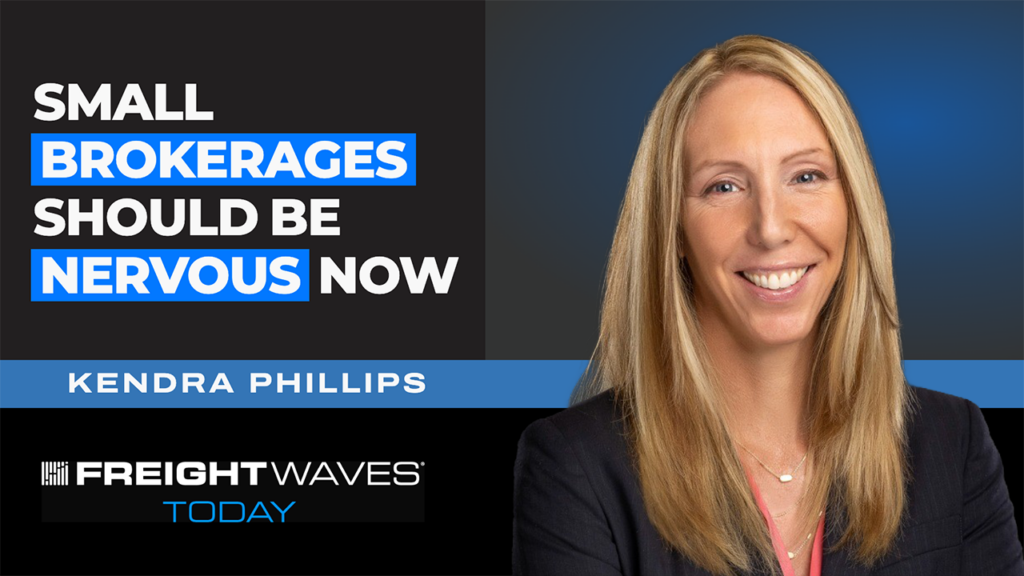
Small and mid-sized freight brokerages are under unprecedented pressure as nuclear verdicts and stricter carrier safety standards reshape the logistics industry, according to Kendra Phillips, Vice President at Ryder overseeing transportation management and brokerage operations.
The company’s dual model, combining asset-based dedicated operations with a freight brokerage, positions it uniquely to navigate industry shifts.
The shift, accelerated by high-profile legal cases such as the C.H. Robinson verdict and what Phillips termed the “post-Montgomery world,” is pushing shippers toward larger, well-capitalized providers with robust safety cultures. “If I was managing a small brokerage, I would be nervous,” Phillips said. “The cases you’re having, the settlements you’re having, you’ve got to have a big brand and a big name behind that. And a smaller mid-sized broker is going to struggle in that environment.”
Shippers Are Demanding More from Brokers More from Brokers: Freight
Shippers are no longer prioritising the cheapest rates above all else. Instead, they are asking tougher questions about carrier vetting methodologies, often at the C-suite level. Phillips noted that Ryder, which operates both asset-based dedicated operations and a freight brokerage, has not had to adjust its vetting standards in response to recent verdicts because its thresholds were already more stringent than many competitors.
Ryder’s approach includes proactively contacting shipper partners when a carrier no longer meets qualification criteria, even if replacing that carrier increases costs. “We have gone to our shippers and said, hey, we have to remove this carrier from your network. They no longer meet our qualification needs,” Phillips explained. “They understand and they appreciate the conversation.” This proactive stance reflects Ryder’s broader commitment to risk management, a priority that has become even more critical in the wake of high-profile legal settlements.
Smaller brokerages, which may lack the scale or technology to implement rigorous vetting, could find themselves at a disadvantage.
Phillips emphasised that asset-based carriers, which directly manage drivers and equipment, are in a stronger position due to their hands-on safety culture and familiarity with litigation. “It’s not just the cheapest rate anymore. It really isn’t. And I do agree with you. I think the asset-based players, this is a good time for them,” she said.
The Role of Technology
Technology is becoming a critical differentiator for brokers aiming to remain relevant in an evolving market. Ryder has developed an AI-driven network to identify operational problems requiring immediate attention for customers. For example, the platform can flag impending Walmart on-time fines or load optimisation opportunities, allowing Ryder to address issues in real time rather than after lengthy reviews. This capability is particularly valuable for shippers operating in fast-paced environments, where delays can result in significant financial penalties or lost sales.
The AI platform was developed in part by the team behind Baton, a startup Ryder acquired in 2022. Baton specialised in digital freight matching and real-time visibility tools, which Ryder has integrated into its broader logistics ecosystem. The acquisition reflects Ryder’s strategy of leveraging cutting-edge technology to enhance its brokerage operations, ensuring that it remains competitive in a market increasingly dominated by data-driven decision-making.
Ryder has also strengthened its technology capabilities by hiring a former executive from Convoy, a digital freight brokerage that shut down in 2023. Convoy’s expertise in digital freight matching and automation has further bolstered Ryder’s ability to optimise load assignments and carrier selection.
Phillips highlighted that brokers will need the right technology to stay competitive, particularly as autonomous trucking becomes more prevalent. “Autonomous trucking is absolutely coming,” she said, noting that public comfort with the technology is being built through consumer-facing deployments like Waymo.
Companies like Waymo, which operates autonomous ride-hailing services in cities such as Phoenix and cities such as Phoenix and San Francisco, are helping to normalise the concept of self-driving vehicles. This gradual acceptance is expected to extend to freight, where autonomous trucks could revolutionise long-haul transportation by reducing labour costs and increasing efficiency.
However, brokers may face challenges in an autonomous freight world due to their lack of expertise in managing physical assets. The biggest winners in this space will likely be those who control the continuous movement of assets and own autonomous trucks. Ryder, with its asset-based operations, is well-positioned to capitalise on this trend. The company’s ability to manage both traditional and autonomous fleets could give it a significant advantage over pure-play brokers, which may struggle to adapt to the shift away from human-driven trucks.
For small brokerages, the message is clear: survival will depend on their ability to demonstrate rigorous carrier vetting, invest in technology, and align with shippers who prioritise safety over cost. The post-Montgomery era is not just a challenge but a fundamental shift in how the freight brokerage industry operates, and those who fail to adapt risk being squeezed out of the market entirely.
Shippers and logistics managers can stay informed about these changes by monitoring industry reports from organisations like the American Trucking Associations or attending events such as the Council of Supply Chain Management Professionals’ annual conference, where trends in freight and logistics are regularly discussed.


Sign up free to ask CAMAL AI for a summary, the key points or anything else about this story.
Related stories
CAMAL AI
 Financial Ports Newsletter
The maritime economy, every morning
Ports, shipping and freight markets in one short email. Free.
Financial Ports Newsletter
The maritime economy, every morning
Ports, shipping and freight markets in one short email. Free.



