

VLCCs hit record 49% premium as secondhand ships outprice newbuilds
Five-year-old VLCCs now valued at $207.6m—49% above newbuild prices—a record gap in tanker markets.
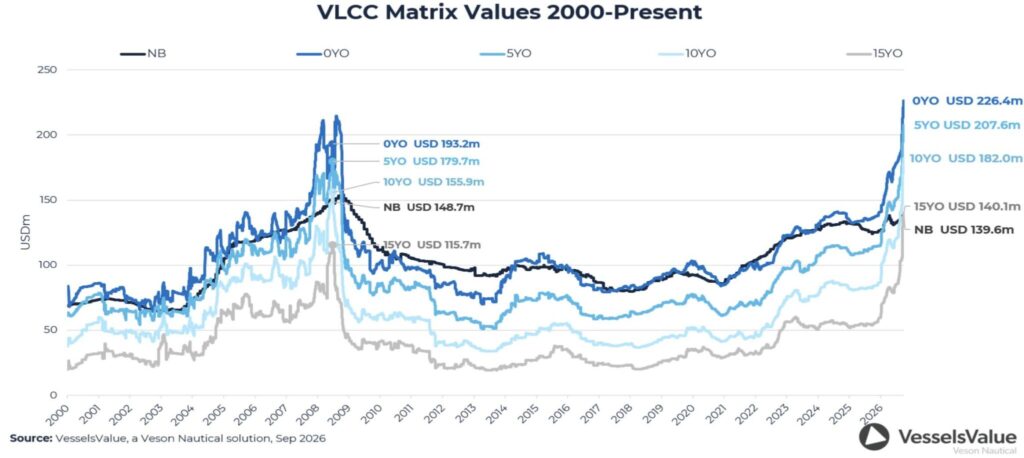
Very Large Crude Carriers (VLCCs) have reached a historic pricing milestone, with secondhand vessels now valued significantly higher than newbuilds. According to data from VesselsValue, a five-year-old VLCC is currently priced at $207.6 million, nearly 49% more than a newbuild, which stands at $139.6 million. Even older ships are fetching unprecedented sums: a 15-year-old VLCC is valued at $140.1 million, just above the newbuild benchmark, while a prompt resale vessel commands $226.4 million.
The primary driver behind this inversion is the extended delivery timeline for newbuilds. Ships ordered today are not expected to enter service until 2029, leaving owners with no choice but to rely on existing tonnage to capitalize on current market conditions. Freight rates for VLCCs have surged to around $600,000 per day, a figure 17 times higher than the 10-year average, as reported by Clarksons Research. This spike is fueled by recovering export volumes from the Middle East and disruptions in global tanker trading patterns.
Historical context and rarity of the phenomenon: VLCCs
The current pricing dynamic is not only extreme but also exceptionally rare. Rebecca Galanopoulos, an analyst at Veson Nautical, highlights that this is the widest premium on record for a five-year-old VLCC over a newbuild, surpassing the previous high of 21% observed in December 2007. “This inversion is unprecedented in scale,” Galanopoulos stated.
Historical data underscores the infrequency of such events. Using the five-year-old VLCC as a benchmark, Veson Nautical records only five sustained inversions this century, with an average duration of six months. The current episode, which began in February 2024, has already outlasted two of the four previous occurrences in 2004. Another notable milestone was reached in September 2024, when a 15-year-old VLCC surpassed newbuild values for the first time.
Affinity Shipping’s analysis, which averages data across seven vessel sizes, reveals an even rarer pattern. Only two previous inversions have been recorded, with an average duration of 3.5 months. However, individual vessel classes have demonstrated longer periods of inversion. For instance, suezmaxes remained above newbuild parity for 26 consecutive months between September 2006 and October 2008.
Danish Ship Finance, which tracks a broader secondhand-to-newbuilding price ratio for tankers, identifies 11 distinct episodes since 2000, including the current one. Their data suggests that while such inversions typically last around 12 months, the 2003-2008 supercycle—accounting for over half of all months above parity—skews this average.
Maritime Strategies International (MSI) offers a more conservative estimate, recording only one previous VLCC inversion since 2000, lasting three months. “This is very uncommon in VLCCs compared to other asset classes,” noted Adam Kent, MSI’s managing director.
Market implications and future outlook
The current market dynamics present both opportunities and risks for tanker owners and charterers. The immediate availability of secondhand vessels allows owners to capitalize on soaring freight rates, but the sustainability of this trend remains uncertain. Danish Ship Finance cautioned that “the death zone usually punishes those who linger,” a reference to the fleeting nature of such pricing peaks in past cycles.
With newbuild deliveries still years away, the pressure on the existing VLCC fleet is expected to intensify. The coming months will be critical in determining whether this inversion marks the beginning of a prolonged cycle or a temporary anomaly. For now, the crude shipping market remains in uncharted territory, with VLCCs at the forefront of this unprecedented shift.


Sign up free to ask CAMAL AI for a summary, the key points or anything else about this story.
Related stories
CAMAL AI
 Financial Ports Newsletter
The maritime economy, every morning
Ports, shipping and freight markets in one short email. Free.
Financial Ports Newsletter
The maritime economy, every morning
Ports, shipping and freight markets in one short email. Free.



