

Ukraine Sinks Russian Drone Boat in First-Ever USV Naval Clash
A Ukrainian Sargan-3000 unmanned vessel armed with a 12.7mm machine gun destroyed a Russian Orcan drone boat in the.
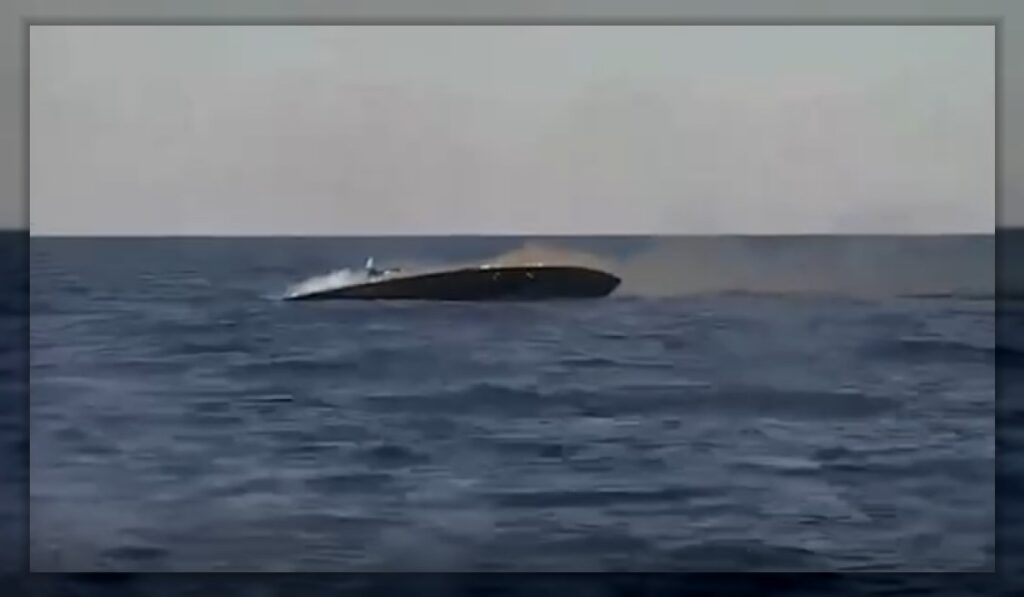
Ukraine has claimed the world’s first naval battle between two unmanned surface vessels (USVs) after its Sargan-3000 drone boat sank a Russian Orcan attack craft in the Black Sea.
The Ukrainian Navy confirmed the mid-September clash, stating that its Main Intelligence Directorate (GUR) detected the Russian drone before the Sargan-3000, armed with a Kongsberg Protector 12.7 mm remote weapon station, opened fire. The video shows the Ukrainian USV tracking the Russian vessel, firing short bursts to disable its hull, mast, and antennas before it sank stern-first.
The Battle That Changes Naval Warfare: unmanned surface vessels
Open-source analyst H.I. Sutton identified the Russian vessel as an Orcan, a one-way attack drone boat typically used for kamikaze strikes on Ukrainian ports and ships.
The system allows operators to fire with precision from a safe distance, a critical advantage in modern naval combat. The Ukrainian Navy’s statement on Telegram described the battle as “the first naval battle in history between unmanned boats,” underscoring its historic significance.
The engagement also highlights the growing sophistication of Ukraine’s unmanned systems.
Ukraine’s USV Fleet: A Growing Threat to Russia
Since 2022, Ukraine has deployed multiple USV platforms against Russia’s Black Sea Fleet, including the Sea Baby, Magura, and Sargan-3000. These drones have played a pivotal role in Ukraine’s maritime strategy, targeting Russian vessels both at sea and in port. Over the summer of 2026 alone, Ukrainian USVs destroyed more than 100 Russian ships in the Black Sea and Sea of Azov, according to reports from The Jerusalem Post.
The Sea Baby, operated by Ukraine’s Security Service, specialises in strikes against larger vessels, while the Magura and Sargan-3000 are used for a broader range of missions, including reconnaissance and counter-drone operations.
The mid-September engagement suggests a shift in how unmanned vessels are used in warfare. This evolution mirrors the gunboat battles of the 20th century but with a 21st-century twist: autonomous, remote-controlled, and increasingly lethal. For naval strategists, the battle raises critical questions about the future of maritime conflict. Could fleets of armed USVs replace traditional warships in coastal defence? How will navies adapt to a battlefield where the enemy is a swarm of drones rather than a single vessel?
The Ukrainian Navy did not disclose the exact location or time of the battle, but the release of the video on September 12, 2026, confirmed the engagement had taken place. The footage, which includes both onboard and aerial perspectives, provides a rare glimpse into the future of naval combat, where human operators remain safely ashore while drones do the fighting.
The 81-second clip, shared on Telegram and analysed by defence outlets like Army Recognition, shows the Sargan-3000’s operator adjusting fire in real time, a testament to the system’s precision and the training of Ukraine’s drone crews.
For maritime analysts, the battle raises critical questions about the future of naval warfare. If replicated at scale, a fleet of armed USVs could revolutionise how nations defend their coastlines and project power at sea. The Black Sea, already a hotspot for drone warfare, may well become the testing ground for these new strategies.
The region’s unique geography, shallow waters, narrow straits, and proximity to Ukrainian-held ports, makes it an ideal proving ground for unmanned systems. Unlike open-ocean engagements, where large warships dominate, the Black Sea’s confined waters favour small, agile platforms like the Sargan-3000, which can operate in areas where traditional vessels would be vulnerable to mines or anti-ship missiles.
The implications extend beyond the Black Sea. Nations with long coastlines or contested maritime borders, from the Baltic to the South China Sea, are closely watching Ukraine’s success with USVs. The technology is relatively inexpensive compared to traditional warships, making it accessible to smaller navies and even non-state actors. This democratisation of naval power could reshape global maritime security, forcing major powers to rethink their reliance on large, expensive fleets.
As Ukraine continues to innovate in unmanned systems, the pressure on Russia to respond will only grow. The destruction of the Orcan drone is not just a tactical victory; it is a signal that the rules of naval engagement are changing, and those who fail to adapt risk being left behind.
Russia’s own USV programme has lagged behind Ukraine’s, with its drones often plagued by technical failures and limited operational range. The Orcan, for example, is believed to have a maximum range of just 200 nautical miles, far less than the Sargan-3000’s endurance, which allows it to operate for days at a time.
For now, the Ukrainian Navy’s achievement stands as a historic first, but it is unlikely to be the last. The era of drone-on-drone naval combat has arrived, and the Black Sea is its proving ground. The next phase of this conflict may see Ukraine expand its USV fleet further, integrating artificial intelligence to enable autonomous targeting and swarm tactics. If successful, these innovations could redefine naval warfare for decades to come, rendering traditional warships obsolete in certain scenarios and shifting the balance of power at sea.
For industry observers, the battle also underscores the growing importance of defence partnerships. Ukraine’s ability to field advanced USVs like the Sargan-3000 is partly due to its collaboration with Western firms, including Kongsberg, which supplies the Protector RWS. These partnerships have allowed Ukraine to leapfrog Russia in unmanned maritime technology, despite Moscow’s larger defence budget. As the war enters its third year, such collaborations are likely to deepen, with Ukraine serving as a real-world laboratory for next-generation naval systems.
For those tracking the evolution of maritime conflict, the Ukrainian Navy’s Telegram channel and defence outlets like The Maritime Executive and The Jerusalem Post remain essential sources of information. The former provides real-time updates on engagements, while the latter offers in-depth analysis of the strategic implications. As the situation in the Black Sea continues to evolve, these platforms will be critical for understanding how drone warfare is reshaping the world’s oceans.


Sign up free to ask CAMAL AI for a summary, the key points or anything else about this story.
Related stories
CAMAL AI
 Financial Ports Newsletter
The maritime economy, every morning
Ports, shipping and freight markets in one short email. Free.
Financial Ports Newsletter
The maritime economy, every morning
Ports, shipping and freight markets in one short email. Free.



