

$5.1bn Overhaul to Keep USS Truman Fighting for 20 More Years
The US Navy’s USS Harry S. Truman has begun a $5.1 billion refuelling and complex overhaul at Newport News Shipbuilding.
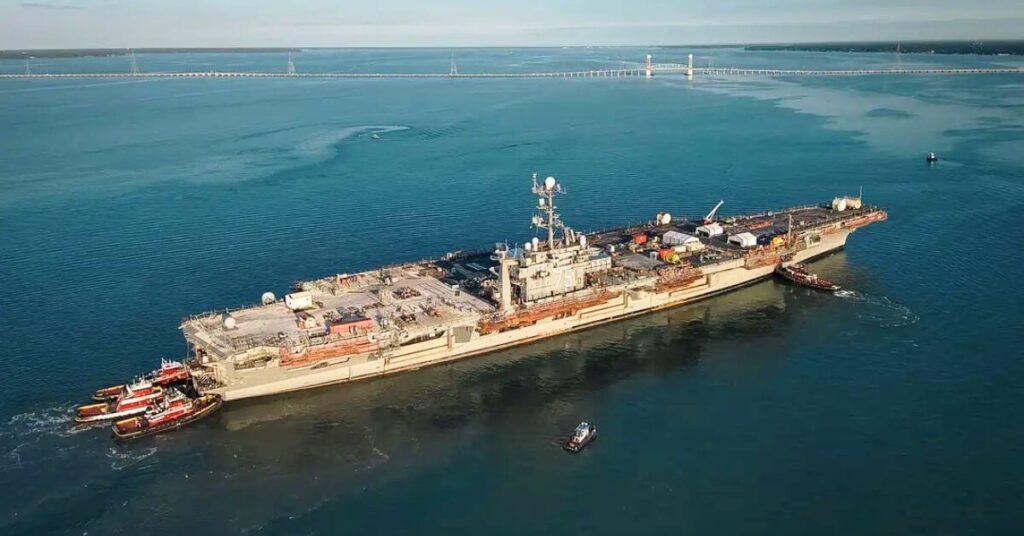
The U.S. Navy’s nuclear-powered aircraft carrier USS Harry S. Truman has arrived at Newport News Shipbuilding in Virginia for a nearly $5.1 billion refuelling and complex overhaul (RCOH), a process that will extend its operational life beyond 50 years and prepare it for the next phase of its service.
fleet, will undergo a comprehensive upgrade that includes refuelling its nuclear reactors, repairing critical propulsion systems, and modernising its combat capabilities.
What the $5.1 Billion Overhaul Entails: Truman
The RCOH is not merely a routine maintenance procedure, it represents roughly one-third of the total maintenance and modernisation work a carrier undergoes during its service life. For the USS Harry S. Truman, this means a full-scale transformation, including.
- Refuelling and defuelling of its two nuclear reactors, a process that requires meticulous handling and specialised expertise.
- Repairs to the ship’s propellers, sea chests, shafts, and rudders, ensuring optimal performance in high-stakes naval operations.
- Blasting and repainting of the hull and freeboard to protect against corrosion and extend structural integrity.
- Work across thousands of compartments and tanks, addressing everything from electrical systems to life-support infrastructure.
The Pentagon awarded Huntington Ingalls Industries (HII), the parent company of Newport News Shipbuilding, a fixed-ceiling incentive contract worth $5,099,973,132 for the overhaul.
Bryan Caccavale, vice president of programme management at Newport News Shipbuilding, stated that the company had already taken proactive steps to ensure the project’s success. “We’ve ordered materials with long delivery times and conducted thousands of inspections before the carrier even arrived,” Caccavale noted, underscoring the logistical complexity of the overhaul.
Why This Overhaul Matters for Naval Strategy
The USS Harry S. Truman’s RCOH is more than a financial commitment, it is a strategic investment in the U.S. Navy’s ability to project power globally.
However, the deployment was not without challenges. In February 2025, the Truman collided with the merchant vessel Besiktas-M near Port Said, Egypt, an incident that led to the relief of its commanding officer, Capt. Dave Snowden, after the Navy lost confidence in his leadership. The carrier also lost three F/A-18 Super Hornets during the deployment, one in a friendly-fire incident with the guided-missile cruiser USS Gettysburg, another after a failed arrested landing, and a third when it slipped from the hangar deck into the Red Sea during evasive manoeuvres.
The overhaul also reflects the Navy’s broader strategy of extending the service lives of its Nimitz-class carriers rather than retiring them prematurely.
The Truman is the eighth Nimitz-class carrier to undergo an RCOH at Newport News, a process that has become a cornerstone of the shipyard’s business.
Beyond the Truman’s overhaul, HII has also secured a separate $400 million contract to build 10 unmanned surface vessels under the Navy’s Medium Unmanned Surface Vessel programme. Five of these vessels, known as Romulus-class, are already under construction in Louisiana at Breaux Brothers Enterprises and Halimar Shipyard, with delivery expected before the end of fiscal 2027. The Navy plans to procure a total of 30 medium unmanned surface vessels from HII, Galliano Marine Services, and Saronic Technologies, at an average cost of $40 million per vessel.
This dual focus on manned and unmanned systems underscores the Navy’s commitment to modernising its fleet while maintaining its traditional strengths. The Truman’s RCOH, in particular, ensures that the U.S. retains a critical asset in its naval arsenal, capable of operating in high-threat environments and projecting power across the globe.
For industry observers and naval strategists, the Truman’s overhaul is a bellwether for the future of U.S. carrier operations. defence strategy, and their maintenance is a national priority.
The next five years will be critical for the Truman. As the overhaul progresses, the Navy and HII will need to navigate the complexities of nuclear refuelling, system upgrades, and workforce challenges. If successful, the Truman will emerge as a more capable and resilient platform, ready to meet the demands of 21st-century warfare. If delays or cost overruns occur, the project could face scrutiny from lawmakers and defence analysts alike.
One thing is certain: the $5.1 billion investment in the USS Harry S. Truman is not just about maintaining a single ship, it is about preserving a legacy of naval dominance that has defined U.S. military power for generations.


Sign up free to ask CAMAL AI for a summary, the key points or anything else about this story.
Related stories
CAMAL AI
 Financial Ports Newsletter
The maritime economy, every morning
Ports, shipping and freight markets in one short email. Free.
Financial Ports Newsletter
The maritime economy, every morning
Ports, shipping and freight markets in one short email. Free.